Gutscheinbedingungen

**Gültig bis 15.06.2026 auf Spiele & Spielzeug online auf thalia.at, in der Thalia App ab einem Mindestbestellwert von 30€ und in allen Thalia Buchhandlungen in Österreich. In den Buchhandlungen nur gültig auf lagernde Ware. Einzelne Artikel können ausgeschlossen sein. Ausgenommen sind preisgebundene Artikel sowie online auf thalia.at und in der Thalia App einzelne Artikel von tonies®. Pro Einkauf einmal einlösbar. Nur gültig gegen Vorlage oder im Onlineshop hinterlegter Bonuscard. Infos zur Einlösung in der Buchhandlung sind auf der Bonuscard-Vorteilspreisseite zu finden. Click & Collect nur bei Onlinevorabzahlung möglich. Keine Einlösung bei Scan & Go-Bezahlung. Keine Barauszahlung. Nicht kombinierbar mit anderen Aktionen und Gutscheinen. Gutschein wird auf max. 500€ Bestellwert angerechnet. Nicht gültig für Geschenkkarten, Versandkosten und Services.

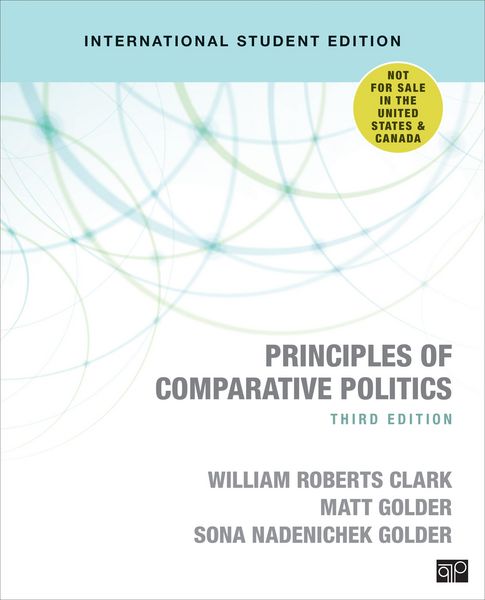
Produktbild: Principles of Comparative Politics (International Student Edition)
- 11%

Principles of Comparative Politics (International Student Edition) International Student Edition / 3rd Edition

11% sparen

143,99 € UVP 163,40 €

inkl. gesetzl. MwSt., Versandkostenfrei


Beschreibung

Produktdetails

Einband

Taschenbuch

Erscheinungsdatum

26.06.2017

Verlag

Sage Publications

Seitenzahl

888

Maße (L/B/H)

23,1/18,7/5 cm

Gewicht

1383 g

Auflage

3 Revised edition

Sprache

Englisch

ISBN

978-1-5063-8979-0

Beschreibung

Produktdetails

Einband

Taschenbuch

Erscheinungsdatum

26.06.2017

Verlag

Sage Publications

Seitenzahl

888

Maße (L/B/H)

23,1/18,7/5 cm

Gewicht

1383 g

Auflage

3 Revised edition

Sprache

Englisch

ISBN

978-1-5063-8979-0

EU-Ansprechpartner

Zeitfracht Medien GmbH
Ferdinand-Jühlke-Straße 7|99095|Erfurt|DE

Herstelleradresse

SAGE Publications
1 Oliver's Yard 55 City Road|EC1Y 1SP|London|GB

Kundinnen und Kunden meinen

0 Bewertungen

Informationen zu Bewertungen

Zur Abgabe einer Bewertung ist eine Anmeldung im Konto notwendig. Die Authentizität der Bewertungen wird von uns nicht überprüft. Wir behalten uns vor, Bewertungstexte, die unseren Richtlinien widersprechen, entsprechend zu kürzen oder zu löschen.

Die Bewertungen sind nach Format, Anzahl Sterne und Datum sortiert.

Verfassen Sie die erste Bewertung zu diesem Artikel

Helfen Sie anderen Kund*innen durch Ihre Meinung

Kundinnen und Kunden meinen

0 Bewertungen filtern

  • Produktbild: Principles of Comparative Politics (International Student Edition)
  • Part I. What Is Comparative Politics?
    Chapter 1. Introduction
    Overview of the Book
    The Approach Taken in This Book
    Key Concepts
    Chapter 2. What Is Science?
    Introduction
    What Is Science?
    The Scientific Method
    An Introduction to Logic
    Myths about Science
    Conclusion
    Key Concepts
    Problems
    Chapter 3. What Is Politics?
    The Exit, Voice, and Loyalty Game
    Solving the Exit, Voice, and Loyalty Game
    Evaluating the Exit, Voice, and Loyalty Game
    Conclusion
    Key Concepts
    Preparation for the Problems
    Problems
    Part II. The Modern State: Democracy or Dictatorship?
    Chapter 4. The Origins of the Modern State
    What Is a State?
    Somalia and Syria: Two Failed States
    The Contractarian View of the State
    The Predatory View of the State
    Conclusion
    Key Concepts
    Preparation for the Problems
    Problems
    Chapter 5. Democracy and Dictatorship: Conceptualization and Measurement
    Democracy and Dictatorship in Historical Perspective
    Classifying Democracies and Dictatorships
    Conclusion
    Key Concepts
    Problems
    Chapter 6. The Economic Determinants of Democracy and Dictatorship
    Classic Modernization Theory
    A Variant of Modernization Theory
    Some More Empirical Evidence
    Conclusion
    Key Concepts
    Appendix: An Intuitive Take on Statistical Analyses
    Problems
    Chapter 7. Cultural Determinants of Democracy and Dictatorship
    Classical Cultural Arguments: Mill and Montesquieu
    Does Democracy Require a Civic Culture?
    Religion and Democracy
    Experiments and Culture
    Conclusion
    Key Concepts
    Problems
    Chapter 8. Democratic Transitions
    Bottom-Up Transitions to Democracy
    Top-Down Transitions to Democracy
    Conclusion
    Key Concepts
    Problems
    Chapter 9. Democracy or Dictatorship: Does it Make a Difference?
    The Effect of Regime Type on Economic Growth
    The Effect of Regime Type on Government Performance
    Conclusion
    Key Concepts
    Problems
    Part III. Varieties of Democracy and Dictatorship
    Chapter 10. Varieties of Dictatorship
    A Common Typology of Authoritarian Regimes
    The Two Fundamental Problems of Authoritarian Rule
    Selectorate Theory
    Conclusion
    Key Concepts
    Problems
    Chapter 11. Problems with Group Decision Making
    Problems with Group Decision Making
    Arrow's Theorem
    Conclusion
    Key Concepts
    Problems
    APPENDIX: STABILITY IN TWO-DIMENSIONAL MAJORITY-RULE VOTING
    Chapter 12. Parliamentary, Presidential, and Semi-Presidential Democracies
    Classifying Democracies
    Making and Breaking Governments in Parliamentary Democracies
    Making and Breaking Governments in Presidential Democracies
    Making and Breaking Governments in Semi-Presidential Democracies
    A Unifying Framework: Principal-Agent and Delegation Problems
    Conclusion
    Key Concepts
    Problems
    Chapter 13. Elections and Electoral Systems
    Elections and Electoral Integrity
    Electoral Systems
    Conclusion
    Key Concepts
    Problems
    Chapter 14. Social Cleavages and Party Systems
    Political Parties: What Are They, and What Do They Do?
    Party Systems
    Where Do Parties Come From?
    Types of Parties: Social Cleavages and Political Identity Formation
    Number of Parties: Duverger's Theory
    Conclusion
    Key Concepts
    Problems
    Chapter 15. Institutional Veto Players
    Federalism
    Bicameralism
    Constitutionalism
    Veto Players
    Conclusion
    Key Concepts
    Problems
    Part IV. Varieties of Democracy and Political Outcomes
    Chapter 16. Consequences of Democratic Institutions
    Majoritarian or Consensus Democracy?
    The Effect of Political Institutions on Fiscal Policy
    Electoral Laws, Federalism, and Ethnic Conflict
    Presidentialism and Democratic Survival
    Conclusion
    Key Concepts
    Problems