KI-Beratung Beta

Gutscheinbedingungen

**Gültig bis 18.11.2026 auf englischsprachige Klassiker (klassiker-32728) online auf thalia.at und in der Thalia App. Einzelne Artikel können ausgeschlossen sein. Ausgenommen sind preisgebundene Artikel & eBooks. Pro Einkauf einmal einlösbar. Click & Collect nur bei Onlinevorabzahlung möglich. Keine Barauszahlung. Nicht kombinierbar mit anderen Aktionen und Gutscheinen. Gutschein wird auf max. 500€ Bestellwert angerechnet. Nicht gültig für Geschenkkarten, Versandkosten und Services.

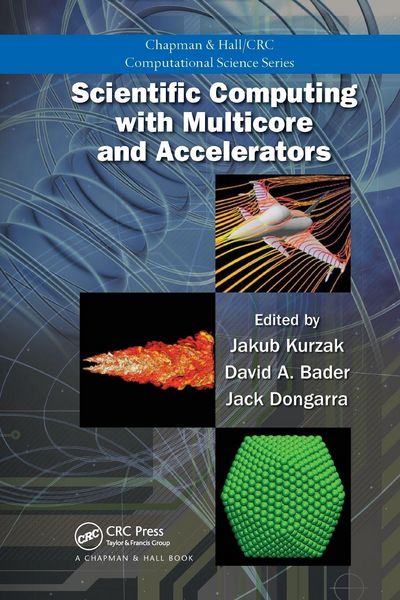
Produktbild: Scientific Computing with Multicore and Accelerators

Scientific Computing with Multicore and Accelerators

107,99 €

inkl. gesetzl. MwSt., Versandkostenfrei


Beschreibung

The hybrid/heterogeneous nature of future microprocessors and large high-performance computing systems will result in a reliance on two major types of components: multicore/manycore central processing units and special purpose hardware/massively parallel accelerators. While these technologies have numerous...

Beschreibung

The hybrid/heterogeneous nature of future microprocessors and large high-performance computing systems will result in a reliance on two major types of components: multicore/manycore central processing units and special purpose hardware/massively parallel accelerators. While these technologies have numerous benefits, they also pose substantial performance challenges for developers, including scalability, software tuning, and programming issues.

Researchers at the Forefront Reveal Results from Their Own State-of-the-Art Work
Edited by some of the top researchers in the field and with contributions from a variety of international experts, Scientific Computing with Multicore and Accelerators focuses on the architectural design and implementation of multicore and manycore processors and accelerators, including graphics processing units (GPUs) and the Sony Toshiba IBM (STI) Cell Broadband Engine (BE) currently used in the Sony PlayStation 3. The book explains how numerical libraries, such as LAPACK, help solve computational science problems; explores the emerging area of hardware-oriented numerics; and presents the design of a fast Fourier transform (FFT) and a parallel list ranking algorithm for the Cell BE. It covers stencil computations, auto-tuning, optimizations of a computational kernel, sequence alignment and homology, and pairwise computations. The book also evaluates the portability of drug design applications to the Cell BE and illustrates how to successfully exploit the computational capabilities of GPUs for scientific applications. It concludes with chapters on dataflow frameworks, the Charm++ programming model, scan algorithms, and a portable intracore communication framework.

Explores the New Computational Landscape of Hybrid Processors
By offering insight into the process of constructing and effectively using the technology, this volume provides a thorough and practical introduction to the area of hybrid computing. It discusses introductory concepts and simple examples of parallel computing, logical and performance debugging for parallel computing, and advanced topics and issues related to the use and building of many applications.

Produktdetails

Einband

Taschenbuch

Erscheinungsdatum

07.06.2017

Abbildungen

163 SW-Abb., 37 Tabellen

Herausgeber Kurzak Jakub + weitere

Produktdetails

Einband

Taschenbuch

Erscheinungsdatum

07.06.2017

Abbildungen

163 SW-Abb., 37 Tabellen

Herausgeber
Verlag Taylor & Francis
Seitenzahl

516

Maße (L/B/H)

23,4/15,6/2,8 cm

Gewicht

775 g

Sprache

Englisch

ISBN

978-1-138-11332-9

EU-Ansprechpartner

Taylor & Francis Verlag GmbH
Kaufingerstraße 24
80331 München
DE
GPSR@taylorandfrancis.com

Herstelleradresse

Taylor & Francis Group
5 Howick Place
SW1P 1WG London
UK
GPSR@taylorandfrancis.com

Noch keine Bewertungen vorhanden

Verfassen Sie die erste Bewertung zu diesem Artikel

Helfen Sie anderen Kundinnen und Kunden durch Ihre Meinung.

Kundinnen und Kunden meinen

Bewertungen (0)

Die Leseprobe wird geladen.
  • Produktbild: Scientific Computing with Multicore and Accelerators
  • Dense Linear Algebra. Sparse Linear Algebra. Multigrid Methods. Fast Fourier Transforms. Combinatorial Algorithms. Stencil Algorithms. Bioinformatics. Molecular Modeling. Complementary Topics. Index.