Gutscheinbedingungen

**Gültig am 28.06.2026 auf Spielzeug, Schreibwaren, Filme, Geschenke & Trends, Musik, tolino eReader & Zubehör, Hörbücher und Hörbuch-Downloads (außer Abo), nicht preisgebundene Bücher und Kalender online auf thalia.at und in der Thalia App. Einzelne Artikel können ausgeschlossen sein. Aufgrund der Buchpreisbindung sind deutschsprachige Bücher und eBooks ausgenommen. Zusätzlich ausgenommen sind preisgebundene Artikel, Abos & Flatrates, eBooks, Games, Geschenkkarten/-boxen, Shelfies, Software, Zeitschriften sowie einzelne Artikel von tonies®. Pro Einkauf einmal einlösbar. Click & Collect nur bei Onlinevorabzahlung möglich. Keine Barauszahlung. Nicht kombinierbar mit anderen Aktionen und Gutscheinen. Gutschein wird auf max. 500€ Bestellwert angerechnet. Nicht gültig für Versandkosten und Services.

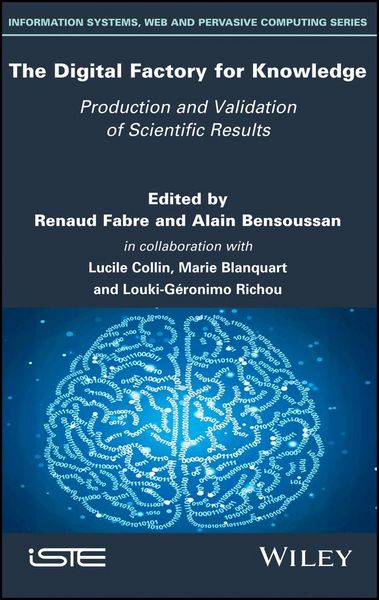
Produktbild: The Digital Factory for Knowledge

The Digital Factory for Knowledge Production and Validation of Scientific Results

199,99 €

inkl. gesetzl. MwSt., Versandkostenfrei


Beschreibung

Produktdetails

Einband

Gebundene Ausgabe

Erscheinungsdatum

08.05.2018

Herausgeber

Renaud Fabre + weitere

Verlag

ISTE Ltd and John Wiley & Sons Inc

Seitenzahl

198

Maße (L/B/H)

23,4/16,5/1,8 cm

Gewicht

440 g

Sprache

Englisch

ISBN

978-1-78630-241-0

Beschreibung

Portrait

Alain Bensoussan, Consultant.

Marie Blanquart, Sciences Po Paris, France.

Lucille Colin, Sciences Po Paris, France.

Renaud Fabre, CNRS, France.

Produktdetails

Einband

Gebundene Ausgabe

Erscheinungsdatum

08.05.2018

Herausgeber

Verlag

ISTE Ltd and John Wiley & Sons Inc

Seitenzahl

198

Maße (L/B/H)

23,4/16,5/1,8 cm

Gewicht

440 g

Sprache

Englisch

ISBN

978-1-78630-241-0

Herstelleradresse

Libri GmbH
Europaallee 1
36244 Bad Hersfeld
DE

Email: gpsr@libri.de

Kundinnen und Kunden meinen

0 Bewertungen

Informationen zu Bewertungen

Zur Abgabe einer Bewertung ist eine Anmeldung im Konto notwendig. Die Authentizität der Bewertungen wird von uns nicht überprüft. Wir behalten uns vor, Bewertungstexte, die unseren Richtlinien widersprechen, entsprechend zu kürzen oder zu löschen.

Die Bewertungen sind nach Format, Anzahl Sterne und Datum sortiert.

Verfassen Sie die erste Bewertung zu diesem Artikel

Helfen Sie anderen Kund*innen durch Ihre Meinung

Kundinnen und Kunden meinen

0 Bewertungen filtern

Die Leseprobe wird geladen.
  • Produktbild: The Digital Factory for Knowledge
  • Preface   xi
    Renaud FABRE and Alain BENSOUSSAN

    Part 1. Scientific Resources and Data Economy   1

    Chapter 1. Data Production and Sharing: Towards a Universal Right? 3
    Marie BLANQUART, Thomas DESCOUS and Ewen HUET

    1.1. The right to knowledge today: between attempts at universalization and "self-regulation" by the GAFA 4

    1.1.1. Towards the emergence of a universal right to knowledge subject to divergent economic thinking 5

    1.1.2. The recognition of a universal right to knowledge: a "realistic utopia"? 6

    1.2. Platform and scientific community rights: the absence of an upfront legal framework  7

    1.2.1. A system partly caused by the development of the digital sector  7

    1.2.2. The now-fragile law attempting to protect the results of research  8

    1.2.3. Intellectual property rights   8

    1.2.4. The notion of databases and protection by sui generis law 9

    1.2.5. Problems with the legal statute of knowledge   11

    1.3. The need to elaborate several types of legislation   12

    1.3.1. Platform rights 12

    1.3.2. Text and Data Mining: the great new stake 14

    1.4. Open Science: an achievable goal?  15

    Chapter 2. Data: a Simple Raw Material?  19
    Bertrand PELETIER and Thomas DESCOUS

    2.1. The new generation of data: management issues arising from ownership rights 19

    2.2. How to transform these data into knowledge? 20

    2.3. A new knowledge economy is necessary 21

    2.3.1. The information war and the stakes of data protection  21

    2.4. International scientific publishing: high added-value services and researcher community   22

    2.4.1. The open platform as the preferred tool for sharing and exploiting data 22

    2.4.2. An undeniable added value in processing data brought about by platforms  24

    Chapter 3. New Knowledge Tools   27
    Christoph LOHSCHELDER

    3.1. Sharing and uncertainty   27

    3.2. Platform construction   28

    3.3. Machine learning 30

    3.4. Promising progress to be qualified...  31

    Part 2. The Knowledge Factory 33

    Chapter 4. Economic Models of Knowledge Sharing   35
    Vincent GIACOBBI

    4.1. A quick historic overview 35

    4.2. Property and/or sharing   35

    4.3. An immaterial good capable of fueling the production of material goods 37

    4.4. The large stakes of knowledge production  38

    4.4.1. Limits of this model: consistency, reliability and indistinction 39

    4.4.2. Business models of knowledge sharing  39

    4.4.3. Some numbers 40

    4.5. Development prospects allowing for new fields of study and more nimbly integrating researchers into the economic chain 41

    Chapter 5. From the Author to the Valorizer  43
    Lucile COLLIN

    5.1. The author and the valorizer: conciliation and efficiency of the interaction 43

    5.2. One point on patents   44

    5.3. The innovation cycle   45

    5.4. The law for a Digital Republic   46

    5.5. Scientific openness surpassing ancient legal tools   48

    Chapter 6. Valorization: a Global Geopolitical Stake   51
    Marie BLANQUART

    6.1. A multispeed competition 51

    6.1.1. The United States: a country losing its lead   51

    6.1.2. French stagnation   53

    6.1.3. The expanding Chinese model  54

    6.2. International cooperation in the scientific sector   57

    6.2.1. A developing European project  57

    6.2.2. International organizations   58

    Chapter 7. Focus: the Chinese Patent Strategy   61
    Vincent GIACOBBI

    7.1. Chinese expansion 62

    7.2. An inflation of Chinese patents   63

    7.3. Some fallbacks in China nuancing its strategic position  65

    7.3.1. A fallback in favor of applied research  66

    7.3.2. Territorial withdrawal 66

    7.3.3. A long certification process with uncertain ends   66

    7.3.4. The procedure for submitting a dispute on a patent   67

    7.4. Contestable and contested digital supremacy 68

    Chapter 8. Artificial Intelligence Policies  71
    Maximilian NOMINACHER and Bertrand PELETIER

    8.1. Policies concerning "strong" AI   72

    8.2. Policies concerning "weak" AI   72

    8.3. Policies concerning artificial intelligence safety   74

    8.4. From practice to ethics: what is AI's legal status?   75

    Chapter 9. New Formulations of Results and New "Markets" 77
    Louki-Géronimo RICHOU

    9.1. Making universal: establishing common standards of expression 78

    9.1.1. Requirement of uniqueness   79

    9.1.2. Hierarchy requirement 79

    9.2. To adapt: from popularization to simplification   82

    9.2.1. Versatility or specialization?   83

    9.2.2. Simplifying rather than popularizing 84

    9.2.3. Measures following the precautionary principle: archiving and protection   85

    9.2.4. Preserving the researcher while optimizing knowledge for the general interest during the digital era 85

    9.3. Developing the general state of knowledge with care   87

    Chapter 10. Open Science: a Common Good that Needs to be Valued?   89
    Nicolas MASSEREAU

    10.1. A global challenge that must take the economy into account   90

    10.2. A wide variety of public policies respond to this challenge   90

    10.2.1. Enterprises and States 90

    10.2.2. Valorization as a junction point  91

    10.2.3. Basic research: competing with applied research?   93

    10.3. The French case and international rankings 94

    10.4. The limits of the patent system and publication count   96

    10.5. Investment tools aiming to correct these failures   98

    10.6. How to measure innovation? 100

    10.6.1. The university: the first knowledge production framework recognized by law  100

    10.6.2. Research data: a new intangible "place" for producing knowledge 101

    10.7. The application of research is not an end in itself   102

    Conclusion   105
    Renaud FABRE and Alain BENSOUSSAN

    Appendices  109

    Appendix 1. Extract from the CNRS White Paper: "The Work of Science and the Digital Field: Data, Publications, Platforms. A Systematic Analysis of the Law for a Digital Republic"  111

    Appendix 2. Extract from the CNRS White Paper "Open Science in a Digital Republic: Studies and Proposals for Law Application. Strategic

    Application Guide" 161

    Bibliography  179

    List of Authors 183

    Index  185