
Gutscheinbedingungen

**Gültig am 28.06.2026 auf Spielzeug, Schreibwaren, Filme, Geschenke & Trends, Musik, tolino eReader & Zubehör, Hörbücher und Hörbuch-Downloads (außer Abo), nicht preisgebundene Bücher und Kalender online auf thalia.at und in der Thalia App. Einzelne Artikel können ausgeschlossen sein. Aufgrund der Buchpreisbindung sind deutschsprachige Bücher und eBooks ausgenommen. Zusätzlich ausgenommen sind preisgebundene Artikel, Abos & Flatrates, eBooks, Games, Geschenkkarten/-boxen, Shelfies, Software, Zeitschriften sowie einzelne Artikel von tonies®. Pro Einkauf einmal einlösbar. Click & Collect nur bei Onlinevorabzahlung möglich. Keine Barauszahlung. Nicht kombinierbar mit anderen Aktionen und Gutscheinen. Gutschein wird auf max. 500€ Bestellwert angerechnet. Nicht gültig für Versandkosten und Services.

  • Produktbild: Mathematical Modelling and Applications
  • Produktbild: Mathematical Modelling and Applications
- 10%

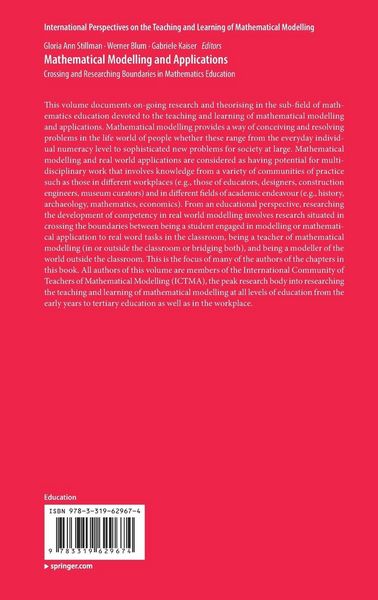
Mathematical Modelling and Applications Crossing and Researching Boundaries in Mathematics Education

10% sparen

216,99 € UVP 241,99 €

inkl. gesetzl. MwSt., Versandkostenfrei


Beschreibung

Produktdetails

Einband

Gebundene Ausgabe

Erscheinungsdatum

20.11.2017

Abbildungen

XI, 139 illus., schwarz-weiss Illustrationen

Herausgeber

Gloria Ann Stillman + weitere

Verlag

Springer

Seitenzahl

647

Maße (L/B/H)

24,1/16/4,1 cm

Gewicht

1150 g

Auflage

1st edition 2017

Sprache

Englisch

ISBN

978-3-319-62967-4

Beschreibung

Produktdetails

Einband

Gebundene Ausgabe

Erscheinungsdatum

20.11.2017

Abbildungen

XI, 139 illus., schwarz-weiss Illustrationen

Herausgeber

Verlag

Springer

Seitenzahl

647

Maße (L/B/H)

24,1/16/4,1 cm

Gewicht

1150 g

Auflage

1st edition 2017

Sprache

Englisch

ISBN

978-3-319-62967-4

Herstelleradresse

Springer-Verlag GmbH
Tiergartenstr. 17
69121 Heidelberg
DE

Email: GPSR Kontakt

Kundinnen und Kunden meinen

0 Bewertungen

Informationen zu Bewertungen

Zur Abgabe einer Bewertung ist eine Anmeldung im Konto notwendig. Die Authentizität der Bewertungen wird von uns nicht überprüft. Wir behalten uns vor, Bewertungstexte, die unseren Richtlinien widersprechen, entsprechend zu kürzen oder zu löschen.

Die Bewertungen sind nach Format, Anzahl Sterne und Datum sortiert.

Verfassen Sie die erste Bewertung zu diesem Artikel

Helfen Sie anderen Kund*innen durch Ihre Meinung

Kundinnen und Kunden meinen

0 Bewertungen filtern

Weitere Artikel finden Sie in

  • Produktbild: Mathematical Modelling and Applications
  • Produktbild: Mathematical Modelling and Applications
  • Series Preface, Gabriele Kaiser and Gloria Stillman.- Boundary Crossings in Mathematical Modelling and Applications Educational Research and Practice, Gloria Stillman, Werner Blum, and Gabriele Kaiser.- Part I New Approaches in Research, Teaching and Practice from Crossing Boundaries.- Mathematical Modelling with Increasing Learning Aids – A Video Study, Deike S. Alfke (née Jütting).- Modelling with Statistical Data: Characterisation of Student Models, Àngels Aymerich, Núria Gorgorió, and Lluís Albarracín.- How Teachers Can Promote Mathematising by Means of Mathematical City Walks, Nils Buchholtz.- L’Hospital’s Weight Problem: Testing the Boundaries between Mathematics and Physics, between Application and Modelling, France Caron and Kathleen Pineau. Representations of Modelling in Mathematics Education, Helen M. Doerr, Jonas B. Ärlebäck and Morten Misfeldt.- The Primacy of ‘Noticing’: a Key to Successful Modelling, Peter Galbraith, Gloria Ann Stillman and Jill P. Brown.- Combining Models Related to Data Distribution through Productive Experimentation, Takashi Kawakami.- Reconciling Intuitions and Conventional Knowledge: The Challenge of Teaching and Learning Mathematical Modelling, Azita Manouchehri and Stephen T. Lewis.-       A Modelling Perspective in Designing Teacher Professional Learning Communities, Nicholas Mousoulides, Marilena Nicolaidou, and Maria Evagorou.- Mathematical Modelling and Proof by Recurrence: an Analysis from a Wittgensteinian Perspective, Bárbara Palharini, Emerson Tortola and Lourdes Maria Werle de Almeida.- Quality Criteria for Mathematical Models in Relation to Models’ Purposes - Their Usefulness in Engineering Education, Jacob Perrenet, Bert Zwaneveld, Kees van Overveld and Tijn Borghuis.- Ethnomodelling as the Mathematization of Cultural Practices, Milton Rosa and Daniel Clark Orey.- Enabling Anticipation through Visualisation in Mathematising Real World Problems in a Flipped Classroom, Gloria Ann Stillman.- Measuring Metacognitive Modelling Competencies, Katrin Vorhölter.- Part II Researching Boundaries in Mathematical Modelling Education.- The Mathematical Modelling Competencies Required for Solving Engineering Statics Assignments, Burkhard Alpers.- Pre-service Teachers’ Levels of Reflectivity after Mathematical Modelling Activities with High-School Students, Rita Borromeo Ferri.- Context and Understanding: The Case of Linear Models, Jill P. Brown.- Difficulties in Teaching Modelling: A French-Spanish Exploration, Richard Cabassut and Irene Ferrando.- How Students Connect Mathematical Models to Descriptions of Real-World Situations, Dirk De Bock, Nele Veracx and Wim Van Dooren.- Mathematical Modelling Strategies and Attitudes of Third Year Pre-Service Teachers, Rina Durandt and Gerrie J Jacobs.- Exploring the Notion of Mathematical Literacy in Curricula Documents, Peter Frejd and Vincent Geiger.- Design and Implementation of a Tool for Analysing Student Products when They Solve Fermi Problems, César Gallart, Irene Ferrando, Lluís M. García-Raffi, Lluís Albarracín and Núria Gorgorió.- Implementing Modelling into Classrooms – Results of an Empirical Research Study, Jana Kreckler.- A Commognitive Perspective on Pre-service Secondary Teachers’ Content Knowledge in Mathematical Modelling, Joo Young Park.- Mathematics Teachers’ Learning at the Boundaries of Teaching, Research and Workplace, Giorgos Psycharis and Despina Potari.- Case Study of Pre-service Teachers Education for Mathematical Modelling and Applications Connecting Paintings with Mathematics, Akihiko Saeki, Masafumi Kaneko and Daisuke Saito.- Inquiry and Modelling in a Real Archaeological Context, Gemma Sala Sebastià, Vicenç Font Moll, Joaquim Giménez Rodríguez, Berta Barquero Farràs.- Students’ Overreliance on Linearity in Economic Applications: A State of the Art, Daam Van Reeth and Dirk De Bock.- Part III Pedagogical Issues for Teachers and Teacher Educators Using Mathematical Modelling and Applications.- Teaching Modelling and Systemic Change, Hugh Burkhardt and Malcolm Swan.- Mathematical Modelling as a Professional Activity – Lessons for the Classroom, Peter Frejd.- Modelling Task Design: Sciences Teachers’ View, Carolina Guerrero-Ortiz and Jaime Mena-Lorca.- Modelling as Interactive Translations among Plural Worlds - Experimental teaching using the Night Time Problem, Toshikazu Ikeda and Max Stephens.- The Dual Modelling Cycle Framework: Report on an Australian Study, Janeen Lamb, Akio Matsuzaki, Akihiko Saeki and Takashi Kawakami.- Implementing Mathematical Modelling: The Challenge of Teacher Educating, Azita Manouchehri.- The Velocity Concept – History of its Modelling  Development, Regina Dorothea Moeller.- Developing a Mathematical Modelling Task for All Students, Edel Reilly.- Hidden Benefits of Modelling for Students with Disabilities, Rina Scott-Wilson, Dirk Wessels, Helena Wessels, and Estelle Swart.- Scaffolding Complex Modelling Processes – An In-depth Study, Peter Stender,Nadine Krosanke and Gabriele Kaiser.- Long-term Development of How Students Interpret a model; Complementarity of Contexts and Mathematics, Pauline Vos and Gerrit Roorda, Exploring Aspects of Creativity in Mathematical Modelling, Helena Wessels.- Mathematical Modelling in Dutch Textbooks: Is it Genuine Mathematical Modelling? Bert Zwaneveld, Jacob Perrenet, Kees van Overveld and Tijn Borghuis.- Part IV Influences of Technologies on Modelling and Applications.- Initial Results of an Intervention Using a Mobile Game App to Simulate A Pandemic Outbreak, Peter Frejd and Jonas B. Ärlebäck.- Modelling and Simulation with the Help of Digital Tools, Gilbert Greefrath and Hans-Stefan Siller.- Mathematical Modelling for Engineering Diploma Students: Perspectives on Visualisation, Hanti Kotze, Gerrie J. Jacobs, Erica D. Spangenberg.- Interactive Diagrams Used for Collaborative Learning Concerning Mathematical Models of Motion, Elena Naftaliev.- Using Modelling and Tablets in the Classroom to Learn Quadratic Functions, Miriam Ortega and Luis Puig.- Mathematical Modelling in a Long Distance Teacher Education in Brazil: Democratising Mathematics, Daniel Clark Orey and Milton Rosa.- Part V Assessment of Mathematical Modelling in Schools.- Six Principles to Assess Modelling Abilities of Students Working in Groups, Piera Biccard and Dirk Wessels.- Assessing Mathematizing Competences through Multiple Choice Tasks: Using Students’ Response Processes to Investigate Task Validity, Brikena Djepaxhija, Pauline Vos and Anne Berit Fuglestad.- Part VI Applicability at Different Levels of Schooling.- How to Build a Hydrogen Refuelling Station Infrastructure in Germany – an Interdisciplinary Project Approach for Mathematics Classrooms, Irene Grafenhofer and Hans-Stefan Siller.- Authentic Mathematical Modelling Experiences of Upper Secondary School: A Case Study, Kerri Spooner.- Refereeing Process.- Index.