KI-Beratung Beta

Gutscheinbedingungen

**Gültig bis 18.11.2026 auf englischsprachige Klassiker (klassiker-32728) online auf thalia.at und in der Thalia App. Einzelne Artikel können ausgeschlossen sein. Ausgenommen sind preisgebundene Artikel & eBooks. Pro Einkauf einmal einlösbar. Click & Collect nur bei Onlinevorabzahlung möglich. Keine Barauszahlung. Nicht kombinierbar mit anderen Aktionen und Gutscheinen. Gutschein wird auf max. 500€ Bestellwert angerechnet. Nicht gültig für Geschenkkarten, Versandkosten und Services.

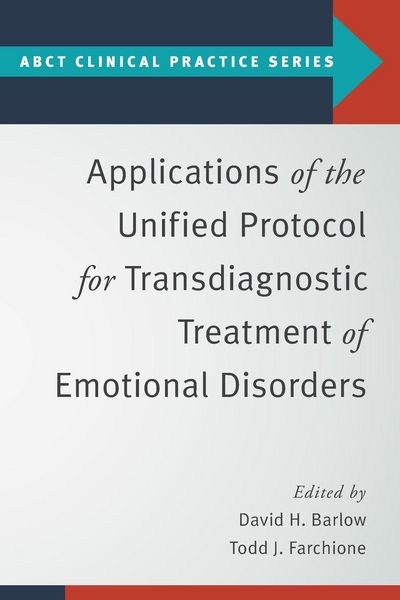
Produktbild: Applications of the Unified Protocol for Transdiagnostic Treatment of Emotional Disorders

Applications of the Unified Protocol for Transdiagnostic Treatment of Emotional Disorders

91,99 €

inkl. gesetzl. MwSt., Versandkostenfrei


Beschreibung

Recent conceptualization of anxiety, depressive, and related "emotional" disorders emphasize their similarities rather than their differences. In response, there has been a movement in recent years away from traditional disorder-specific manuals for the treatment of these disorders and toward treatment...

Beschreibung

Recent conceptualization of anxiety, depressive, and related "emotional" disorders emphasize their similarities rather than their differences. In response, there has been a movement in recent years away from traditional disorder-specific manuals for the treatment of these disorders and toward treatment approaches that focus on addressing psychological processes that appear to cut across disorders. These "transdiagnostic" evidence-based treatments may prove to be more cost efficient and have the potential to increase availability of evidence-based treatments to meet a significant public health need. Among clinicians, the Unified Protocol for Transdiagnostic Treatment of Emotional Disorders (UP), developed by Dr. David Barlow and colleagues, is the most recognizable and widely used transdiagnostic treatment protocol with empirical support for its use. Applications of the Unified Protocol for Transdiagnostic Treatment of Emotional Disorders provides clinicians with a "how to" guide for using the UP to treat a broad range of commonly encountered psychological disorders in adults. Each chapter covers a specific anxiety, depressive, or related "emotional" disorder, and important transdiagnostic processes are highlighted and discussed in relation to treatment. Case studies are employed throughout to illustrate the real-world application of this unique cognitive behavioral protocol and to instruct clinicians in the nuts and bolts of assessment, case formulation, and treatment in accordance with a transdiagnostic perspective.

Produktdetails

Einband

Taschenbuch

Erscheinungsdatum

01.09.2017

Herausgeber Barlow David H. + weitere
Verlag Oxford University Press

Produktdetails

Einband

Taschenbuch

Erscheinungsdatum

01.09.2017

Herausgeber
Verlag Oxford University Press
Seitenzahl

372

Maße (L/B/H)

23,4/15,6/2,2 cm

Gewicht

633 g

Sprache

Englisch

ISBN

978-0-19-025554-1

Herstelleradresse

Libri GmbH
Europaallee 1
36244 Bad Hersfeld
DE

Email: gpsr@libri.de

Noch keine Bewertungen vorhanden

Verfassen Sie die erste Bewertung zu diesem Artikel

Helfen Sie anderen Kundinnen und Kunden durch Ihre Meinung.

Kundinnen und Kunden meinen

Bewertungen (0)

Die Leseprobe wird geladen.
  • Produktbild: Applications of the Unified Protocol for Transdiagnostic Treatment of Emotional Disorders
    • Series Foreword
    • Preface
    • About the Editors
    • Contributors
    • Chapter 1 The Unified Protocol for Transdiagnostic Treatment of Emotional Disorders: An Introduction
    • Katherine A. Kennedy and David H. Barlow
    • Chapter 2 Transdiagnostic Assessment and Case Formulation: Rationale and Application with the Unified Protocol
    • Hannah Boettcher and Laren R. Conklin
    • Chapter 3 The Unified Protocol for Anxiety Disorders
    • Laren R. Conklin, Todd J Farchione, and Steven Dufour
    • Chapter 4 The Unified Protocol for Obsessive-compulsive and Related Disorders
    • Johanna Thompson-Hollands
    • Chapter 5 The Unified Protocol for Major Depressive Disorder
    • James F. Boswell, Laren R. Conklin, Jennifer M. Oswald, and Matteo Bugatti
    • Chapter 6 The Unified Protocol for Bipolar and Comorbid Disorders
    • Kristen K. Ellard, Emily Bernstein, Andrew A. Nierenberg, and Thilo Deckersbac
    • Chapter 7 The Unified Protocol for Posttraumatic Stress Disorder
    • Matthew W. Gallagher
    • Chapter 8 The Unified Protocol for Comorbid Alcohol Use and Anxiety Disorders
    • Todd J Farchione, Tracie M. Goodness, and Katelyn M. E. Williams
    • Chapter 9 The Unified Protocol for Eating Disorders
    • Christina L. Boisseau and James F. Boswell
    • Chapter 10 The Unified Protocol for Insomnia Disorder
    • Jacqueline R. Bullis and Shannon Sauer-Zavala
    • Chapter 11 The Unified Protocol for Nonsuicidal and Suicidal Self-Injury
    • Kate H. Bentley, Shannon Sauer-Zavala, Clair Cassiello-Robbins, and Stephanie Vento
    • Chapter 12 The Unified Protocol for Borderline Personality Disorder
    • Shannon Sauer-Zavala, Kate H. Bentley and Julianne G. Wilner
    • Chapter 13 The Unified Protocol for Chronic Pain
    • Laura A. Payne
    • Chapter 14 The Unified Protocol for Complex, Highly Comorbid Cases
    • Heather Murray Latin and Clair Cassiello-Robbins
    • Chapter 15 Group Treatment Applications of the Unified Protocol
    • Jacqueline R. Bullis, Kate H. Bentley and Katherine A. Kennedy
    • Chapter 16 Cross-cultural Applications of the Unified Protocol: Examples from Japan and Colombia
    • Amantia Ametaj, Nina Wong Sarver, Obianujunwa Anakwenze, Masaya Ito, Michel Ratner and Ramya Potluri
    • Chapter 17 The Unified Protocol: Future Directions
    • Clair Cassiello-Robbins, Heather Murray Latin, and Shannon Sauer-Zavala
    • References
    • Index