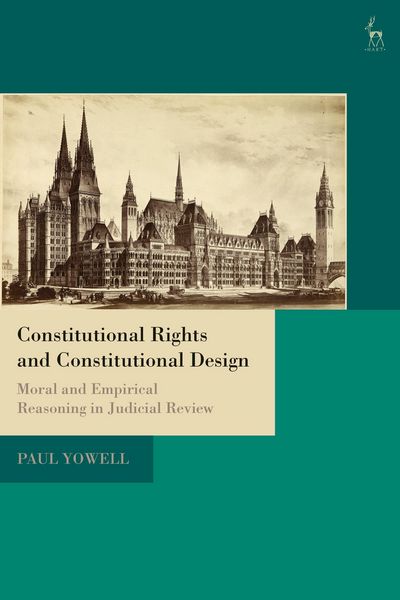
Constitutional Rights and Constitutional Design Moral and Empirical Reasoning in Judicial Review
134,99 €
inkl. gesetzl. MwSt.,
Beschreibung
Produktdetails
Einband
Gebundene Ausgabe
Erscheinungsdatum
26.04.2018
Verlag
Bloomsbury 3PLSeitenzahl
186
Maße (L/B/H)
24/16,1/1,5 cm
Gewicht
449 g
Sprache
Englisch
ISBN
978-1-5099-1359-6
The decisions courts make in constitutional rights cases pervade our political life and touch on our most basic interests and values. The spread of judicial review of legislation around the world means that courts are increasingly called on to settle matters of moral and political controversy, including assisted suicide, data privacy, anti-terrorism measures, marriage, and abortion. But doubts regarding the institutional capacities of courts for deciding such questions are growing. Judges now regularly review social science research to assess whether a law will effectively achieve its aim, and at what cost to other interests. They cite studies and statistical information from psychology, sociology, medicine, and other disciplines in which they are rarely trained. This empirical reasoning proceeds alongside open-ended moral reasoning, with judges employing terms such as equality, liberty, and autonomy, then determining what these require in concrete circumstances. This book shows that courts were not designed for this kind of moral and empirical reasoning. It argues that in comparison to legislatures, the institutional capacities of courts are deficient. Legislatures are better equipped than courts for deliberating and decision-making in regard to the kinds of factual and moral issues that arise in constitutional rights cases. The book concludes by considering the implications of comparative institutional capacity for constitutional design. Is a system of judicial review of legislation something that constitutional framers should choose to adopt? If so, in what form? For countries with systems of judicial review, practical proposals are made to remedy deficiencies in the institutional capacities of courts.
Noch keine Bewertungen vorhanden
Verfassen Sie die erste Bewertung zu diesem Artikel
Helfen Sie anderen Kundinnen und Kunden durch Ihre Meinung.
Kurze Frage zu unserer Seite
Vielen Dank für Ihr Feedback
Wir nutzen Ihr Feedback, um unsere Produktseiten zu verbessern. Bitte haben Sie Verständnis, dass wir Ihnen keine Rückmeldung geben können. Falls Sie Kontakt mit uns aufnehmen möchten, können Sie sich aber gerne an unseren Kund*innenservice wenden.
zum Kundenservice