KI-Beratung Beta

  • Produktbild: Second Language Learning Theories
  • Produktbild: Second Language Learning Theories

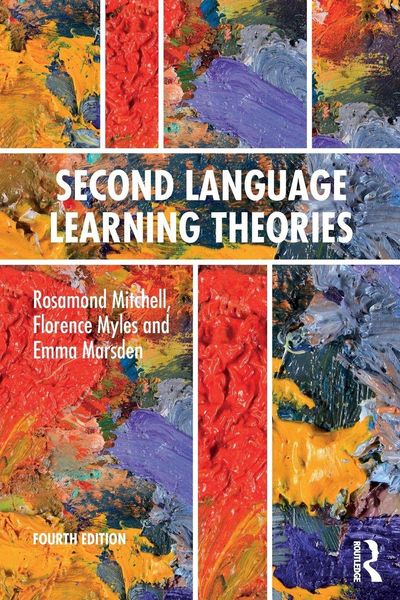
Second Language Learning Theories Fourth Edition

69,99 €

inkl. gesetzl. MwSt., Versandkostenfrei


Beschreibung

Written by a team of leading experts working in different SLA specialisms, this fourth edition is a clear and concise introduction to the main theories of second language acquisition (SLA) from multiple perspectives, comprehensively updated to reflect the very latest developments SLA research in recent...

Beschreibung

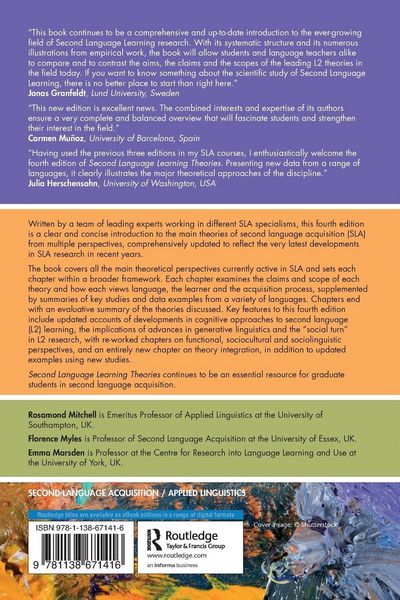
Written by a team of leading experts working in different SLA specialisms, this fourth edition is a clear and concise introduction to the main theories of second language acquisition (SLA) from multiple perspectives, comprehensively updated to reflect the very latest developments SLA research in recent years.

The book covers all the main theoretical perspectives currently active in SLA and sets each chapter within a broader framework. Each chapter examines the claims and scope of each theory and how each views language, the learner and the acquisition process, supplemented by summaries of key studies and data examples from a variety of languages. Chapters end with an evaluative summary of the theories discussed. Key features to this fourth edition include updated accounts of developments in cognitive approaches to second language (L2) learning, the implications of advances in generative linguistics and the "social turn" in L2 research, with re-worked chapters on functional, sociocultural and sociolinguistic perspectives, and an entirely new chapter on theory integration, in addition to updated examples using new studies.

Second Language Learning Theories continues to be an essential resource for graduate students in second language acquisition.

Produktdetails

Einband

Taschenbuch

Erscheinungsdatum

29.01.2019

Abbildungen

33 SW-Abb., 33 SW-Zeichn., 59 Tabellen

Verlag Taylor & Francis

Produktdetails

Einband

Taschenbuch

Erscheinungsdatum

29.01.2019

Abbildungen

33 SW-Abb., 33 SW-Zeichn., 59 Tabellen

Verlag Taylor & Francis
Seitenzahl

462

Maße (L/B/H)

22,9/15,2/2,5 cm

Gewicht

664 g

Auflage

4. Auflage

Sprache

Englisch

ISBN

978-1-138-67141-6

Herstelleradresse

Libri GmbH
Europaallee 1
36244 Bad Hersfeld
DE

Email: gpsr@libri.de

Noch keine Bewertungen vorhanden

Verfassen Sie die erste Bewertung zu diesem Artikel

Helfen Sie anderen Kundinnen und Kunden durch Ihre Meinung.

Kundinnen und Kunden meinen

Bewertungen (0)

Weitere Artikel finden Sie in

Die Leseprobe wird geladen.
  • Produktbild: Second Language Learning Theories
  • Produktbild: Second Language Learning Theories
  • Table of Contents

    List of illustrations

    Acknowledgements

    Preface

    1. Second language learning: key concepts and issues
      1. Introduction
      2. What makes for a good theory?
      3. Views on the nature of language
      4. The language learning process
      5. Views of the language learner
      6. Links with social practice
      7. Conclusion
      8. References

    2. The recent history of second language learning research
      1. Introduction
      2. The 1950s and 1960s
      3. The 1970s
      4. The 1980s: a turning point
      5. Continuities and new themes
      6. Second language learning timeline
      7. References

    3. Linguistics and language learning: the Universal Grammar approach
      1. Introduction
      2. Why a Universal Grammar?
      3. What does Universal Grammar consist of?
      4. Universal Grammar and L1 acquisition
      5. Universal Grammar and L2 acquisition
      6. Evaluation of Universal Grammar-based approaches to L2 acquisition
      7. References

    4. Cognitive approaches to second language learning (1): general learning mechanisms
      1. Introduction
      2. Input-based emergentist perspectives
      3. Processing-based perspectives
      4. Evaluation of general cognitive approaches
      5. References

    5. Cognitive approaches to second language learning (2): Memory systems, explicit knowledge, and skill learning
      1. Introduction
      2. Memory systems and their role in L2 learning
      3. Explicit knowledge, information processing and skill acquisition
      4. Awareness and attention in L2 acquisition
      5. Working memory and L2 learning
      6. Evaluation of cognitive approaches (2): memory systems, explicit knowledge, and skill learning
      7. References

    6. Interaction in second language learning
      1. Introduction
      2. The revised Interaction Hypothesis (Long, 1996): an appeal to cognitive theory
      3. Negotiation of meaning and the learning of target L2 structures and vocabulary
      4. The role of feedback during oral interaction
      5. The problem of "noticing"
      6. L2 development in computer-mediated interaction
      7. Characteristics of learners and of tasks
      8. <