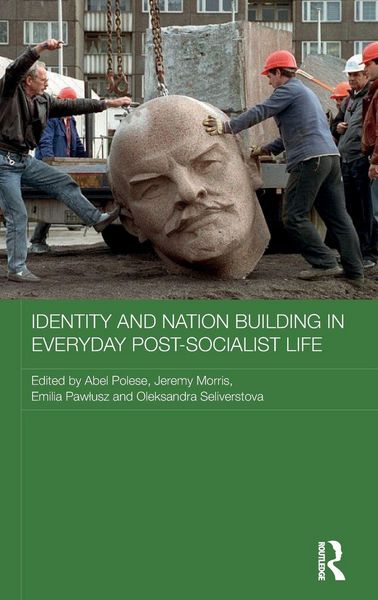
Identity and Nation Building in Everyday Post-Socialist Life
-
- Hardcover ausgewählt
- Taschenbuch
- eBook
-
Sprache:Englisch
259,99 €
inkl. gesetzl. MwSt.,
Beschreibung
Produktdetails
Einband
Gebundene Ausgabe
Erscheinungsdatum
02.08.2017
Abbildungen
Raster,schwarz-weiss, Tabellen, schwarz-weiss
Herausgeber
Abel Polese + weitereVerlag
Taylor and FrancisSeitenzahl
182
Maße (L/B/H)
23,8/16/1,6 cm
Gewicht
408 g
Sprache
Englisch
ISBN
978-1-138-73641-2
This book explores the function of the "everyday" in the formation, consolidation and performance of national, sub-national and local identities in the former socialist region. Based on extensive original research including fieldwork, the book demonstrates how the study of everyday and mundane practices is a meaningful and useful way of understanding the socio-political processes of identity formation both at the top and bottom level of a state. The book covers a wide range of countries including the Baltic States, Ukraine, Russia, the Caucasus and Central Asia, and considers "everyday" banal practices, including those related to consumption, kinship, embodiment, mobility, music, and the use of objects and artifacts. Overall, the book draws on, and contributes to, theory; and shows how the process of nation-building is not just undertaken by formal actors, such as the state, its institutions and political elites.
Noch keine Bewertungen vorhanden
Verfassen Sie die erste Bewertung zu diesem Artikel
Helfen Sie anderen Kundinnen und Kunden durch Ihre Meinung.
Kurze Frage zu unserer Seite
Vielen Dank für Ihr Feedback
Wir nutzen Ihr Feedback, um unsere Produktseiten zu verbessern. Bitte haben Sie Verständnis, dass wir Ihnen keine Rückmeldung geben können. Falls Sie Kontakt mit uns aufnehmen möchten, können Sie sich aber gerne an unseren Kund*innenservice wenden.
zum Kundenservice