KI-Beratung Beta

Gutscheinbedingungen

**Gültig am 27.11.2026 auf Spielzeug, Schreibwaren, Filme, Geschenke & Trends, Musik, tolino eReader & Zubehör, Hörbücher und Hörbuch-Downloads, nicht preisgebundene Bücher und Kalender online auf thalia.at und in der Thalia App. Einzelne Artikel können ausgeschlossen sein. Aufgrund der Buchpreisbindung sind deutschsprachige Bücher und eBooks ausgenommen. Zusätzlich ausgenommen sind Abos & Flatrates, Games, Geschenkkarten/-boxen, Shelfies, Software, Zeitschriften sowie einzelne Artikel von tonies®. Pro Einkauf einmal einlösbar. Click & Collect nur bei Onlinevorabzahlung möglich. Keine Barauszahlung. Nicht kombinierbar mit anderen Aktionen und Gutscheinen. Gutschein wird auf max. 500€ Bestellwert angerechnet. Nicht gültig für Versandkosten und Services.

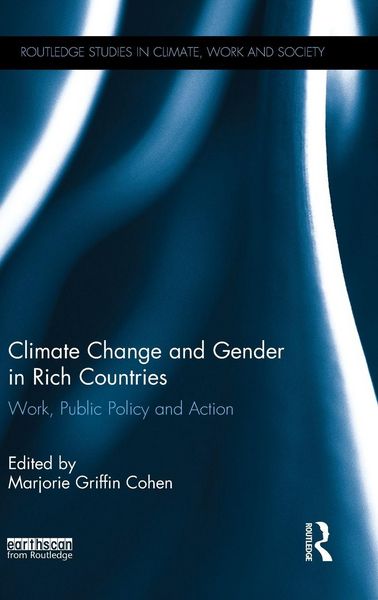
Produktbild: Climate Change and Gender in Rich Countries

Climate Change and Gender in Rich Countries Work, public policy and action

229,99 €

inkl. gesetzl. MwSt., Versandkostenfrei


Beschreibung

Climate change is at the forefront of ideas about public policy, the economy and labour issues. However, the gendered dimensions of climate change and the public policy issues associated with it in wealthy nations are much less understood.

Climate Change and Gender in Rich Countries covers a wide range...

Beschreibung

Climate change is at the forefront of ideas about public policy, the economy and labour issues. However, the gendered dimensions of climate change and the public policy issues associated with it in wealthy nations are much less understood.

Climate Change and Gender in Rich Countries covers a wide range of issues dealing with work and working life. The book demonstrates the gendered distinctions in both experiences of climate change and the ways that public policy deals with it. The book draws on case studies from the UK, Sweden, Australia, Canada, Spain and the US to address key issues such as: how gendered distinctions affect the most vulnerable; paid and unpaid work; and activism on climate change. It is argued that including gender as part of the analysis will lead to more equitable and stronger societies as solutions to climate change advance.

This volume will be of great relevance to students, scholars, trade unionists and international organisations with an interest in climate change, gender, public policy and environmental studies.

Rezension

"This book is unique in that it provides a forward looking full-scale gender analysis that moves beyond common perceptions of women as vulnerable victims to show there are no universal experiences of climate change. Gender is highly relevant but in complex ways." - Annica Kronsell, Professor, Political Science, Lund University, Sweden

"These are elegantly written essays that urgently address the dearth of information about the implications of climate change by gender in the rich countries. This volume takes stock of the current global order and sets a compelling research and political agenda for tackling the systemic changes needed for progress whilst remaining sensitive to the intersectionality of experiences brought to life through this important book." - Isabella Bakker, FRSC, Distinguished Research Professor, York University, Canada

"By putting gender at the centre of its analysis and policy discussions this path-breaking book highlights that climate change poses inescapable challenges for all of us. Crucially it also points to the need for activism and contestation in order to forge a sustainable and fairer world for future generations." - Rhonda Sharp, Professor of Economics, University of South Australia, Australia and former President of the International Association for Feminist Economics

"This is a timely volume that breaks a strange silence: it provides critical analysis and compelling evidence that gender inequality shapes experiences of and responses to climate change as much in rich countries as it does in poor countries, albeit in different ways. It is an invaluable resource to all of us who are committed to understanding climate change as a feminist and social justice issue." - Sherilyn MacGregor, Reader in Environmental Politics, The University of Manchester, UK

"Putting a gender lens on Climate Change is putting a gender lens on Aboriginal issues, forestry, natural disasters, just transition, agriculture, water, energy, jobs, health, resource extraction, government policies, food security, mitigation and adaptation, housing, and transportation. Reading this book exposes the injustices and offers concrete solutions." - Donald Lafleur, Vice Président Exécutif, Canadian Labour Congress, Canada

"This excellent, wide-ranging, multi-disciplinary, collection makes a welcome and valuable contribution to redressing the gender balance in rich countries, and to cultivating broader gender and climate change scholarship." - Karen Morrow, College of Law and Criminology, Swansea University, Wales, UK

"An exciting collection of top scholars comes together in this path-breaking book to decipher the collision of two of today's hottest political topics: gender and climate change. It reveals how this massive problem of climate change is better tackled when gender forms the centre of policy solutions." - Kennedy Stewart, MP, Opposition Science Critic, New Democratic Party, Parliament of Canada.
Produktdetails

Einband

Gebundene Ausgabe

Erscheinungsdatum

23.05.2017

Abbildungen

20 SW-Abb., 5 SW-Zeichn., 15 Tabellen

Herausgeber Marjorie Griffin Cohen

Produktdetails

Einband

Gebundene Ausgabe

Erscheinungsdatum

23.05.2017

Abbildungen

20 SW-Abb., 5 SW-Zeichn., 15 Tabellen

Herausgeber Marjorie Griffin Cohen
Verlag Taylor & Francis
Seitenzahl

344

Maße (L/B/H)

24/16,1/2,3 cm

Gewicht

631 g

Sprache

Englisch

ISBN

978-1-138-22239-7

Herstelleradresse

Libri GmbH
Europaallee 1
36244 Bad Hersfeld
DE

Email: gpsr@libri.de

Noch keine Bewertungen vorhanden

Verfassen Sie die erste Bewertung zu diesem Artikel

Helfen Sie anderen Kundinnen und Kunden durch Ihre Meinung.

Kundinnen und Kunden meinen

Bewertungen (0)

Die Leseprobe wird geladen.
  • Produktbild: Climate Change and Gender in Rich Countries
  • Part One: Context and Overview

    1. Introduction: Why Gender Matters when Dealing with Climate Change
    2. Masculinities of Global Climate Change: Exploring Ecomodern, Industrial and Ecological Masculinity
    3. It's Not Just the Numbers: Challenging Masculinist Working Practices in Climate Change Decision-Making in UK Government and Environmental Non-Governmental Organizations
    4. Part Two: Challenges for Paid and Unpaid Work

    5. Women and Low Energy Construction in Europe: A New Opportunity?
    6. Renewable Inequity? Women's Employment in Clean Energy in Industrialized, Emerging and Developing Economies
    7. UK Environmental and Trade Union Groups' Struggles to Integrate Gender Issues into Climate Change Analysis and Activism
    8. Transporting Difference at Work: Taking Gendered Intersectionality Seriously in Climate Change Agendas
    9. The US Example of Integrating Gender and Climate Change in Training: Response to the 2008-09 Recession Part Three: Vulnerability, Insecurity and Work
    10. Gendered Outcomes in Post-Disaster Sites: Public Policy and Resource Distribution
    11. Climate Change, Traditional Roles, and Work- Interactions in the Inuit Nunangat
    12. Towards Humane Jobs: Recognizing Gendered, Multispecies Intersections and Possibilities
    13. Part Four: Rural and Resource Communities

    14. Maybe Tomorrow Will Be Better: Gender and Farm Work in a Changing Climate
    15. Understanding the Gender Labours of Adaptation to Climate Change in Forest-Based Communities Through Different Models of Analysis
    16. The Complex Impacts of Intensive Resource Extraction on Women, Children and Aboriginal Peoples: Towards Contextually-Informed Approaches to Climate Change and Health
    17. Part Five: Public Policy and Activism

    18. How a Gendered Understanding of Climate Change Can Help Shape Canadian Climate Policy
    19. The Integration of Gender in Climate Change Mitigation and Adaptation in Québec: Silos and Possibilities
    20. A Gendered Analysis of Housing Policies in the Context of Climate Change: A Comparison of Canada and Spain
    21. Canadian Indigenous Female Leadership and Political Agency on Climate Change
    22. Using Information about Gender and Climate Change to Inform Green Economic Policies