KI-Beratung Beta

Gutscheinbedingungen

**Gültig bis 18.11.2026 auf englischsprachige Klassiker (klassiker-32728) online auf thalia.at und in der Thalia App. Einzelne Artikel können ausgeschlossen sein. Ausgenommen sind preisgebundene Artikel & eBooks. Pro Einkauf einmal einlösbar. Click & Collect nur bei Onlinevorabzahlung möglich. Keine Barauszahlung. Nicht kombinierbar mit anderen Aktionen und Gutscheinen. Gutschein wird auf max. 500€ Bestellwert angerechnet. Nicht gültig für Geschenkkarten, Versandkosten und Services.

  • Produktbild: Morality, Governance, and Social Institutions
  • Produktbild: Morality, Governance, and Social Institutions

Morality, Governance, and Social Institutions Reflections on Russell Hardin

118,99 €

inkl. gesetzl. MwSt., Versandkostenfrei


Beschreibung

This book reflects on the research and career of political theorist Russell Hardin from scholars of Political Science, Philosophy, Sociology, Economics, and Law, among other disciplines. Contributions address core issues of political theory as perceived by Hardin, starting with his insistence that many...

Beschreibung

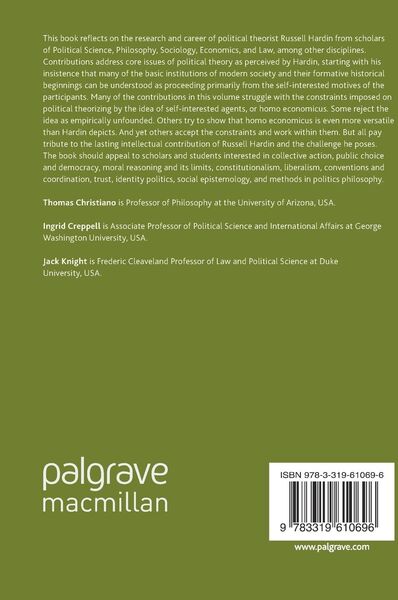
This book reflects on the research and career of political theorist Russell Hardin from scholars of Political Science, Philosophy, Sociology, Economics, and Law, among other disciplines. Contributions address core issues of political theory as perceived by Hardin, starting with his insistence that many of the basic institutions of modern society and their formative historical beginnings can be understood as proceeding primarily from the self-interested motives of the participants. Many of the contributions in this volume struggle with the constraints imposed on political theorizing by the idea of self-interested agents, or homo economicus. Some reject the idea as empirically unfounded. Others try to show that homo economicus is even more versatile than Hardin depicts. And yet others accept the constraints and work within them. But all pay tribute to the lasting intellectual contribution of Russell Hardin and the challenge he poses. The book should appeal to scholars and students interested in collective action, public choice and democracy, moral reasoning and its limits, constitutionalism, liberalism, conventions and coordination, trust, identity politics, social epistemology, and methods in politics philosophy.

Portrait


Thomas Christiano is Professor of Philosophy at the University of Arizona, USA.


Ingrid Creppell is Associate Professor of Political Science and International Affairs at George Washington University, USA.


Jack Knight is Frederic Cleaveland Professor of Law and Political Science at Duke University, USA.

Produktdetails

Einband

Gebundene Ausgabe

Erscheinungsdatum

23.10.2017

Abbildungen

XIII, 353 p. 24 illus.

Herausgeber Thomas Christiano + weitere

Produktdetails

Einband

Gebundene Ausgabe

Erscheinungsdatum

23.10.2017

Abbildungen

XIII, 353 p. 24 illus.

Herausgeber
Verlag Springer
Seitenzahl

353

Maße (L/B/H)

21,6/15,3/2,5 cm

Gewicht

549 g

Auflage

1st ed. 2018

Sprache

Englisch

ISBN

978-3-319-61069-6

Herstelleradresse

Springer-Verlag GmbH
Europaplatz 3
69115 Heidelberg
DE

Email: ProductSafety@springernature.com

Noch keine Bewertungen vorhanden

Verfassen Sie die erste Bewertung zu diesem Artikel

Helfen Sie anderen Kundinnen und Kunden durch Ihre Meinung.

Kundinnen und Kunden meinen

Bewertungen (0)

  • Produktbild: Morality, Governance, and Social Institutions
  • Produktbild: Morality, Governance, and Social Institutions

  • 1. Introduction.- 2. The Political Psychology of Constitution-Making.- 3. Russell Hardin's Hobbes.- 4. "FüHrer Befiehl, Wir Folgen Dir!": Opinion Dynamics in Extremist Groups.- 5. Trendsetters and Norm Change.- 6. Self-ESTEEM.- 7. Violence and Politics in Northern Ireland: IRA/Sinn Fein's Strategy and the 2005 Disarmament.- 8. The Priority of Social Morality.- 9. The Liberty of the Ancient from a Humean Perspective.- 10. A Political Theory of Constitutional Democracy: On Legitimacy of Constitutional Courts in Stable Liberal Democracies.- 11. Assesing Constitutional Efficacy:  Motivated by Constitutional Law or by Social Norms? How Can We Know?.- 12. Constitutions as Conventions: A History of Non-Reception.- 13. On the Twentieth Anniversary of One for All: The Logic of Group Conflict in Northern Ireland and Beyond.