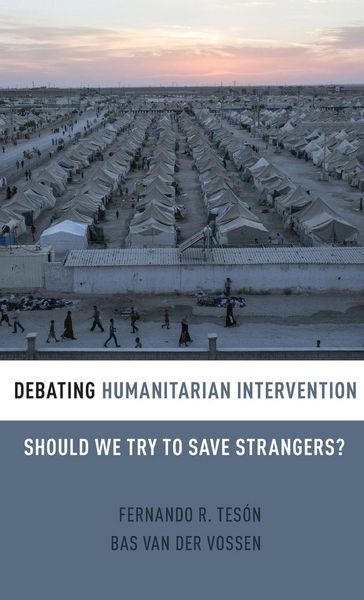
Debating Humanitarian Intervention Should We Try to Save Strangers?
-
- Hardcover ausgewählt
- Taschenbuch
- eBook
-
Sprache:Englisch
211,99 €
inkl. gesetzl. MwSt.,
Beschreibung
Produktdetails
Einband
Gebundene Ausgabe
Erscheinungsdatum
10.09.2008
Verlag
Oxford AcademicSeitenzahl
290
Maße (L/B/H)
22,2/14,5/1,9 cm
Gewicht
522 g
Sprache
Englisch
ISBN
978-0-19-020290-3
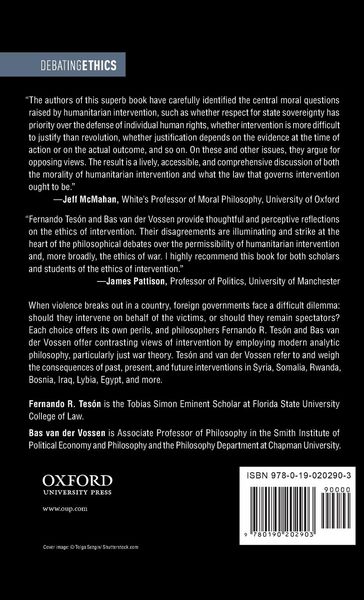
When foreign powers attack civilians, other countries face an impossible dilemma. Two courses of action emerge: either to retaliate against an abusive government on behalf of its victims, or to remain spectators. Either course offers its own perils: the former, lost lives and resources without certainty of restoring peace or preventing worse problems from proliferating; the latter, cold spectatorship that leaves a country at the mercy of corrupt rulers or to revolution.
Philosophers Fernando Tesón and Bas van der Vossen offer contrasting views of humanitarian intervention, defining it as either war aimed at ending tyranny, or as violence. The authors employ the tools of impartial modern analytic philosophy, particularly just war theory, to substantiate their claims. According to Tesón, a humanitarian intervention has the same just cause as a justified revolution: ending tyranny. He analyzes the different kinds of just cause and whether or not an intervener may pursue other justified causes. For Tesón, the permissibility of humanitarian intervention is almost exclusively determined by the rules of proportionality. Bas van der Vossen, by contrast, holds that military intervention is morally impermissible in almost all cases. Justified interventions, Van der Vossen argues, must have high ex ante chance of success. Analyzing the history and prospects of intervention shows that they almost never do.
Tesón and van der Vossen refer to concrete cases, and weigh the consequences of continued or future intervention in Syria, Somalia, Rwanda, Bosnia, Iraq, Lybia and Egypt. By placing two philosophers in dialogue, Debating Humanitarian Intervention is not constrained by a single, unifying solution to the exclusion of all others. Rather, it considers many conceivable actions as judged by analytic philosophy, leaving the reader equipped to make her own, informed judgments.
Noch keine Bewertungen vorhanden
Verfassen Sie die erste Bewertung zu diesem Artikel
Helfen Sie anderen Kundinnen und Kunden durch Ihre Meinung.
Kurze Frage zu unserer Seite
Vielen Dank für Ihr Feedback
Wir nutzen Ihr Feedback, um unsere Produktseiten zu verbessern. Bitte haben Sie Verständnis, dass wir Ihnen keine Rückmeldung geben können. Falls Sie Kontakt mit uns aufnehmen möchten, können Sie sich aber gerne an unseren Kund*innenservice wenden.
zum Kundenservice