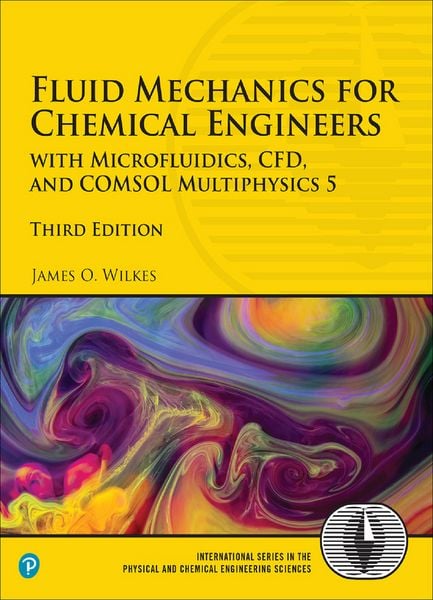
Produktbild: Fluid Mechanics for Chemical Engineers: with Microfluidics, CFD, and COMSOL Multiphysics 5

Fluid Mechanics for Chemical Engineers: with Microfluidics, CFD, and COMSOL Multiphysics 5 with Microfluidics, CFD, and COMSOL Multiphysics 5

176,99 €

inkl. gesetzl. MwSt., Versandkostenfrei


Beschreibung

Produktdetails

Einband

Taschenbuch

Erscheinungsdatum

17.08.2017

Verlag

Pearson Studium

Seitenzahl

816

Maße (L/B/H)

25,4/20,3/4,4 cm

Gewicht

1601 g

Auflage

3. Auflage

Sprache

Englisch

ISBN

978-0-13-471282-6

Beschreibung

Produktdetails

Einband

Taschenbuch

Erscheinungsdatum

17.08.2017

Verlag

Pearson Studium

Seitenzahl

816

Maße (L/B/H)

25,4/20,3/4,4 cm

Gewicht

1601 g

Auflage

3. Auflage

Sprache

Englisch

ISBN

978-0-13-471282-6

Herstelleradresse

Pearson
St.-Martin-Straße 82
81541 München
DE

Email: salesde@pearson.com

Kundinnen und Kunden meinen

0 Bewertungen

Informationen zu Bewertungen

Zur Abgabe einer Bewertung ist eine Anmeldung im Konto notwendig. Die Authentizität der Bewertungen wird von uns nicht überprüft. Wir behalten uns vor, Bewertungstexte, die unseren Richtlinien widersprechen, entsprechend zu kürzen oder zu löschen.

Die Bewertungen sind nach Format, Anzahl Sterne und Datum sortiert.

Verfassen Sie die erste Bewertung zu diesem Artikel

Helfen Sie anderen Kund*innen durch Ihre Meinung

Kundinnen und Kunden meinen

0 Bewertungen filtern

  • Produktbild: Fluid Mechanics for Chemical Engineers: with Microfluidics, CFD, and COMSOL Multiphysics 5
  • Preface xv


    Part I: Macroscopic Fluid Mechanics 1


    Chapter 1: Introduction to Fluid Mechanics 3

    1.1 Fluid Mechanics in Chemical Engineering 3

    1.2 General Concepts of a Fluid 3

    1.3 Stresses, Pressure, Velocity, and the Basic Laws 5

    1.4 Physical Properties—Density, Viscosity, and Surface Tension 10

    1.5 Units and Systems of Units 21

    1.6 Hydrostatics 26

    1.7 Pressure Change Caused by Rotation 39

    Problems for Chapter 1 42


    Chapter 2: Mass, Energy, and Momentum Balances 55

    2.1 General Conservation Laws 55

    2.2 Mass Balances 57

    2.3 Energy Balances 61

    2.4 Bernoulli’s Equation 67

    2.5 Applications of Bernoulli’s Equation 70

    2.6 Momentum Balances 78

    2.7 Pressure, Velocity, and Flow Rate Measurement 92

    Problems for Chapter 2 96


    Chapter 3: Fluid Friction in Pipes 120

    3.1 Introduction 120

    3.2 Laminar Flow 123

    3.3 Models for Shear Stress 129

    3.4 Piping and Pumping Problems 133

    3.5 Flow in Noncircular Ducts 150

    3.6 Compressible Gas Flow in Pipelines 156

    3.7 Compressible Flow in Nozzles 159

    3.8 Complex Piping Systems 163

    Problems for Chapter 3 168


    Chapter 4: Flow in Chemical Engineering Equipment 185

    4.1 Introduction 185

    4.2 Pumps and Compressors 188

    4.3 Drag Force on Solid Particles in Fluids 194

    4.4 Flow Through Packed Beds 204

    4.5 Filtration 210

    4.6 Fluidization 215

    4.7 Dynamics of a Bubble-Cap Distillation Column 216

    4.8 Cyclone Separators 219

    4.9 Sedimentation 222

    4.10 Dimensional Analysis 224

    Problems for Chapter 4 230


    Part II: Microscopic Fluid Mechanics 247


    Chapter 5: Differential Equations of Fluid Mechanics 249

    5.1 Introduction to Vector Analysis 249

    5.2 Vector Operations 250

    5.3 Other Coordinate Systems 263

    5.4 The Convective Derivative 266

    5.5 Differential Mass Balance 267

    5.6 Differential Momentum Balances 271

    5.7 Newtonian Stress Components in Cartesian Coordinates 274

    Problems for Chapter 5 285


    Chapter 6: Solution Of Viscous-Flow Problems 292

    6.1 Introduction 292

    6.2 Solution of the Equations of Motion in Rectangular Coordinates 294

    6.3 Alternative Solution Using a Shell Balance 301

    6.4 Poiseuille and Couette Flows in Polymer Processing 313

    6.5 Solution of the Equations of Motion in Cylindrical Coordinates 325

    6.6 Solution of the Equations of Motion in Spherical Coordinates 330

    Problems for Chapter 6 336


    Chapter 7: Laplace’s Equation, Irrotational and Porous-Media Flows 357

    7.1 Introduction 357

    7.2 Rotational and Irrotational Flows 359

    7.3 Steady Two-Dimensional Irrotational Flow 364

    7.4 Physical Interpretation of the Stream Function 367

    7.5 Examples of Planar Irrotational Flow 369

    7.6 Axially Symmetric Irrotational Flow 382

    7.7 Uniform Streams and Point Sources 384

    7.8 Doublets and Flow Past a Sphere 388

    7.9 Single-Phase Flow in a Porous Medium 391

    7.10 Two-Phase Flow in Porous Media 394

    7.11 Wave Motion in Deep Water 400

    Problems for Chapter 7 404


    Chapter 8: Boundary-Layer and Other Nearly Unidirectional Flows 418

    8.1 Introduction 418

    8.2 Simplified Treatment of Laminar Flow Past a Flat Plate 419

    8.3 Simplification of the Equations of Motion 426

    8.4 Blasius Solution for Boundary-Layer Flow 429

    8.5 Turbulent Boundary Layers 432

    8.6 Dimensional Analysis of the Boundary-Layer Problem 434

    8.7 Boundary-Layer Separation 437

    8.8 The Lubrication Approximation 448

    8.9 Polymer Processing by Calendering 457

    8.10 Thin Films and Surface Tension 463

    Problems for Chapter 8 466


    Chapter 9: Turbulent Flow 480

    9.1 Introduction 480

    9.2 Physical Interpretation of the Reynolds Stresses 487

    9.3 Mixing-Length Theory 488

    9.4 Determination of Eddy Kinematic Viscosity and Mixing Length 491

    9.5 Velocity Profiles Based on Mixing-Length Theory 493

    9.6 The Universal Velocity Profile for Smooth Pipes 495

    9.7 Friction Factor in Terms of Reynolds Number for Smooth Pipes 497

    9.8 Thickness of the Laminar Sublayer 499

    9.9 Velocity Profiles and Friction Factor for Rough Pipe 501

    9.10 Blasius-Type Law and the Power-Law Velocity Profile 502

    9.11 A Correlation for the Reynolds Stresses 503

    9.12 Computation of Turbulence by the k–ε Method 506

    9.13 Analogies Between Momentum and Heat Transfer 520

    9.14 Turbulent Jets 524

    Problems for Chapter 9 532


    Chapter 10: Bubble Motion, Two-Phase Flow, and Fluidization 542

    10.1 Introduction 542

    10.2 Rise of Bubbles in Unconfined Liquids 542

    10.3 Pressure Drop and Void Fraction in Horizontal Pipes 547

    10.4 Two-Phase Flow in Vertical Pipes 554

    10.5 Flooding 566

    10.6 Introduction to Fluidization 570

    10.7 Bubble Mechanics 572

    10.8 Bubbles in Aggregatively Fluidized Beds 577

    Problems for Chapter 10 586


    Chapter 11: Non-Newtonian Fluids 602

    11.1 Introduction 602

    11.2 Classification of Non-Newtonian Fluids 603

    11.3 Constitutive Equations for Inelastic Viscous Fluids 606

    11.4 Constitutive Equations for Viscoelastic Fluids 626

    11.5 Response to Oscillatory Shear 633

    11.6 Characterization of the Rheological Properties of Fluids 636

    Problems for Chapter 11 644


    Chapter 12: Microfluidics and Electrokinetic Flow Effects 653

    12.1 Introduction 653

    12.2 Physics of Microscale Fluid Mechanics 654

    12.3 Pressure-Driven Flow Through Microscale Tubes 655

    12.4 Mixing, Transport, and Dispersion 656

    12.5 Species, Energy, and Charge Transport 658

    12.6 The Electrical Double Layer and Electrokinetic Phenomena 661

    12.7 Measuring the Zeta Potential 676

    12.8 Electroviscosity 678

    12.9 Particle and Macromolecule Motion in Microfluidic Channels 678

    Problems for Chapter 12 683


    Chapter 13: An Introduction to Computational Fluid Dynamics and ANSYS Fluent 688

    13.1 Introduction and Motivation 688

    13.2 Numerical Methods 690

    13.3 Learning CFD by Using ANSYS Fluent 699

    13.4 Practical CFD Examples 703

    References for Chapter 13 719


    Chapter 14: COMSOL Multiphysics for Solving Fluid Mechanics Problems 720

    14.1 COMSOL Multiphysics—An Overview 720

    14.2 The Steps for Solving Problems in COMSOL 723

    14.3 How to Run COMSOL 725

    14.4 Variables, Constants, Expressions, and Units 741

    14.5 Boundary Conditions 742

    14.6 Variables Used by COMSOL 743

    14.7 Wall Functions in Turbulent-Flow Problems 744

    14.8 Streamline Plotting in COMSOL 747

    14.9 Special COMSOL Features Used in the Examples 749

    14.10 Drawing Tools 754

    14.11 Fluid Mechanics Problems Solvable by COMSOL 756

    14.12 Conclusion—Problems and Learning Tools 761


    Appendix A: Useful Mathematical Relationships 762


    Appendix B: Answers to the True/False Assertions 768


    Appendix C: Some Vector and Tensor Operations 771


    General Index 773

    Comsol Multiphysics Index 782

    The Authors 784