KI-Beratung Beta

Gutscheinbedingungen

**Gültig bis 18.11.2026 auf englischsprachige Klassiker (klassiker-32728) online auf thalia.at und in der Thalia App. Einzelne Artikel können ausgeschlossen sein. Ausgenommen sind preisgebundene Artikel & eBooks. Pro Einkauf einmal einlösbar. Click & Collect nur bei Onlinevorabzahlung möglich. Keine Barauszahlung. Nicht kombinierbar mit anderen Aktionen und Gutscheinen. Gutschein wird auf max. 500€ Bestellwert angerechnet. Nicht gültig für Geschenkkarten, Versandkosten und Services.

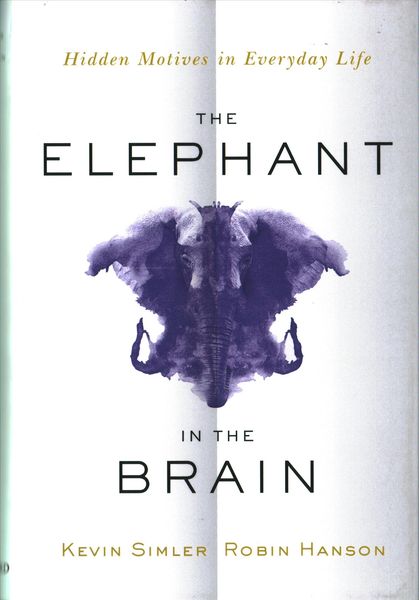
Produktbild: The Elephant in the Brain

The Elephant in the Brain Hidden Motives in Everyday Life

43,99 €

inkl. gesetzl. MwSt., Versandkostenfrei


Beschreibung

Human beings are primates, and primates are political animals. Our brains, therefore, are designed not just to hunt and gather, but also to help us get ahead socially, often via deception and self-deception. But while we may be self-interested schemers, we benefit by pretending otherwise. The less we...

Beschreibung

Human beings are primates, and primates are political animals. Our brains, therefore, are designed not just to hunt and gather, but also to help us get ahead socially, often via deception and self-deception. But while we may be self-interested schemers, we benefit by pretending otherwise. The less we know about our own ugly motives, the better - and thus we don't like to talk or even think about the extent of our selfishness. This is "the elephant in the brain." Such an introspective taboo makes it hard for us to think clearly about our nature and the explanations for our behavior. The aim of this book, then, is to confront our hidden motives directly - to track down the darker, unexamined corners of our psyches and blast them with floodlights. Then, once everything is clearly visible, we can work to better understand ourselves: Why do we laugh? Why are artists sexy? Why do we brag about travel? Why do we prefer to speak rather than listen?
Our unconscious motives drive more than just our private behavior; they also infect our venerated social institutions such as Art, School, Charity, Medicine, Politics, and Religion. In fact, these institutions are in many ways designed to accommodate our hidden motives, to serve covert agendas alongside their "official" ones. The existence of big hidden motives can upend the usual political debates, leading one to question the legitimacy of these social institutions, and of standard policies designed to favor or discourage them. You won't see yourself - or the world - the same after confronting the elephant in the brain.

Rezension

The argument that Simler and Hanson make is rather comprehensive, and compelling. They bring together research on various topics of limited reach that, when combined, speak to the outrageous gall of the mind in recreating reality to its own liking, and then covering its tracks. Katherine Oktober Matthews, Riding the Dragon

Produktdetails

Einband

Gebundene Ausgabe

Erscheinungsdatum

08.02.2018

Abbildungen

10

Verlag Oxford University Press

Produktdetails

Einband

Gebundene Ausgabe

Erscheinungsdatum

08.02.2018

Abbildungen

10

Verlag Oxford University Press
Seitenzahl

416

Maße (L/B/H)

24,1/16,1/4 cm

Gewicht

681 g

Sprache

Englisch

ISBN

978-0-19-049599-2

Herstelleradresse

Libri GmbH
Europaallee 1
36244 Bad Hersfeld
DE

Email: gpsr@libri.de

Noch keine Bewertungen vorhanden

Verfassen Sie die erste Bewertung zu diesem Artikel

Helfen Sie anderen Kundinnen und Kunden durch Ihre Meinung.

Kundinnen und Kunden meinen

Bewertungen (0)

Die Leseprobe wird geladen.
  • Produktbild: The Elephant in the Brain
    • 00 Introduction ......................................................................................... .............................
    • 01 Animal Behavior ......................................................................................... .....................
    • 02 Competition.............................................................................. ........................................
    • 03 Norms ......................................................................................... ......................................
    • 04 Cheating ......................................................................................... ..................................
    • 05 Self-Deception ......................................................................................... ........................
    • 06 Counterfeit Reasons ......................................................................................... ................
    • 07 Body Language ......................................................................................... .......................
    • 08 Laughter ......................................................................................... ..................................
    • 09 Conversation ......................................................................................... ...........................
    • 10 Consumption ......................................................................................... ...........................
    • 11 Art ......................................................................................... ...........................................
    • 12 Charity.................................................................................. ............................................
    • 13 Education ......................................................................................... ................................
    • 14 Medicine ......................................................................................... .................................
    • 15 Religion ......................................................................................... ...................................
    • 16 Politics................................................................................. .............................................
    • 17 Conclusion