Gutscheinbedingungen

**Gültig bis 14.09.2026 auf Spielzeug, Schreibwaren, Filme, Geschenke & Trends, Musik, tolino eReader & Zubehör, Hörbücher, nicht preisgebundene Bücher und Kalender in der Thalia App. Einzelne Artikel können ausgeschlossen sein. Aufgrund der Buchpreisbindung sind deutschsprachige Bücher und eBooks ausgenommen. Zusätzlich ausgenommen sind Abos & Flatrates, Games, Geschenkkarten/-boxen, Shelfies, Software, Zeitschriften sowie einzelne Artikel von tonies®. Pro Einkauf einmal einlösbar. Nur gültig mit im Onlineshop hinterlegter Bonuscard. Click & Collect nur bei Onlinevorabzahlung möglich. Keine Barauszahlung. Nicht kombinierbar mit anderen Aktionen und Gutscheinen. Gutschein wird auf max. 500€ Bestellwert angerechnet. Nicht gültig für Versandkosten und Services.

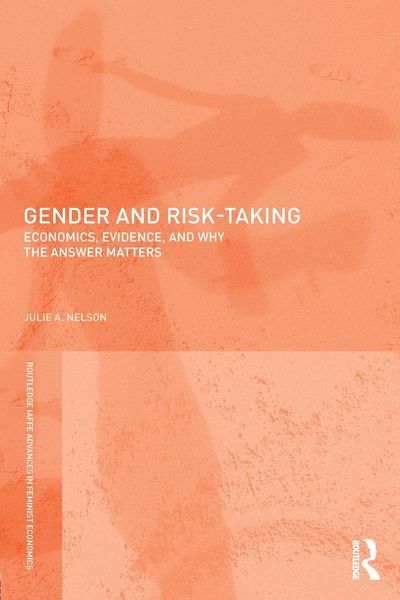
  • Produktbild: Gender and Risk-Taking
  • Produktbild: Gender and Risk-Taking

Gender and Risk-Taking Economics, Evidence, and Why the Answer Matters

56,99 €

inkl. gesetzl. MwSt., Versandkostenfrei


Beschreibung

Produktdetails

Einband

Taschenbuch

Erscheinungsdatum

21.06.2017

Abbildungen

20 SW-Abb., 20 SW-Zeichn., 8 Tabellen

Verlag

Taylor & Francis

Seitenzahl

158

Maße (L/B/H)

23,4/15,6/0,9 cm

Gewicht

251 g

Sprache

Englisch

ISBN

978-1-138-28403-6

Beschreibung

Rezension

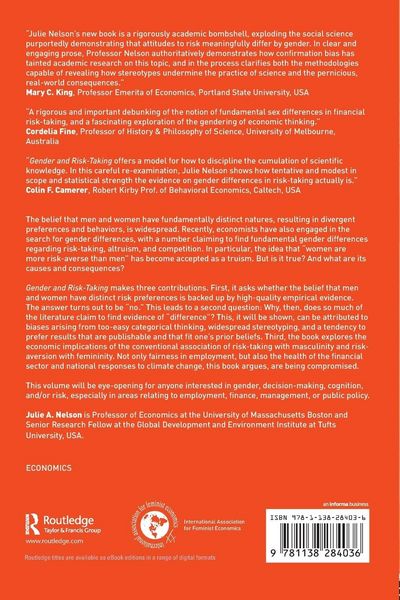
'Julie Nelson's new book is a rigorously academic bombshell, exploding the social science purportedly demonstrating that attitudes to risk meaningfully differ by gender. In clear and engaging prose, Professor Nelson authoritatively demonstrates how confirmation bias has tainted academic research on this topic, and in the process clarifies both the methodologies capable of revealing how stereotypes undermine the practice of science and the pernicious, real-world consequences.' - Mary C. King, Professor Emerita of Economics, Portland State University, USA

'A rigorous and important debunking of the notion of fundamental sex differences in financial risk-taking, and a fascinating exploration of the gendering of economic thinking.' - Cordelia Fine, Professor of History & Philosophy of Science, University of Melbourne, Australia

'Gender and Risk-Taking offers a model for how to discipline the cumulation of scientific knowledge. In this careful re-examination, Julie Nelson shows how tentative and modest in scope and statistical strength, the evidence on gender differences in risk-taking actually is.' - Colin F. Camerer, Robert Kirby Prof. of Behavioral Economics, Caltech, USA

"Nelson provides an extremely clear explanation of the methods for comparing groups' characteristics, written at an undergraduate level and thus accessible to anyone with some understanding of statistics. The book is available in paperback and e-book formats, and the short chapters make it ideal for teaching. Part I should be assigned to students in every statistics course." -Cordelia W. Reimers, Hunter College and the Graduate School of the City University of New York.

Produktdetails

Einband

Taschenbuch

Erscheinungsdatum

21.06.2017

Abbildungen

20 SW-Abb., 20 SW-Zeichn., 8 Tabellen

Verlag

Taylor & Francis

Seitenzahl

158

Maße (L/B/H)

23,4/15,6/0,9 cm

Gewicht

251 g

Sprache

Englisch

ISBN

978-1-138-28403-6

Herstelleradresse

Libri GmbH
Europaallee 1
36244 Bad Hersfeld
DE

Email: gpsr@libri.de

Noch keine Bewertungen vorhanden

Verfassen Sie die erste Bewertung zu diesem Artikel

Helfen Sie anderen Kundinnen und Kunden durch Ihre Meinung.

Kundinnen und Kunden meinen

Bewertungen (0)

Die Leseprobe wird geladen.
  • Produktbild: Gender and Risk-Taking
  • Produktbild: Gender and Risk-Taking
  • Dedication

    List of Figures and Tables

    Acknowledgements

    Introduction

    Part I. To Understand the Answer, You First Have to Have a Clear Question

    Chapter 1. The Better Question: How Much Different and How Much Similar

    Chapter 2. Why We Get Stuck on the Bad Question

    Chapter 3. Statistical Tools for Analyzing Similarity and Difference

    Chapter 4. Statistical Tools for Inference and the Detection of Bias

    Part II. Evidence about Risk Behavior: Little Difference, Much Similarity

    Chapter 5. Difference and Similarity in 35 Scholarly Works

    Chapter 6. Difference and Similarity in 37 Investment Game Studies

    Part III. Evidence about Stereotyping and Confirmation Bias: Rampant

    Chapter 7. Stereotyping and Research Participants

    Chapter 8. Confirmation Bias Among Researchers in 35 Scholarly Works

    Chapter 9. Confirmation Bias and the Review of 37 Investment Game Studies

    Part IV. Why It Matters

    Chapter 10. Presumed Timidity: Consequences for Women

    Chapter 11. Recklessness: The (Masculine) Gendering of Commerce and Finance

    Chapter 12. Fearing Fear: The (Masculine) Gendering of Economics and Policy

    Conclusion

    Index