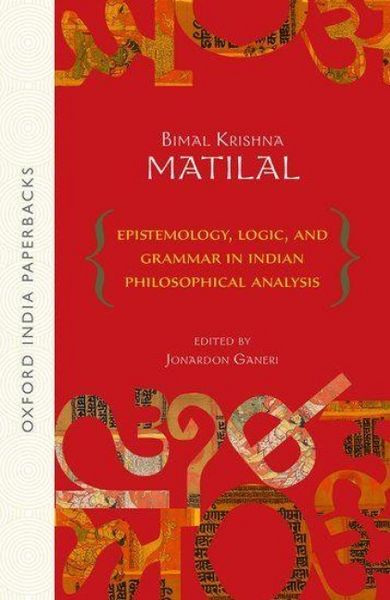
Produktbild: Epistemology, Logic and Grammar in Indian Philosophical Analysis

Epistemology, Logic and Grammar in Indian Philosophical Analysis

29,99 €

inkl. gesetzl. MwSt., zzgl. Versandkosten


  • Kostenlose Lieferung ab 30 € Einkaufswert
  • Versandkostenfrei für Bonuscard-Kund*innen

Beschreibung

Produktdetails

Einband

Taschenbuch

Erscheinungsdatum

25.09.2015

Herausgeber

Jornardon Ganeri

Verlag

Oxford University Press

Seitenzahl

168

Maße (L/B/H)

21,3/14/1,5 cm

Gewicht

136 g

Sprache

Englisch

ISBN

978-0-19-946093-9

Beschreibung

Produktdetails

Einband

Taschenbuch

Erscheinungsdatum

25.09.2015

Herausgeber

Jornardon Ganeri

Verlag

Oxford University Press

Seitenzahl

168

Maße (L/B/H)

21,3/14/1,5 cm

Gewicht

136 g

Sprache

Englisch

ISBN

978-0-19-946093-9

Herstelleradresse

Libri GmbH
Europaallee 1
36244 Bad Hersfeld
DE

Email: gpsr@libri.de

Noch keine Bewertungen vorhanden

Verfassen Sie die erste Bewertung zu diesem Artikel

Helfen Sie anderen Kundinnen und Kunden durch Ihre Meinung.

Kundinnen und Kunden meinen

Bewertungen (0)

  • Produktbild: Epistemology, Logic and Grammar in Indian Philosophical Analysis
    • Preface to the New Edition: J. Ganeri

    • Preface to the First Edition

    • Chronological Table of Philosophers

    • l. Perception and Language

    • 1.1. General remarks on the problem

    • 1.2. Early Nyaáya theory of perception

    • 1.3. The rise of idealism

    • 1.4. Bhartrhari's theory of knowledge: 'Construction'(vikalpa)

    • 1.5. Di¿ága's theory of perception

    • 1.6. Word-meaning as 'exclusion' (apoha)

    • 1.7. Di¿¿aga and modem reductionism

    • 2. Individuals, Universals, and Perception

    • 2.1. A critique of the Di¿¿aga school

    • 2.2. Material bodies and their atomic constituents

    • 2.3. 'Inseparable' relation (s¿mav¿ya)

    • 2.4. The law of contradiction and the 'delimitors'

    • 2.5. Universals as meanings of general terms

    • 2.6. Uses of articles and quantifiers: 'Modes' of reference

    • 2.7. The problem of 'real' universal (j¿ti)

    • 2.8. The notion of 'propositional' perception

    • 2.9. Non-qualificative perception in Navya-ny¿ya: 'Simple' properties

    • 2.1 0. Terms and propositional assertions

    • 3. Early Grammarians on Philosophical Semantics

    • 3.1. Preliminary remarks

    • 3.2. The notion of 'substance' : P¿nini's rule 1.2.64

    • 3.3. 'Substance' and 'quality': P¿nini's rule 5.1.119

    • 3.4. Two aspects of meaning: Vy¿di and V¿japy¿yana

    • 3.5. Bhartrhari's definition of 'substance'

    • 3.6. Vy¿di's theory of meaning

    • 3.7. An analysis of Vy¿di's theory in modem terminology

    • 4. Empty Subject Terms in Logic

    • 4.1. Non-referring expressions in language

    • 4.2. The riddle of 'non-being'

    • 4.3. The status of 'example' in Indian logic

    • 4.4. The Ny¿ya-Buddhist controversy

    • 4.5. The epistemological significance of the controversy

    • 4.6. The implicit Ny¿ya semantic principle

    • 4.7. Interpretation of existence and negation

    • 4.8. The pan-fictional approach of Buddhism

    • 5. Negation and the M¿dhyamika Dialectic

    • 5.1. The M¿dhyamika attitude-'emptiness'

    • 5.2. Two levels of truth

    • 5.3. The indeterminacy of the phenomenal world

    • 5.4. The paradox of 'emptiness'

    • 5.5. Sophistry and the semantical paradoxes

    • 5.6. Two aspects of negation

    • 5.7. 'Mysticism' and the M¿dhyamika school

    • Bibliographical References

    • Index