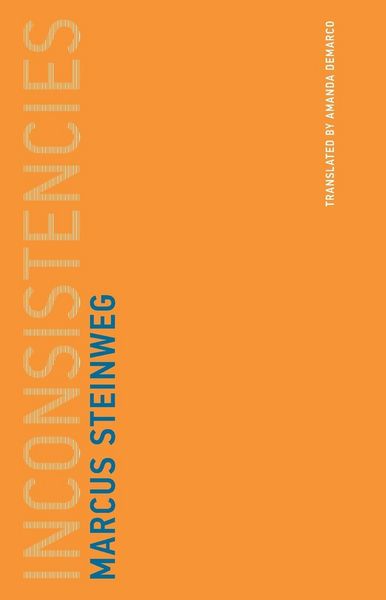
Inconsistencies
-
- Taschenbuch ausgewählt
- eBook
-
Sprache:Englisch
16,99 €
UVP
21,10 €
inkl. gesetzl. MwSt.,
- Kostenlose Lieferung ab 30 € Einkaufswert
- Versandkostenfrei für Bonuscard-Kund*innen
Beschreibung
Produktdetails
Einband
Taschenbuch
Erscheinungsdatum
06.10.2017
Verlag
Mit PressSeitenzahl
144
Maße (L/B/H)
17,8/11,4/0,9 cm
Gewicht
143 g
Übersetzt von
Amanda DeMarco
Sprache
Englisch
ISBN
978-0-262-53435-2
Those who continue to think never return to their point of departure.
Inconsistencies
These 130 short texts aphoristic, interlacing, and sometimes perplexing target a perennial philosophical problem: Our consciousness and our experience of reality are inconsistent, fragmentary, and unstable; God is dead, and our identity as subjects discordant. How can we establish a new mode of thought that does not cling to new gods or the false security of rationality? Marcus Steinweg, as he did in his earlier book The Terror of Evidence, constructs a philosophical position from fragments, maxims, meditations, and notes, formulating a philosophy of thought that expresses and enacts the inconsistency of our reality.
Steinweg considers, among other topics, life as a game ( To think is to play because no thought is firmly grounded ); sexuality ( wasteful, contradictory, and contingent ); desire ( Desire has a thousand names; It's earned none of them ); reality ( overdetermined and excessively complex ); and world ( a nonconcept ). He disposes of philosophy in one sentence ( Philosophy is a continual process of its own redefinition. ) but spends multiple pages on A Tear in Immanence, invoking Nietzsche, Heidegger, Sartre, and others. He describes Wandering with Foucault ( Thought entails wandering as well as straying into madness ) and brings together Derrida and Debord. He poses a question: Why should a cat be more mysterious than a dog? and later answers one: Beauty is truth because truth is beauty. By the end, we have accompanied Steinweg on converging trains of thought. Thinking means continuing to think, he writes, adding But thinking can only pose questions by answering others. The question of inconsistency? Asked and answered, and asked.
Noch keine Bewertungen vorhanden
Verfassen Sie die erste Bewertung zu diesem Artikel
Helfen Sie anderen Kundinnen und Kunden durch Ihre Meinung.
Kurze Frage zu unserer Seite
Vielen Dank für Ihr Feedback
Wir nutzen Ihr Feedback, um unsere Produktseiten zu verbessern. Bitte haben Sie Verständnis, dass wir Ihnen keine Rückmeldung geben können. Falls Sie Kontakt mit uns aufnehmen möchten, können Sie sich aber gerne an unseren Kund*innenservice wenden.
zum Kundenservice