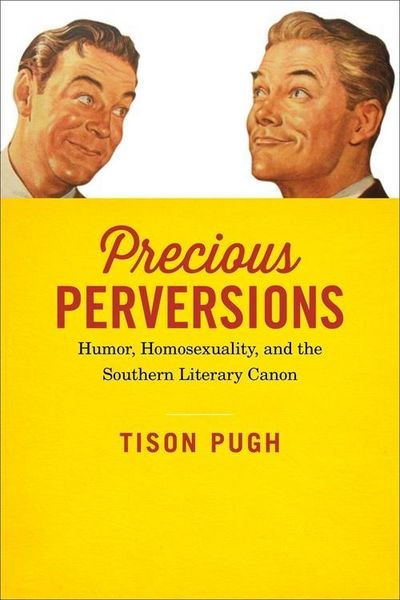
Precious Perversions Humor, Homosexuality, and the Southern Literary Canon
20,10 €
inkl. gesetzl. MwSt.Beschreibung
Produktdetails
Format
ePUB
Kopierschutz
Nein
Family Sharing
Nein
Text-to-Speech
Ja
Erscheinungsdatum
21.03.2016
Verlag
LAPA PublishersSeitenzahl
240 (Printausgabe)
Dateigröße
2109 KB
Sprache
Englisch
EAN
9780807162712
The tragic sentiment of Southern literature and its heteronormative perspective are foundational attributes generally accepted by both popular and scholarly audiences. Yet a pantheon of great authors ranging from like Tennessee Williams, Carson McCullers, and Truman Capote to present-day voices of Alice Walker, John Waters, and David Sedaris, collectively attest to both the vibrancy of queer experience and the prevalence of humor found in this rich regional cannon. In Precious Perversions: Humor, Homosexuality, and the Southern Literary Canon, Tison Pugh challenges the premises that elevate William Faulkner and diminish Florence King, that esteem Walker Percy yet marginalize David Sedaris, by arguing for the inclusion of gay comic authors as long-standing, defining voices in the field.
By redefining the tenets of Southern literature Pugh reveals long-overlooked or discounted aspects of gay humor within the South's literary realm. Noting, for example, that Tennessee Williams is revered as a dramatist who probes the heart of the human condition rather than for his submerged camp humor, and Truman Capote's comic cinema and literature never eclipsed serious works, Pugh establishes a history of mainstream and academic critique that ignored queer humor. Likewise, Florence King and Rita Mae Brown wrote defining narratives of Southern lesbian experience in, respectively, Confessions of a Failed Southern Lady and Rubyfruit Jungle, yet, according to Pugh, they are almost entirely neglected in accounts of the literary South. More recently, the author shows, the critical reception of Dorothy Allison's Bastard Out of Carolina testifies to an overarching interest in the traumatic aspects of her poetry and fiction rather than in her humor and its cathartic power. Pugh also asserts that David Sedaris, as a writer of the "post-Southern South," who appears to fall beyond the parameters of regional literature for many readers, creates a new, humorous vision of the region that recognizes both its pained history and its grudging accession to modernity.
Drawing from works of key southern writers Pugh sets forth a new vision of Southern literature emerges -- one illuminated by the humor of gay voices no longer at the margins.
Noch keine Bewertungen vorhanden
Verfassen Sie die erste Bewertung zu diesem Artikel
Helfen Sie anderen Kundinnen und Kunden durch Ihre Meinung.
Kurze Frage zu unserer Seite
Vielen Dank für Ihr Feedback
Wir nutzen Ihr Feedback, um unsere Produktseiten zu verbessern. Bitte haben Sie Verständnis, dass wir Ihnen keine Rückmeldung geben können. Falls Sie Kontakt mit uns aufnehmen möchten, können Sie sich aber gerne an unseren Kund*innenservice wenden.
zum Kundenservice