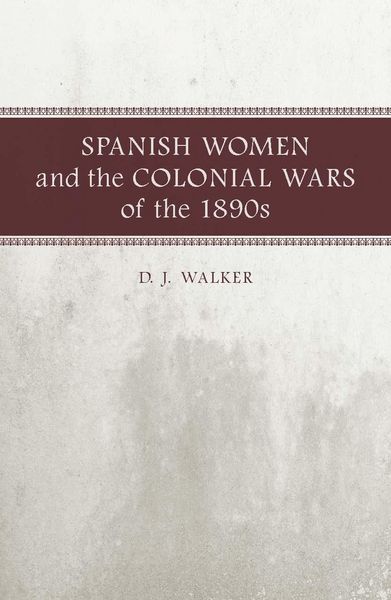
Spanish Women and the Colonial Wars of the 1890s A Writer's Life
-
- Taschenbuch
- eBook ausgewählt
-
Form:Einzelkauf Download
-
Sprache:Englisch
20,10 €
inkl. gesetzl. MwSt.Beschreibung
Produktdetails
Format
ePUB
Kopierschutz
Ja
Family Sharing
Nein
Text-to-Speech
Ja
Erscheinungsdatum
01.05.2008
Verlag
LAPA PublishersSeitenzahl
176 (Printausgabe)
Dateigröße
2249 KB
Sprache
Englisch
EAN
9780807154892
In the late 1890s a journalist wrote, "Spanish women would rather weep at a husband's or a son's gravesite than blush for lack of patriotic fervor." Yet at a time when women were expected to sacrifice their sons and husbands willingly for the sake of the nation, women organized and led three significant demonstrations against conscription in Spain. In Spanish Women and the Colonial Wars of the 1890s,D. J. Walker succeeds not only in contextualizing these demonstrations but also in elucidating what they suggested to contemporaries about the role of women in public life in late nineteenth-century Spain.
During Spain's military action against an uprising in its North African enclave of Melilla (1893) and its wars against separatists in Cuba (1868--78, 1895--98) and the Philippines (1896--98), Spaniards could pay a fee to the government to avoid being drafted -- leaving the poor to fill the military's ranks. To protest unequal conscription practices, women organized a demonstration in Zaragoza on August 1, 1896, and two smaller demonstrations followed in Chiva (Valencia) and Viso del Alcor (near Sevilla). While such demonstrations were small in number and had no effect on government policy, they received considerable attention in Spain and across the globe.
Drawing on a broad range of primary sources, including literature, memoirs, and visual representations, Walker explores what the eruption of these protests meant to the various groups that made up the political opposition in Spain. She also considers the extent to which the history of women in the 1890s yields insights into the Spanish government's efforts to muffle any calls for change that were connected either to the status of women or that of the working classes. She reviews the representation of women in connection to war and violence in the press and in other contemporary writings, as well as the perceptions of women and violence regarding the Paris Commune (still a vivid memory for a number of Spaniards in 1896) and anarchism. The appendix includes excerpts from primary sources that present often-neglected ideas and programs of dissident women, including Teresa Claramunt, Soledad Gustavo, and Angeles López de Ayala.
Affording specific insights into the formidable obstacles -- including the Catholic Church, class, and gender animosities -- that blocked change in the status and role of women in Spanish society, Spanish Women and the Colonial Wars of the 1890s delineates the beginnings of meaningful struggles against those barriers.
Noch keine Bewertungen vorhanden
Verfassen Sie die erste Bewertung zu diesem Artikel
Helfen Sie anderen Kundinnen und Kunden durch Ihre Meinung.
Kurze Frage zu unserer Seite
Vielen Dank für Ihr Feedback
Wir nutzen Ihr Feedback, um unsere Produktseiten zu verbessern. Bitte haben Sie Verständnis, dass wir Ihnen keine Rückmeldung geben können. Falls Sie Kontakt mit uns aufnehmen möchten, können Sie sich aber gerne an unseren Kund*innenservice wenden.
zum Kundenservice