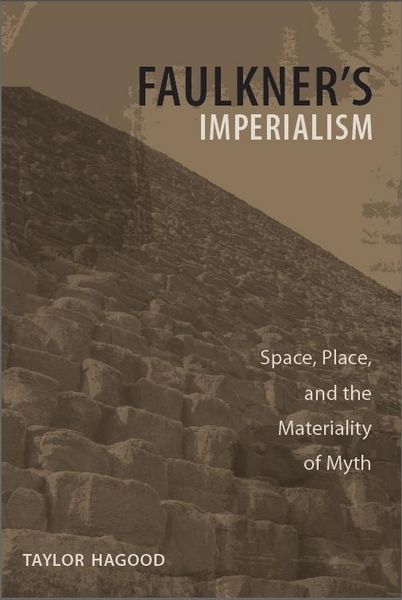
Faulkner's Imperialism Space, Place, and the Materiality of Myth
-
- Hardcover
- Taschenbuch
- eBook ausgewählt
-
Form:Einzelkauf Download
-
Sprache:Englisch
20,10 €
inkl. gesetzl. MwSt.Beschreibung
Produktdetails
Format
ePUB
Kopierschutz
Ja
Family Sharing
Nein
Text-to-Speech
Ja
Erscheinungsdatum
15.11.2008
Verlag
LAPA PublishersSeitenzahl
264 (Printausgabe)
Dateigröße
2724 KB
Sprache
Englisch
EAN
9780807148747
In Faulkner's Imperialism, Taylor Hagood explores two staples of Faulkner's world: myth and place. Using an interdisciplinary approach to examine the economic, sociological, and political factors in Faulkner's writing, he applies postcolonial theory, cultural materialism, and the work of the New Southernists to analyze the ways myth and place come together to encode narratives of imperialism -- and anti-imperialism -- in the worlds in which Faulkner lived and the one that he created. The resulting discussion highlights the deeply embedded imperial impulses underpinning not just Yoknapatawpha and Mississippi, but the Midwest, the Caribbean, France, and a host of often-overlooked corners of the Faulknerian map.
Faulkner defines space in his fiction by creating places through culturally compelling narratives. Although these narrative spaces often have imperial roots, Hagood reveals how the oppressed can subvert these "mythic places" by turning the myths against their oppressors. The Greco-Roman myths long recognized as part of Faulkner's fictional world, for example, define racially hybrid spaces ostensibly designed to articulate white patriarchal narratives of imperial control but which actually carry within their very dreams of Arcady an anti-imperial narrative. In Faulkner's Mississippi Delta, which he modeled after the Nile Delta, plantation owners evoke the imperial power of ancient Egypt to confirm their own cultural ascendancy even while African Americans use biblical narratives of the Israelites enslaved in Egypt to speak against the power that controls them. Faulkner also used places he personally experienced -- such as New Orleans, a city that he recognized as containing multiple layers of imperial design -- to dramatize the constant struggle between the oppressor and the oppressed.
Rather than reading the roles of myth and place according to conventional myth criticism or typical place models used by other Faulkner scholars, Hagood examines the intertextuality within Faulkner's writing, as well as the relationship of his writing to others' work, in an attempt to understand how the texts fit together and speak to one another. One of the few books that examine Faulkner's work as a whole, Faulkner's Imperialism moves beyond South-versus-North paradigms to encompass all the spaces within Faulkner's created cosmos, considering their interrelationships in a precise, holistic way.
Noch keine Bewertungen vorhanden
Verfassen Sie die erste Bewertung zu diesem Artikel
Helfen Sie anderen Kundinnen und Kunden durch Ihre Meinung.
Kurze Frage zu unserer Seite
Vielen Dank für Ihr Feedback
Wir nutzen Ihr Feedback, um unsere Produktseiten zu verbessern. Bitte haben Sie Verständnis, dass wir Ihnen keine Rückmeldung geben können. Falls Sie Kontakt mit uns aufnehmen möchten, können Sie sich aber gerne an unseren Kund*innenservice wenden.
zum Kundenservice