KI-Beratung Beta

Gutscheinbedingungen

**Gültig am 15.10.2026 auf Spielzeug, Schreibwaren, Filme, Geschenke & Trends, Musik, tolino eReader & Zubehör, Hörbücher und Hörbuch-Downloads, nicht preisgebundene Bücher und Kalender in der Thalia App. Einzelne Artikel können ausgeschlossen sein. Aufgrund der Buchpreisbindung sind deutschsprachige Bücher und eBooks ausgenommen. Zusätzlich ausgenommen sind Abos & Flatrates, Games, Geschenkkarten/-boxen, Shelfies, Software, Zeitschriften sowie einzelne Artikel von tonies®. Pro Einkauf einmal einlösbar. Click & Collect nur bei Onlinevorabzahlung möglich. Keine Barauszahlung. Nicht kombinierbar mit anderen Aktionen und Gutscheinen. Gutschein wird auf max. 500€ Bestellwert angerechnet. Nicht gültig für Versandkosten und Services.

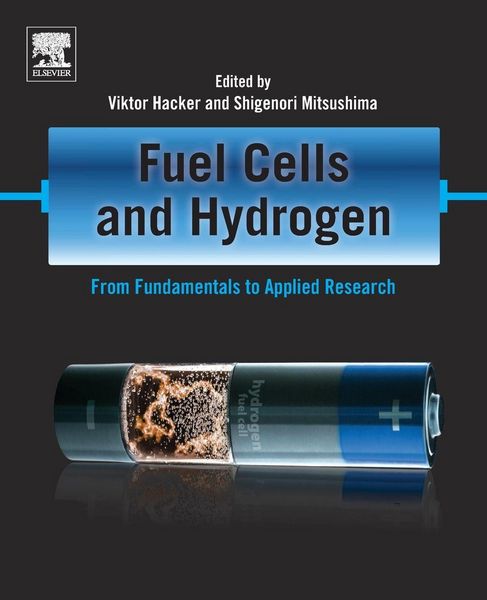
  • Produktbild: Fuel Cells and Hydrogen
  • Produktbild: Fuel Cells and Hydrogen
- 13%

Fuel Cells and Hydrogen From Fundamentals to Applied Research

13% sparen

182,99 € UVP 210,80 €

inkl. gesetzl. MwSt., Versandkostenfrei


Beschreibung

Produktdetails

Einband

Taschenbuch

Erscheinungsdatum

19.07.2018

Herausgeber

Viktor Hacker + weitere

Verlag

Elsevier Science & Technology

Seitenzahl

298

Maße (L/B/H)

23,1/19,1/2 cm

Gewicht

608 g

Sprache

Englisch

ISBN

978-0-12-811459-9

Beschreibung

Portrait

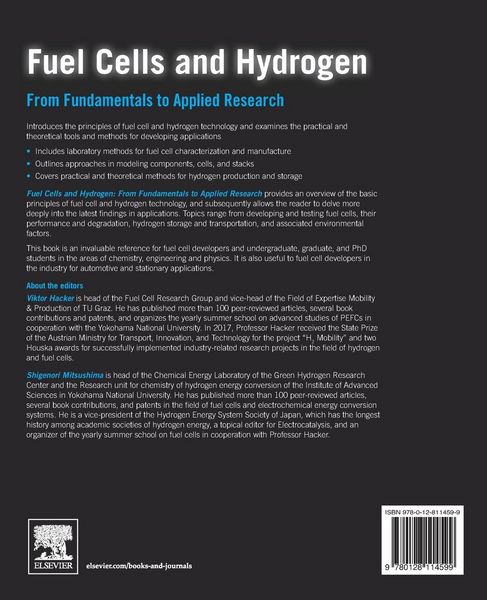
Viktor Hacker, a mechanical engineer with a habilitation in electrochemistry is leading a research group of over fifteen persons at the Institute of Chemical Engineering at TU Graz for more than 15 years. The strongly interdisciplinary research group is working in applied research of low temperature fuel cells and hydrogen production.

Hacker is organizing a yearly summer school on fuel cells in co-operation with Yokohama National University and acts as Austrian Representative in the International Energy Agency (IEA), Implementing Agreement on Advanced Fuel Cells Annex 31 and Annex 35. This book will be used in the summer schools in future.

Professor Shigenori Mitsushima is heading the Chemical Energy Laboratory of the Green Hydrogen Research Center and the Research unit for chemistry of hydrogen energy conversion of the Institute of Advanced Sciences in Yokohama National University (YNU). He received Master's degree from YNU in 1989, and he joined Hitachi, Ltd. He received Doctor in Engineering degree from YNU in 1998, when he had been in Hitachi, Ltd. During this period, he had studied and developed molten carbonate fuel cells. In 2000, he joined YNU as a research associate, and got full professor in 2011 through associate professor from 2006. He has longtime experience for research on fuel cell technology, industrial electrolysis, and hydrogen energy from material to systems as an academic and an industrial engineer. He is a director of the Electrochemical Society of Japan and Hydrogen Energy System Society of Japan, associate editor for Electrocatalysis, and an organizer of yearly summer school on fuel cells in co-operation with Prof. Hacker, Graz University of Technology. Recent research topics are materials and membrane electrolyzer system of hydrogenation of toluene with water decomposition for energy carrier synthesis, nickel based durable anode of alkaline water electrolysis to connect renewable energies, and non-precious metal oxide electrocatalyst for oxygen reduction reaction of polymer electrolyte fuel cells (PEFCs).

Produktdetails

Einband

Taschenbuch

Erscheinungsdatum

19.07.2018

Herausgeber

Verlag

Elsevier Science & Technology

Seitenzahl

298

Maße (L/B/H)

23,1/19,1/2 cm

Gewicht

608 g

Sprache

Englisch

ISBN

978-0-12-811459-9

Herstelleradresse

Libri GmbH
Europaallee 1
36244 Bad Hersfeld
DE

Email: gpsr@libri.de

Noch keine Bewertungen vorhanden

Verfassen Sie die erste Bewertung zu diesem Artikel

Helfen Sie anderen Kundinnen und Kunden durch Ihre Meinung.

Kundinnen und Kunden meinen

Bewertungen (0)

Die Leseprobe wird geladen.
  • Produktbild: Fuel Cells and Hydrogen
  • Produktbild: Fuel Cells and Hydrogen
  • 1. Introduction
    2. Irreversible losses in fuel cells
    3. Modeling of polymer electrolyte fuel cells
    4. Polymer electrolyte fuel cells
    5. Other polymer electrolyte fuel cells
    6. Preparation of MEA
    7. Degradation mechanisms and their lifetime
    8. Characterization methods for components and materials
    9. Electrochemical measurement methods and characterization on cell level
    10. Hydrogen production
    11. Hydrogen storage and transportation
    12. Environmental impact factors associated with hydrogen energy