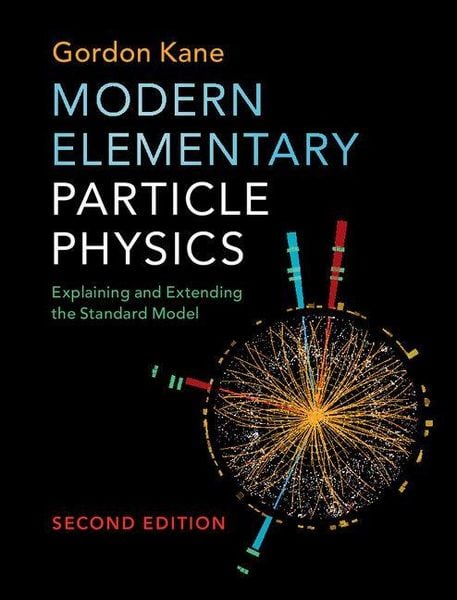
Modern Elementary Particle Physics Explaining and Extending the Standard Model
60,99 €
inkl. gesetzl. MwSt.,
Beschreibung
Produktdetails
Einband
Gebundene Ausgabe
Erscheinungsdatum
08.03.2019
Verlag
Cambridge University PressSeitenzahl
240
Maße (L/B/H)
26/20,8/1,8 cm
Gewicht
690 g
Auflage
2nd rev. ed.
Sprache
Englisch
ISBN
978-1-107-16508-3
This book is written for students and scientists wanting to learn about the Standard Model of particle physics. Only an introductory course knowledge about quantum theory is needed. The text provides a pedagogical description of the theory, and incorporates the recent Higgs boson and top quark discoveries. With its clear and engaging style, this new edition retains its essential simplicity. Long and detailed calculations are replaced by simple approximate ones. It includes introductions to accelerators, colliders, and detectors, and several main experimental tests of the Standard Model are explained. Descriptions of some well-motivated extensions of the Standard Model prepare the reader for new developments. It emphasizes the concepts of gauge theories and Higgs physics, electroweak unification and symmetry breaking, and how force strengths vary with energy, providing a solid foundation for those working in the field, and for those who simply want to learn about the Standard Model.
Kundinnen und Kunden meinen
Verfassen Sie die erste Bewertung zu diesem Artikel
Helfen Sie anderen Kund*innen durch Ihre Meinung
Kurze Frage zu unserer Seite
Vielen Dank für Ihr Feedback
Wir nutzen Ihr Feedback, um unsere Produktseiten zu verbessern. Bitte haben Sie Verständnis, dass wir Ihnen keine Rückmeldung geben können. Falls Sie Kontakt mit uns aufnehmen möchten, können Sie sich aber gerne an unseren Kund*innenservice wenden.
zum Kundenservice