KI-Beratung Beta

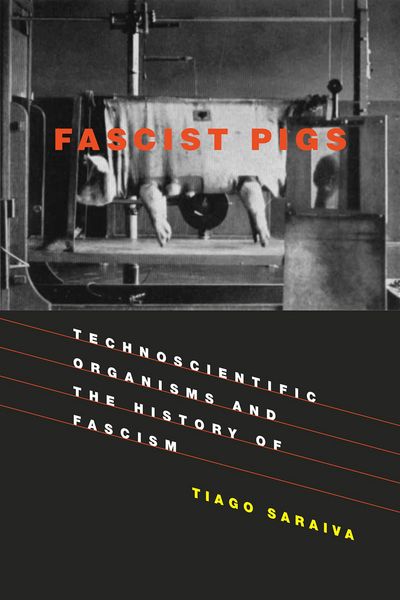
Produktbild: Fascist Pigs

Fascist Pigs Technoscientific Organisms and the History of Fascism

31,90 €

inkl. gesetzl. MwSt.

Beschreibung

How the breeding of new animals and plants was central to fascist regimes in Italy, Portugal, and Germany and to their imperial expansion.

In the fascist regimes of Mussolini's Italy, Salazar's Portugal, and Hitler's Germany, the first mass mobilizations involved wheat engineered to take advantage of...

Beschreibung

How the breeding of new animals and plants was central to fascist regimes in Italy, Portugal, and Germany and to their imperial expansion.

In the fascist regimes of Mussolini's Italy, Salazar's Portugal, and Hitler's Germany, the first mass mobilizations involved wheat engineered to take advantage of chemical fertilizers, potatoes resistant to late blight, and pigs that thrived on national produce. Food independence was an early goal of fascism; indeed, as Tiago Saraiva writes in Fascist Pigs, fascists were obsessed with projects to feed the national body from the national soil. Saraiva shows how such technoscientific organisms as specially bred wheat and pigs became important elements in the institutionalization and expansion of fascist regimes. The pigs, the potatoes, and the wheat embodied fascism. In Nazi Germany, only plants and animals conforming to the new national standards would be allowed to reproduce. Pigs that didn't efficiently convert German-grown potatoes into pork and lard were eliminated.

Saraiva describes national campaigns that intertwined the work of geneticists with new state bureaucracies; discusses fascist empires, considering forced labor on coffee, rubber, and cotton in Ethiopia, Mozambique, and Eastern Europe; and explores fascist genocides, following Karakul sheep from a laboratory in Germany to Eastern Europe, Libya, Ethiopia, and Angola.

Saraiva's highly original account—the first systematic study of the relation between science and fascism—argues that the “back to the land” aspect of fascism should be understood as a modernist experiment involving geneticists and their organisms, mass propaganda, overgrown bureaucracy, and violent colonialism.

Produktdetails

Format

ePUB

Kopierschutz

Ja

Family Sharing

Ja

Text-to-Speech

Ja

Produktdetails

Format

ePUB

Format

eBooks im ePUB-Format erlauben eine dynamische Anpassung des Inhalts an die jeweilige Display-Größe des Lesegeräts. Das Format eignet sich daher besonders für das Lesen auf mobilen Geräten, wie z.B. Ihrem tolino, Tablets oder Smartphones.

Kopierschutz

Ja

Kopierschutz

Zum Lesen dieses eBooks auf Geräten der tolino Familie sowie auf sonstigen eReadern und am PC benötigen Sie eine Adobe ID. Weitere Hinweise zum Lesen von kopiergeschützten eBooks finden Sie unter Hilfe/Downloads.

Family Sharing

Ja

Family Sharing

Mit Family Sharing können Sie eBooks innerhalb Ihrer Familie (max. sechs Mitglieder im gleichen Haushalt) teilen. Sie entscheiden selbst, welches Buch Sie mit welchem Familienmitglied teilen möchten. Auch das parallele Lesen durch verschiedene Familienmitglieder ist durch Family Sharing möglich. Um eBooks zu teilen oder geteilt zu bekommen, muss jedes Familienmitglied ein Konto bei Thalia oder einem anderen tolino-Buchhändler haben. Weitere Informationen finden Sie unter Hilfe/Family-Sharing.

Text-to-Speech

Ja

Text-to-Speech

Bedeutet Ihnen Stimme mehr als Text? Mit der Funktion Text-to-Speech können Sie sich im tolino webReader und in der aktuellen Thalia – Lesen & Hören App das eBook vorlesen lassen. Weitere Informationen finden Sie unter Hilfe/Text-to-Speech.

Erscheinungsdatum

07.10.2016

Verlag Mit Press
Seitenzahl

344 (Printausgabe)

Dateigröße

9137 KB

Sprache

Englisch

EAN

9780262335713

Barrierefreiheit
  • keine Information zur Barrierefreiheit bekannt

Noch keine Bewertungen vorhanden

Verfassen Sie die erste Bewertung zu diesem Artikel

Helfen Sie anderen Kundinnen und Kunden durch Ihre Meinung.

Kundinnen und Kunden meinen

Bewertungen (0)

Weitere Artikel finden Sie in

Die Leseprobe wird geladen.
  • Produktbild: Fascist Pigs