KI-Beratung Beta

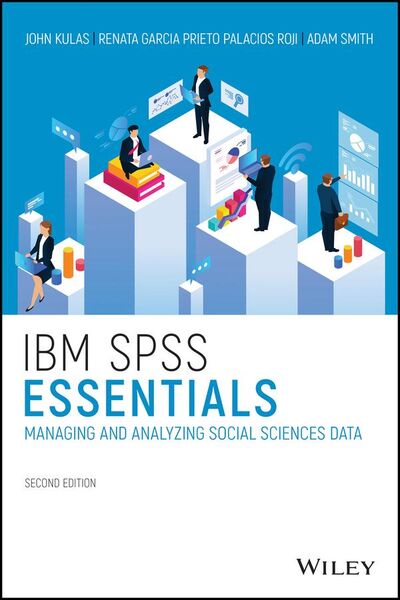
Produktbild: IBM SPSS Essentials - Managing and Analyzing Social Sciences Data, Second Edition

IBM SPSS Essentials - Managing and Analyzing Social Sciences Data, Second Edition Managing and Analyzing Social Sciences Data

77,99 €

inkl. gesetzl. MwSt., Versandkostenfrei


Beschreibung

Master the fundamentals of SPSS with this newly updated and instructive resource

The newly and thoroughly revised Second Edition of SPSS Essentials delivers a comprehensive guide for students in the social sciences who wish to learn how to use the Statistical Package for the Social Sciences (SPSS) for...

Beschreibung

Master the fundamentals of SPSS with this newly updated and instructive resource

The newly and thoroughly revised Second Edition of SPSS Essentials delivers a comprehensive guide for students in the social sciences who wish to learn how to use the Statistical Package for the Social Sciences (SPSS) for the effective collection, management, and analysis of data. The accomplished researchers and authors provide readers with the practical nuts and bolts of SPSS usage and data entry, with a particular emphasis on managing and manipulating data.

The book offers an introduction to SPSS, how to navigate it, and a discussion of how to understand the data the reader is working with. It also covers inferential statistics, including topics like hypothesis testing, one-sample Z-testing, T-testing, ANOVAs, correlations, and regression. Five unique appendices round out the text, providing readers with discussions of dealing with real-world data, troubleshooting, advanced data manipulations, and new workbook activities.

SPSS Essentials offers a wide variety of features, including:

  • A revised chapter order, designed to match the pacing and content of typical undergraduate statistics classes
  • An explanation of when particular inferential statistics are appropriate for use, given the nature of the data being worked with
  • Additional material on understanding your data sample, including discussions of SPSS output and how to find the most relevant information
  • A companion website offering additional problem sets, complete with answers

Perfect for undergraduate students of the social sciences who are just getting started with SPSS, SPSS Essentials also belongs on the bookshelves of advanced placement high school students and practitioners in social science who want to brush up on the fundamentals of this powerful and flexible software package.

Produktdetails

Einband

Taschenbuch

Erscheinungsdatum

23.03.2021

Verlag John Wiley & Sons Inc
Seitenzahl

288

Produktdetails

Einband

Taschenbuch

Erscheinungsdatum

23.03.2021

Verlag John Wiley & Sons Inc
Seitenzahl

288

Maße (L/B/H)

22,7/15,1/1,4 cm

Gewicht

478 g

Auflage

2. Auflage

Sprache

Englisch

ISBN

978-1-119-41742-2

Herstelleradresse

Libri GmbH
Europaallee 1
36244 Bad Hersfeld
DE

Email: gpsr@libri.de

Noch keine Bewertungen vorhanden

Verfassen Sie die erste Bewertung zu diesem Artikel

Helfen Sie anderen Kundinnen und Kunden durch Ihre Meinung.

Kundinnen und Kunden meinen

Bewertungen (0)

Die Leseprobe wird geladen.
  • Produktbild: IBM SPSS Essentials - Managing and Analyzing Social Sciences Data, Second Edition
  • Preface xiii

    Acknowledgments xvii

    Author Biography xix

    Part I Introduction 1

    1 What is SPSS? 3

    Chapter Learning Objectives 3

    What Is SPSS Used For 4

    The Power of SPSS 5

    SPSS Compared to Other Programs 5

    Summary 6

    Key Terms 6

    Discussion Questions 6

    2 Navigating SPSS 7

    Chapter Learning Objectives 7

    How the Program Works 7

    Important File Types 8

    Data Files 8

    Syntax Files 10

    Output Files 10

    The "Others" 11

    Managing Your SPSS Life 11

    The Importance of Maintaining the Raw Data as an "Untouched" File 12

    Summary 13

    Key Terms 13

    Discussion Questions 13

    3 Introduction to Data 15

    Chapter Learning Objectives 15

    Understanding Your Data 16

    Independent Versus Dependent Variables 16

    Scales of Measurement 16

    The SPSS Data Perspective 17

    Data Represented by Numbers (Numeric) 17

    Data Represented by Words (String) 18

    The Other Variable Types 18

    Your Data in SPSS - Think Matrices 19

    Summary 20

    Key Terms 21

    Discussion Questions 21

    4 Getting Your Data into SPSS 23

    Chapter Learning Objectives 23

    Before SPSS 24

    Specifying Operations Through SPSS 25

    Creating a Data Shell 25

    Creating Data Files Via Syntax 28

    Numeric Versus String Variables 29

    Data Entry Within the Syntax File 31

    "Saving" Populated Datafiles 33

    Having SPSS Auto-Generate Your Syntax 34

    Controlling Your "Open" Datafiles 35

    Summary 37

    Key Terms 38

    Discussion Questions 39

    References 39

    5 Accessing Your Data 41

    Chapter Learning Objectives 41

    Accessing Your Data Files 42

    Get File and Save Outfile 43

    Creating Subsets of Data 44

    Importing Data from Excel 44

    Using the Import Data Wizard 45

    The Copy-Paste "Option" (aka This Is a Terrible Idea) 47

    Summary 48

    Key Terms 48

    Discussion Questions 48

    6 Defining Your Data 49

    Chapter Learning Objectives 49

    Annotation 50

    Defining Your Dataset 51

    Adding Variable Labels 51

    Adding Value Labels 52

    Summary 54

    Key Terms 55

    Discussion Questions 55

    Part II Statistics 57

    7 Descriptive Statistics 59

    Chapter Learning Objectives 59

    Frequencies 60

    Displaying Data Graphically 62

    Location and Spread 63

    Descriptive Statistics 65

    Measures of Central Tendency and Variability 65

    A General Note on Analyses 67

    A General Note About Output Files 68

    Summary 68

    Key Terms 68

    Discussion Questions 69

    8 Hypothesis Testing 71

    Chapter Learning Objectives 71

    Descriptive Versus Inferential Statistics 72

    Hypothesis Testing (A Process for Interpreting Inferential Statistics) 72

    Six Steps of Hypothesis Testing 73

    Summary 75

    Key Terms 75

    Discussion Questions 76

    9 Z-and T-Tests 77

    Chapter Learning Objectives 77

    The One Sample Z-Test 78

    The t-Test 80

    One-Sample T-Test 80

    Two Independent Samples T-Test 84

    Two Correlated/Paired Samples T-Test 88

    Summary 93

    Key Terms 93

    Discussion Questions 94

    10 Inferential Analyses (ANOVAs) 97

    Chapter Learning Objectives 97

    One-Way ANOVA (One-Way Command) 98

    Repeated-Measures ANOVA (GLM Command) 101

    Factorial ANOVA (Unianova Command) 109

    Follow-Up Contrasts 113

    Summary 113

    Key Terms 114

    Discussion Questions 115

    Reference 116

    11 Inferential Analyses (Correlation or Regression) 117

    Chap