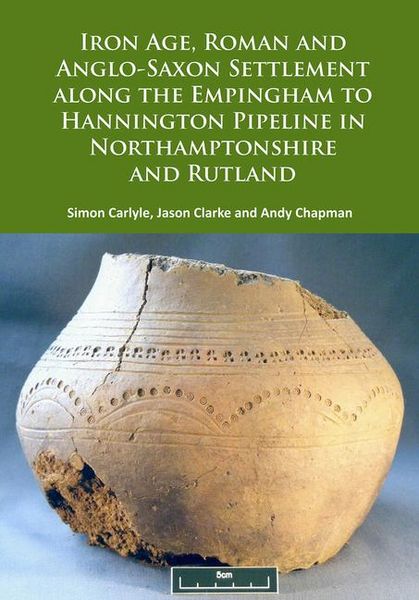
Iron Age, Roman and Anglo-Saxon Settlement along the Empingham to Hannington Pipeline in Northamptonshire and Rutland
-
- Englisch ausgewählt
41,99 €
inkl. gesetzl. MwSt.,
Beschreibung
Produktdetails
Einband
Taschenbuch
Erscheinungsdatum
10.02.2017
Abbildungen
Illustrated throughout in colour and black & white
Verlag
ArchaeopressSeitenzahl
144
Maße (L/B/H)
20,7/28,9/1,2 cm
Gewicht
552 g
Sprache
Englisch
ISBN
978-1-78491-534-6
Between January 2008 and July 2009, Northamptonshire Archaeology, now part of MOLA (Museum of London Archaeology), carried out a series of excavations along the route of a new water pipeline being constructed by Anglian Water Services as part of a major project to increase the supply of water to new homes and businesses in the south-east Midlands region. Nineteen sites were investigated, dating primarily to the Iron Age, Roman and Anglo-Saxon periods. The earliest remains were a late Bronze Age/early Iron Age pit alignment near Seaton, Rutland. The Iron Age and Roman sites were small rural settlements comprising ditched enclosures, the remains of roundhouses and pits. Settlements were located near Seaton and Caldecott in Rutland and in Northamptonshire at Swinawe Barn near Corby, Thorpe Malsor, White Hill Lodge, Great Cransley and Willows Nursery. A Roman site near Rushton, Northamptonshire may be associated with a villa estate. Other sites included part of a Roman field system at Violet Lane, near Corby, and Roman cremation burials near Gretton, Northamptonshire. The settlements mainly date from the late middle Iron Age, 2nd century BC, through to the 4th century AD, although there was little evidence for direct continuity of settlement between the Iron Age and Roman periods. An Anglo-Saxon cremation cemetery dated to the late 5th century to mid-7th century AD, at Glaston, Rutland, contained 16 cremation burials deposited in decorated and plain urns along with small assemblages of grave goods, often also burnt on the pyre, and including a brooch, glass beads, and fragments of a bone comb and mount. Later features generally comprised medieval and post-medieval furrows from ridge and furrow field systems and field boundary ditches.
Noch keine Bewertungen vorhanden
Verfassen Sie die erste Bewertung zu diesem Artikel
Helfen Sie anderen Kundinnen und Kunden durch Ihre Meinung.
Kurze Frage zu unserer Seite
Vielen Dank für Ihr Feedback
Wir nutzen Ihr Feedback, um unsere Produktseiten zu verbessern. Bitte haben Sie Verständnis, dass wir Ihnen keine Rückmeldung geben können. Falls Sie Kontakt mit uns aufnehmen möchten, können Sie sich aber gerne an unseren Kund*innenservice wenden.
zum Kundenservice