KI-Beratung Beta

Gutscheinbedingungen

**Gültig am 27.11.2026 auf Spielzeug, Schreibwaren, Filme, Geschenke & Trends, Musik, tolino eReader & Zubehör, Hörbücher und Hörbuch-Downloads, nicht preisgebundene Bücher und Kalender online auf thalia.at und in der Thalia App. Einzelne Artikel können ausgeschlossen sein. Aufgrund der Buchpreisbindung sind deutschsprachige Bücher und eBooks ausgenommen. Zusätzlich ausgenommen sind Abos & Flatrates, Games, Geschenkkarten/-boxen, Shelfies, Software, Zeitschriften sowie einzelne Artikel von tonies®. Pro Einkauf einmal einlösbar. Click & Collect nur bei Onlinevorabzahlung möglich. Keine Barauszahlung. Nicht kombinierbar mit anderen Aktionen und Gutscheinen. Gutschein wird auf max. 500€ Bestellwert angerechnet. Nicht gültig für Versandkosten und Services.

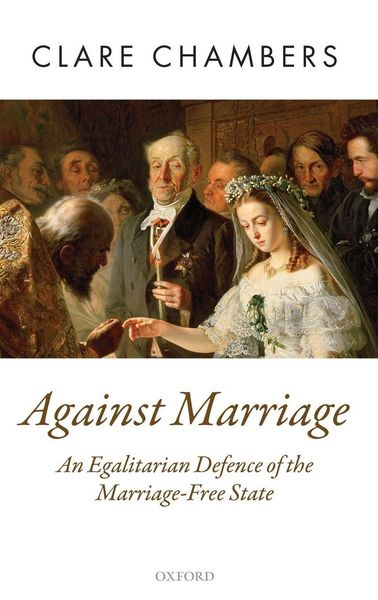
Produktbild: AGAINST MARRIAGE OPT C

AGAINST MARRIAGE OPT C

62,99 €

inkl. gesetzl. MwSt., Versandkostenfrei


Beschreibung

Against Marriage is a radical argument for the abolition of state-recognised marriage. Clare Chambers argues that state-recognised marriage violates both equality and liberty, even when expanded to include same-sex couples. Instead Chambers proposes the marriage-free state: an egalitarian state in which...

Beschreibung

Against Marriage is a radical argument for the abolition of state-recognised marriage. Clare Chambers argues that state-recognised marriage violates both equality and liberty, even when expanded to include same-sex couples. Instead Chambers proposes the marriage-free state: an egalitarian state in which religious or secular marriages are permitted but have no legal status.
Part I makes the case against marriage. Chambers investigates the critique of marriage that has developed within feminist and liberal theory. Feminists have long argued that marriage is a violation of equality since it is both sexist and heterosexist. Chambers endorses the feminist view and argues, in contrast to recent egalitarian pro-marriage movements, that same-sex marriage is not enough to make marriage equal. Chambers argues that state-recognised marriage is also problematic for liberalism, particularly political liberalism, since it imposes a controversial, hierarchical conception of the family that excludes many adults and children.
Part II sets out the case for the marriage-free state. Chambers critically assesses recent theories that attempt to make marriage egalitarian, either by replacing it with relationship contracts or by replacing it with alternative statuses such as civil union. She then sets out a new model for the legal regulation of personal relationships. In the marriage-free state regulation is based on relationship practices not relationship status, and these practices are regulated separately rather than as a bundle. The marriage-free state thus employs piecemeal, practice-based regulation. Finally, Chambers considers how the marriage-free state should respond to unequal religious marriage. The result is an inspiring egalitarian approach that fits the diversity of real relationships.

Rezension

The book is interesting and accessible, and at the cutting edge of scholarly work about alternatives to marriage. Adrian Thatcher, Marriage, Families & Spirituality

Produktdetails

Einband

Gebundene Ausgabe

Erscheinungsdatum

27.07.2017

Verlag Oxford University Press
Seitenzahl

240

Produktdetails

Einband

Gebundene Ausgabe

Erscheinungsdatum

27.07.2017

Verlag Oxford University Press
Seitenzahl

240

Maße (L/B/H)

24/16,1/1,8 cm

Gewicht

478 g

Sprache

Englisch

ISBN

978-0-19-874400-9

Herstelleradresse

Libri GmbH
Europaallee 1
36244 Bad Hersfeld
DE

Email: gpsr@libri.de

Noch keine Bewertungen vorhanden

Verfassen Sie die erste Bewertung zu diesem Artikel

Helfen Sie anderen Kundinnen und Kunden durch Ihre Meinung.

Kundinnen und Kunden meinen

Bewertungen (0)

Die Leseprobe wird geladen.
  • Produktbild: AGAINST MARRIAGE OPT C
    • Introduction
    • Part One: Against Marriage
    • 1: Marriage as a Violation of Equality
    • 2: Marriage as a Violation of Liberty
    • 3: A Liberal Defence of Marriage?
    • Part Two: The Marriage-Free State
    • 4: The Limitations of Contract
    • 5: Regulating Relationships in the Marriage-Free State
    • 6: Marriage in the Marriage-Free State
    • Conclusion