KI-Beratung Beta

Gutscheinbedingungen

**Gültig bis 11.11.2026 auf Spielzeug, Schreibwaren, Filme, Geschenke & Trends, Musik, tolino eReader & Zubehör, Hörbücher und Hörbuch-Downloads, nicht preisgebundene Bücher und Kalender online auf thalia.at und in der Thalia App. Einzelne Artikel können ausgeschlossen sein. Aufgrund der Buchpreisbindung sind deutschsprachige Bücher und eBooks ausgenommen. Zusätzlich ausgenommen sind Abos & Flatrates, Games, Geschenkkarten/-boxen, Shelfies, Software, Zeitschriften sowie einzelne Artikel von tonies®. Pro Einkauf einmal einlösbar. Click & Collect nur bei Onlinevorabzahlung möglich. Keine Barauszahlung. Nicht kombinierbar mit anderen Aktionen und Gutscheinen. Gutschein wird auf max. 500€ Bestellwert angerechnet. Nicht gültig für Versandkosten und Services.

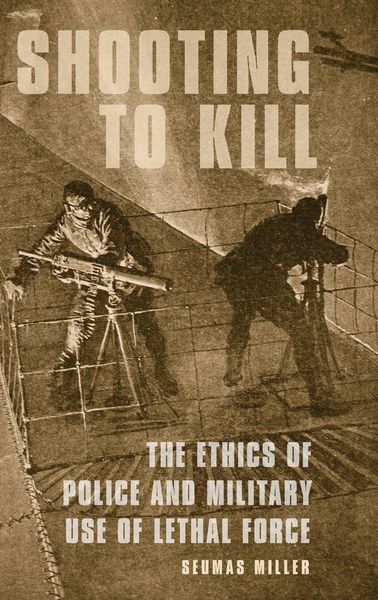
  • Produktbild: Shooting to Kill
  • Produktbild: Shooting to Kill

Shooting to Kill

267,99 €

inkl. gesetzl. MwSt., Versandkostenfrei


Beschreibung

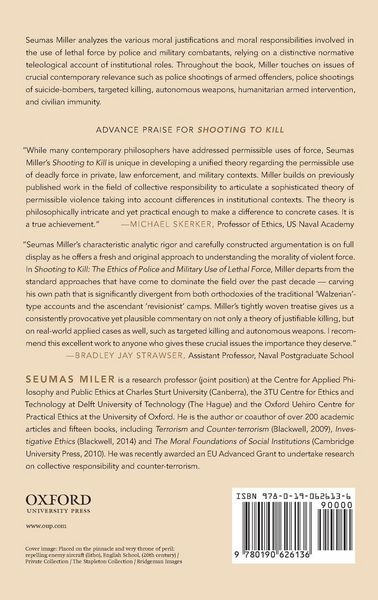
Terrorism, the use of military force in Afghanistan, Iraq and Syria, and the fatal police shootings of unarmed persons have all contributed to renewed interest in the ethics of police and military use of lethal force and its moral justification. In this book, philosopher Seumas Miller analyzes the various...

Beschreibung

Terrorism, the use of military force in Afghanistan, Iraq and Syria, and the fatal police shootings of unarmed persons have all contributed to renewed interest in the ethics of police and military use of lethal force and its moral justification.
In this book, philosopher Seumas Miller analyzes the various moral justifications and moral responsibilities involved in the use of lethal force by police and military combatants, relying on a distinctive normative teleological account of institutional roles. His conception constitutes a novel alternative to prevailing reductive individualist and collectivist accounts. As Miller argues, police and military uses of lethal force are morally justified in part by recourse to fundamental natural moral rights and obligations, especially the right to personal self-defense and the moral obligation to defend the lives of innocent others. Yet the moral justification for police and military use of lethal force is to some extent role-specific. Both police officers and military combatants evidently have an institutionally-based moral duty to put themselves in harm's way to protect others. Under some circumstances, however, police have an institutionally based moral duty to use lethal force to uphold the law; and military combatants have an institutionally based moral duty to use lethal force to win wars. Two key notions in play are joint action and the natural right to self-defense. Miller uses a relational individualist theory of joint actions to construct the notion of multi-layered structures of joint action in order to explicate organizational action. He also provides a novel theory of justifiable killing in self-defense. Over the course of his book, Miller covers a variety of urgent topics, such as police shootings of armed offenders, police shooting of suicide-bombers, targeted killing, autonomous weapons, humanitarian armed intervention, and civilian immunity.

Produktdetails

Einband

Gebundene Ausgabe

Erscheinungsdatum

10.10.2013

Verlag Oxford Academic
Seitenzahl

308

Produktdetails

Einband

Gebundene Ausgabe

Erscheinungsdatum

10.10.2013

Verlag Oxford Academic
Seitenzahl

308

Maße (L/B/H)

24/16,1/2,1 cm

Gewicht

628 g

Sprache

Englisch

ISBN

978-0-19-062613-6

Herstelleradresse

Libri GmbH
Europaallee 1
36244 Bad Hersfeld
DE

Email: gpsr@libri.de

Noch keine Bewertungen vorhanden

Verfassen Sie die erste Bewertung zu diesem Artikel

Helfen Sie anderen Kundinnen und Kunden durch Ihre Meinung.

Kundinnen und Kunden meinen

Bewertungen (0)

Die Leseprobe wird geladen.
  • Produktbild: Shooting to Kill
  • Produktbild: Shooting to Kill
    • Introduction

    • Chapter 1 Morally Permissible Use of Lethal Force: A Taxonomy

    • Chapter 2 Killing in Self-Defence

    • Chapter 3 Police Officers, Regular Soldiers and Normative Institutional Analysis

    • Chapter 4 Police Use of Lethal Force

    • Chapter 5 Police Use of Lethal Force and Suicide Bombers

    • Chapter 6 Military Use of Lethal Force

    • Chapter 7 Civilian Immunity

    • Chapter 8 Humanitarian Armed Intervention

    • Chapter 9 Targeted Killing

    • Chapter 10 Autonomous Weapons and Moral Responsibility

    • Conclusion