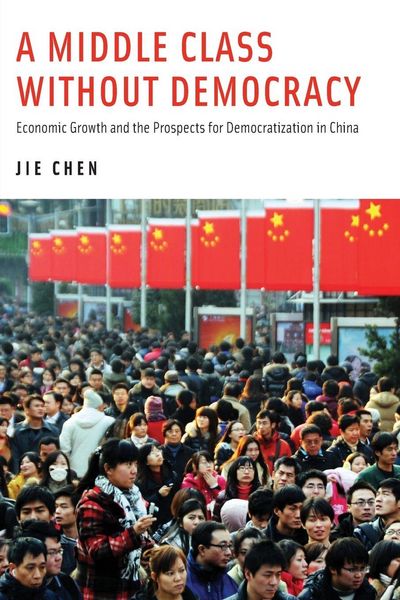
A Middle Class Without Democracy Economic Growth and the Prospects for Democratization in China
-
- Hardcover
- Taschenbuch ausgewählt
- eBook
-
Sprache:Englisch
59,99 €
inkl. gesetzl. MwSt.,
Beschreibung
Produktdetails
Einband
Taschenbuch
Erscheinungsdatum
01.09.2014
Abbildungen
2 figures and 26 tables
Verlag
Oxford University PressSeitenzahl
240
Maße (L/B/H)
23,4/15,6/1,4 cm
Gewicht
415 g
Sprache
Englisch
ISBN
978-0-19-938561-4
What kind of role can the middle class play in potential democratization in such an undemocratic, late developing country as China? To answer this profound political as well as theoretical question, Jie Chen explores attitudinal and behavioral orientation of China's new middle class to democracy and democratization. Chen's work is based on a unique set of data collected from a probability-sample survey and in-depth interviews of residents in three major Chinese cities, Beijing, Chengdu and Xi'an--each of which represents a distinct level of economic development in urban China-in 2007 and 2008. The empirical findings derived from this data set confirm that (1) compared to other social classes, particularly lower classes, the new Chinese middle class-especially those employed in the state apparatus-tends to be more supportive of the current Party-state but less supportive of democratic values and institutions; (2) the new middle class's attitudes toward democracy may be accounted for by this class's close ideational and institutional ties with the state, and its perceived socioeconomic wellbeing, among other factors; (3) the lack of support for democracy among the middle class tends to cause this social class to act in favor of the current state but in opposition to democratic changes.
The most important political implication is that while China's middle class is not likely to serve as the harbinger of democracy now, its current attitudes toward democracy may change in the future. Such a crucial shift in the middle class's orientation toward democracy can take place, especially when its dependence on the Party-state decreases and perception of its own social and economic statuses turns pessimistic. The key theoretical implication from the findings suggests that the attitudinal and behavioral orientations of the middle class-as a whole and as a part-toward democratic change in late developing countries are contingent upon its with the incumbent state and its perceived social/economic wellbeing, and the middle class's support for democracy in these countries is far from inevitable.
Noch keine Bewertungen vorhanden
Verfassen Sie die erste Bewertung zu diesem Artikel
Helfen Sie anderen Kundinnen und Kunden durch Ihre Meinung.
Kurze Frage zu unserer Seite
Vielen Dank für Ihr Feedback
Wir nutzen Ihr Feedback, um unsere Produktseiten zu verbessern. Bitte haben Sie Verständnis, dass wir Ihnen keine Rückmeldung geben können. Falls Sie Kontakt mit uns aufnehmen möchten, können Sie sich aber gerne an unseren Kund*innenservice wenden.
zum Kundenservice