
Gutscheinbedingungen

**Gültig bis 15.06.2026 auf Spiele & Spielzeug online auf thalia.at, in der Thalia App ab einem Mindestbestellwert von 30€ und in allen Thalia Buchhandlungen in Österreich. In den Buchhandlungen nur gültig auf lagernde Ware. Einzelne Artikel können ausgeschlossen sein. Ausgenommen sind preisgebundene Artikel sowie online auf thalia.at und in der Thalia App einzelne Artikel von tonies®. Pro Einkauf einmal einlösbar. Nur gültig gegen Vorlage oder im Onlineshop hinterlegter Bonuscard. Infos zur Einlösung in der Buchhandlung sind auf der Bonuscard-Vorteilspreisseite zu finden. Click & Collect nur bei Onlinevorabzahlung möglich. Keine Einlösung bei Scan & Go-Bezahlung. Keine Barauszahlung. Nicht kombinierbar mit anderen Aktionen und Gutscheinen. Gutschein wird auf max. 500€ Bestellwert angerechnet. Nicht gültig für Geschenkkarten, Versandkosten und Services.

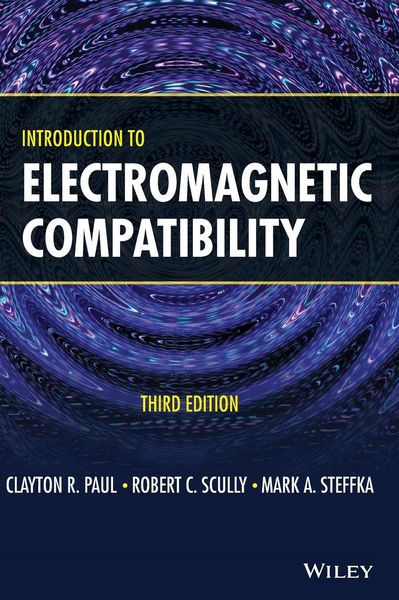
  • Produktbild: Introduction to Electromagnetic Compatibility
  • Produktbild: Introduction to Electromagnetic Compatibility
Band 1

Introduction to Electromagnetic Compatibility

143,99 €

inkl. gesetzl. MwSt., Versandkostenfrei


Beschreibung

Produktdetails

Einband

Gebundene Ausgabe

Erscheinungsdatum

07.11.2022

Verlag

John Wiley & Sons

Seitenzahl

848

Maße (L/B/H)

25,9/18,3/4 cm

Gewicht

1293 g

Auflage

3. Auflage

Sprache

Englisch

ISBN

978-1-119-40434-7

Beschreibung

Produktdetails

Einband

Gebundene Ausgabe

Erscheinungsdatum

07.11.2022

Verlag

John Wiley & Sons

Seitenzahl

848

Maße (L/B/H)

25,9/18,3/4 cm

Gewicht

1293 g

Auflage

3. Auflage

Sprache

Englisch

ISBN

978-1-119-40434-7

Herstelleradresse

Libri GmbH
Europaallee 1
36244 Bad Hersfeld
DE

Email: gpsr@libri.de

Kundinnen und Kunden meinen

0 Bewertungen

Informationen zu Bewertungen

Zur Abgabe einer Bewertung ist eine Anmeldung im Konto notwendig. Die Authentizität der Bewertungen wird von uns nicht überprüft. Wir behalten uns vor, Bewertungstexte, die unseren Richtlinien widersprechen, entsprechend zu kürzen oder zu löschen.

Die Bewertungen sind nach Format, Anzahl Sterne und Datum sortiert.

Verfassen Sie die erste Bewertung zu diesem Artikel

Helfen Sie anderen Kund*innen durch Ihre Meinung

Kundinnen und Kunden meinen

0 Bewertungen filtern

Die Leseprobe wird geladen.
  • Produktbild: Introduction to Electromagnetic Compatibility
  • Produktbild: Introduction to Electromagnetic Compatibility
  • Preface xiii

    1 Introduction to Electromagnetic Compatibility (EMC) 1

    1.1 Aspects of EMC 2

    1.2 Electrical Dimensions and Waves 9

    1.3 Decibels and Common EMC Units 16

    1.4 Summary 30

    2 EMC Requirements for Electronic Systems 35

    2.1 Governmental Requirements 36

    2.2 Additional Product Requirements 62

    2.3 Design Constraints for Products 63

    2.4 Advantages of EMC Design 64

    3 Signal Spectra--the Relationship between the Time Domain and the Frequency Domain 71

    3.1 Periodic Signals 71

    3.2 Spectra of Digital Waveforms 93

    3.3 Spectrum Analyzers 113

    3.4 Representation of Nonperiodic Waveforms 118

    3.5 Representation of Random (Data) Signals 121

    4 Transmission Lines and Signal Integrity 133

    4.1 The Transmission-Line Equations 136

    4.2 The Per-Unit-Length Parameters 139

    4.3 The Time-Domain Solution 155

    4.4 High-Speed Digital Interconnects and Signal Integrity 170

    4.5 Sinusoidal Excitation of the Line and the Phasor Solution 192

    4.6 Lumped-Circuit Approximate Models 210

    5 Nonideal Behavior of Components 221

    5.1 Wires 222

    5.2 Printed Circuit Board (PCB) Lands 232

    5.3 Effect of Component Leads 235

    5.4 Resistors 237

    5.5 Capacitors 243

    5.6 Inductors 251

    5.7 Ferromagnetic Materials--Saturation and Frequency Response 255

    5.8 Ferrite Beads 258

    5.9 Common-Mode Chokes 261

    5.10 Electromechanical Devices 264

    5.11 Digital Circuit Devices 269

    5.12 Effect of Component Variability 270

    5.13 Mechanical Switches 270

    6 Conducted Emissions and Susceptibility 287

    6.1 Measurement of Conducted Emissions 288

    6.2 Power Supply Filters 294

    6.3 Power Supplies 310

    6.4 Power Supply and Filter Placement 319

    6.5 Conducted Susceptibility 321

    7 Antennas 325

    7.1 Elemental Dipole Antennas 325

    7.2 The Half-Wave Dipole and Quarter-Wave Monopole Antennas 332

    7.3 Antenna Arrays 342

    7.4 Characterization of Antennas 349

    7.5 The FRIIs Transmission Equation 365

    7.6 Effects of Reflections 368

    7.7 Broadband Measurement Antennas 381

    7.8 Antenna Modeling and Simulation 388

    8 Radiated Emissions and Susceptibility 397

    8.1 Simple Emission Models for Wires and PCB Lands 398

    8.2 Simple Susceptibility Models for Wires and PCB Lands 423

    9 Crosstalk 445

    9.1 Three-Conductor Transmission Lines and Crosstalk 446

    9.2 The Transmission-Line Equations for Lossless Lines 449

    9.3 The Per-Unit-Length Parameters 452

    9.4 The Inductive--Capacitive Coupling Approximate Model 476

    9.5 Shielded Wires 500

    9.6 Twisted Wires 529

    10 Shielding 557

    10.1 Shielding Effectiveness 561

    10.2 Shielding Effectiveness: Far-Field Sources 563

    10.3 Shielding Effectiveness: Near-Field Sources 576

    10.4 Low-Frequency, Magnetic Field Shielding 581

    10.5 Effects of Apertures 585

    11 System Design for EMC 593

    11.1 Changing the Way we Think About Electrical Phenomena 597

    11.2 What do we Mean by the Term "Ground" 605

    11.3 Printed Circuit Board (PCB) Design 636

    11.4 System Configuration and Design 655

    11.5 Diagnostic Tools 672

    Appendix A The Phasor Solution Method 683

    A.1 Solving Differential Equations for their Sinusoidal, Steady-State Solution 683

    A.2 Solving Electric Circuits for Their Sinusoidal, Steady-State Response 687

    Appendix B The Electromagnetic Field Equations and Waves 693

    B.1 Vector Analysis 694

    B.2 Maxwell's Equations 701

    B.3 Boundary Conditions 720

    B.4 Sinusoidal Steady State 724

    B.5 Power Flow 725

    B.6 Uniform Plane Waves 726

    B.7 Static (DC) Electromagnetic Field Relations--a Special Case 741

    Appendix C Computer Codes for Calculating the Per-Unit-Length (PUL) Parameters and Crosstalk of Multiconductor Transmission Lines 753

    C.1 WIDESEP.FOR for Computing the PUL Parameter Matrices of Widely Spaced Wires 754

    C.2 RIBBON.FOR for Computing the PUL Parameter Matrices of Ribbon Cables 758

    C.3 PCB.FOR for Computing The PUL Parameter Matrices of Printed Circuit Boards 760

    C.4 MSTRP.FOR for Computing the PUL Parameter Matrices of Coupled Microstrip Lines 761

    C.5 STRPLINE.FOR for Computing the PUL Parameter Matrices of Coupled Striplines 762

    Appendix D A Spice (PSPICE, LTSPICE, etc.) Tutorial and Applications Guide 765

    D.1 Creating a Spice or Pspice Simulation 766

    D.2 Creating an Ltspice Simulation 777

    D.3 Lumped-Circuit Approximate Models 785

    D.4 An Exact Spice (Pspice) Model for Lossless, Coupled Lines 788

    D.5 Use of Spice (Pspice) in Fourier Analysis 805

    D.6 Spicemtl.For for Computing a Spice (Pspice) Subcircuit Model of a Lossless, Multiconductor Transmission Line 815

    D.7 Spicelpi.For for Computing a Spice (Pspice) Subcircuit of a Lumped-Pi Model of a Lossless, Multiconductor Transmission Line 817

    Problems 818

    References 820

    Appendix E A Brief History of Electromagnetic Compatibility 823

    E.1 History of EMC 823

    E.2 Examples 825

    Index 827