KI-Beratung Beta

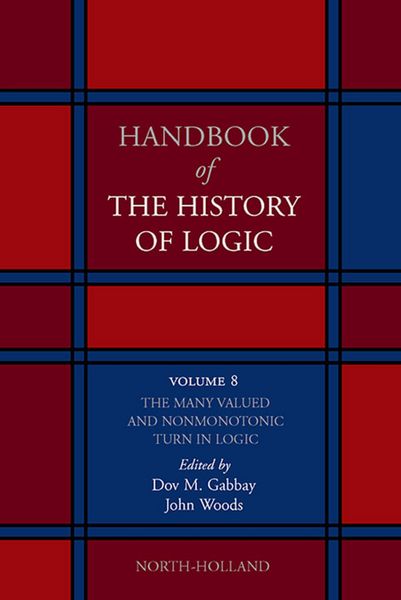
Produktbild: The Many Valued and Nonmonotonic Turn in Logic

The Many Valued and Nonmonotonic Turn in Logic

220,00 €

inkl. gesetzl. MwSt.

Beschreibung

The present volume of the Handbook of the History of Logic brings together two of the most important developments in 20th century non-classical logic. These are many-valuedness and non-monotonicity. On the one approach, in deference to vagueness, temporal or quantum indeterminacy or reference-failure,...

Beschreibung

The present volume of the Handbook of the History of Logic brings together two of the most important developments in 20th century non-classical logic. These are many-valuedness and non-monotonicity. On the one approach, in deference to vagueness, temporal or quantum indeterminacy or reference-failure, sentences that are classically non-bivalent are allowed as inputs and outputs to consequence relations. Many-valued, dialetheic, fuzzy and quantum logics are, among other things, principled attempts to regulate the flow-through of sentences that are neither true nor false. On the second, or non-monotonic, approach, constraints are placed on inputs (and sometimes on outputs) of a classical consequence relation, with a view to producing a notion of consequence that serves in a more realistic way the requirements of real-life inference. Many-valued logics produce an interesting problem. Non-bivalent inputs produce classically valid consequence statements, for any choice of outputs. A major task of many-valued logics of all stripes is to fashion an appropriately non-classical relation of consequence.The chief preoccupation of non-monotonic (and default) logicians is how to constrain inputs and outputs of the consequence relation. In what is called "left non-monotonicity, it is forbidden to add new sentences to the inputs of true consequence-statements. The restriction takes notice of the fact that new information will sometimes override an antecedently (and reasonably) derived consequence. In what is called "right non-monotonicity, limitations are imposed on outputs of the consequence relation. Most notably, perhaps, is the requirement that the rule of or-introduction not be given free sway on outputs. Also prominent is the effort of paraconsistent logicians, both preservationist and dialetheic, to limit the outputs of inconsistent inputs, which in classical contexts are wholly unconstrained.In some instances, our two themes coincide. Dialetheic logics are a case in point. Dialetheic logics allow certain selected sentences to have, as a third truth value, the classical values of truth and falsity together. So such logics also admit classically inconsistent inputs. A central task is to construct a right non-monotonic consequence relation that allows for these many-valued, and inconsistent, inputs.The Many Valued and Non-Monotonic Turn in Logic is an indispensable research tool for anyone interested in the development of logic, including researchers, graduate and senior undergraduate students in logic, history of logic, mathematics, history of mathematics, computer science, AI, linguistics, cognitive science, argumentation theory, and the history of ideas.
- Detailed and comprehensive chapters covering the entire range of modal logic.
- Contains the latest scholarly discoveries and interprative insights that answers many questions in the field of logic.

Produktdetails

Format

ePUB

Kopierschutz

Nein

Family Sharing

Nein

Text-to-Speech

Ja

Produktdetails

Format

ePUB

Format

eBooks im ePUB-Format erlauben eine dynamische Anpassung des Inhalts an die jeweilige Display-Größe des Lesegeräts. Das Format eignet sich daher besonders für das Lesen auf mobilen Geräten, wie z.B. Ihrem tolino, Tablets oder Smartphones.

Kopierschutz

Nein

Kopierschutz

Dieses eBook können Sie uneingeschränkt auf allen Geräten der tolino Familie, allen sonstigen eReadern und am PC lesen. Das eBook ist nicht kopiergeschützt und kann ein personalisiertes Wasserzeichen enthalten. Weitere Hinweise zum Lesen von eBooks mit einem personalisierten Wasserzeichen finden Sie unter Hilfe/Downloads.

Family Sharing

Nein

Family Sharing

Mit Family Sharing können Sie eBooks innerhalb Ihrer Familie (max. sechs Mitglieder im gleichen Haushalt) teilen. Sie entscheiden selbst, welches Buch Sie mit welchem Familienmitglied teilen möchten. Auch das parallele Lesen durch verschiedene Familienmitglieder ist durch Family Sharing möglich. Um eBooks zu teilen oder geteilt zu bekommen, muss jedes Familienmitglied ein Konto bei Thalia oder einem anderen tolino-Buchhändler haben. Weitere Informationen finden Sie unter Hilfe/Family-Sharing.

Text-to-Speech

Ja

Text-to-Speech

Bedeutet Ihnen Stimme mehr als Text? Mit der Funktion Text-to-Speech können Sie sich im tolino webReader und in der aktuellen Thalia – Lesen & Hören App das eBook vorlesen lassen. Weitere Informationen finden Sie unter Hilfe/Text-to-Speech.

Erscheinungsdatum

13.08.2007

Herausgeber
Verlag Elsevier Science & Techn.
Seitenzahl

690 (Printausgabe)

Sprache

Englisch

EAN

9780080549392

Barrierefreiheit
  • keine Information zur Barrierefreiheit bekannt

Noch keine Bewertungen vorhanden

Verfassen Sie die erste Bewertung zu diesem Artikel

Helfen Sie anderen Kundinnen und Kunden durch Ihre Meinung.

Kundinnen und Kunden meinen

Bewertungen (0)

Weitere Artikel finden Sie in

Die Leseprobe wird geladen.
  • Produktbild: The Many Valued and Nonmonotonic Turn in Logic