KI-Beratung Beta

Gutscheinbedingungen

**Gültig am 25.11.2026 auf fremdsprachige Bücher online auf thalia.at und in der Thalia App. Einzelne Artikel können ausgeschlossen sein. Ausgenommen sind preisgebundene Artikel & eBooks. Pro Einkauf einmal einlösbar. Click & Collect nur bei Onlinevorabzahlung möglich. Keine Barauszahlung. Nicht kombinierbar mit anderen Aktionen und Gutscheinen. Gutschein wird auf max. 500€ Bestellwert angerechnet. Nicht gültig für Geschenkkarten, Versandkosten und Services.

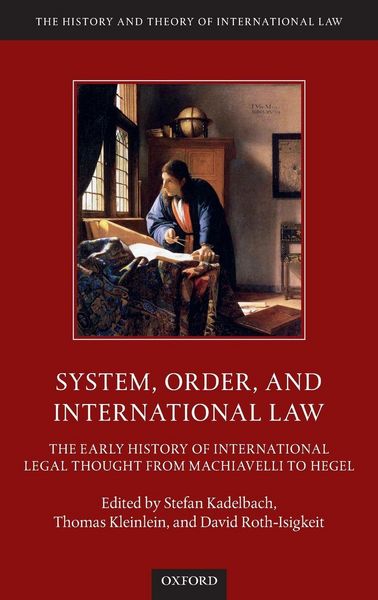
  • Produktbild: SYSTEM,ORDER & INTERNATIONAL LAW HTIL C
  • Produktbild: SYSTEM,ORDER & INTERNATIONAL LAW HTIL C

SYSTEM,ORDER & INTERNATIONAL LAW HTIL C

114,99 €

inkl. gesetzl. MwSt., Versandkostenfrei


Beschreibung

For many centuries, thinkers have tried to understand and to conceptualize political and legal order beyond the boundaries of sovereign territories. Their concepts, deeply entangled with ideas of theology, state formation, and human nature, form the bedrock of todays theoretical discourses on international...

Beschreibung

For many centuries, thinkers have tried to understand and to conceptualize political and legal order beyond the boundaries of sovereign territories. Their concepts, deeply entangled with ideas of theology, state formation, and human nature, form the bedrock of todays theoretical discourses on international law. This volume engages with models of early international legal thought from Machiavelli to Hegel before international law in the modern sense became an academic discipline of its own. The interplay of system and order serves as a leitmotiv throughout the book, helping to link historical models to contemporary discourse.
Part I of the book covers a diverse collection of thinkers in order to scrutinize and contextualize their respective models of the international realm in light of general legal and political philosophy. Part II maps the historical development of international legal thought more generally by distilling common themes and ideas, such as the relationship between universality and particularity, the role of the state, the influence of power and economic interests on the law, and the contingencies of time, space and technical opportunities.
In the current political climate, where it appears that the reinvigorated concept of the nation state as an ordering force competes with internationalist thinking, the problems at issue in the classic theories point to contemporary questions: is an international system without central power possible? How can a normative order come about if there is no central force to order relations between states? These essays show that uncovering the history of international law can offer ways in which to envisage its future.

Rezension

System, Order, and International Law is an ambitious and engaging edited volume at the crossroads of multiple disciplines. Its wide-ranging coverage of authors and topics will speak to scholars of international law, international relations, political theory, and the history of political thought. As a work on the history of international law, it is particularly noteworthy for covering the thoughts of those who are seldom considered part of the international law canon. Claire Vergerio, Journal of the History of International Law

Produktdetails

Einband

Gebundene Ausgabe

Erscheinungsdatum

13.04.2017

Herausgeber Stefan Kadelbach + weitere
Verlag Oxford University Press

Produktdetails

Einband

Gebundene Ausgabe

Erscheinungsdatum

13.04.2017

Herausgeber
Verlag Oxford University Press
Seitenzahl

546

Maße (L/B/H)

24/16,1/3,4 cm

Gewicht

928 g

Sprache

Englisch

ISBN

978-0-19-876858-6

Herstelleradresse

Libri GmbH
Europaallee 1
36244 Bad Hersfeld
DE

Email: gpsr@libri.de

Noch keine Bewertungen vorhanden

Verfassen Sie die erste Bewertung zu diesem Artikel

Helfen Sie anderen Kundinnen und Kunden durch Ihre Meinung.

Kundinnen und Kunden meinen

Bewertungen (0)

Die Leseprobe wird geladen.
  • Produktbild: SYSTEM,ORDER & INTERNATIONAL LAW HTIL C
  • Produktbild: SYSTEM,ORDER & INTERNATIONAL LAW HTIL C
    • Introduction
    • Part I Authors
    • 1: David Roth-Isigkeit: Niccolò Machiavelli's International Legal Thought: Culture, Contingency, and Construction
    • 2: Kirstin Bunge: Francisco de Vitoria: A Redesign of Global Order on the Threshold of the Middle Ages to Modern Times
    • 3: Tobias Schaffner: Francisco Suárez S. J. on the End of Peaceful Order among States and Systematic Doctrinal Scholarship
    • 4: Merio Scattola: Jean Bodin on International Law
    • 5: Andreas Wagner: Alberico Gentili: Sovereignty, Natural Law, and the System of Roman Civil Law
    • 6: Thomas Hüglin: Althusius: Back to the Future
    • 7: Stefan Kadelbach: Hugo Grotius on the Conquest of Utopia by Systematic Reasoning
    • 8: Jonas Heller: Orders in disorder: The Question of a Sovereign State of Nature in Hobbes and Rousseau
    • 9: Tilman Altwicker: The International Legal Argument in Spinoza
    • 10: Vanda Fiorillo: States as Ethico-Political Subjects of International Law: The Relationship between Theory and Practice in the International Politics of Samuel Pufendorf
    • 11: Thomas Kleinlein: Christian Wolff: System as an Episode?
    • 12: Christian Volk: The Law of the Nations as the Civil Law of the World: On Montesquieu's Political Cosmopolitanism
    • 13: Simone Zurbuchen: Emer de Vattel on the Society of Nations and the Political System of Europe
    • 14: Bastian Ronge: Towards a System of Sympathetic Law: Envisioning Adam Smith's Theory of Jurisprudence
    • 15: Benedict Vischer: Systematicity to Excess Kant's Conception of the International Legal Order
    • 16: Carla De Pascale: Fichte and the Echo of his Internationalist Thinking in Romanticism
    • 17: Sergio Dellavalle: The Plurality of States and the World Order of Reason: On Hegel's Understanding of International Law and Relations
    • Part II Perspectives on the Philosophy of International Law
    • 18: Martti Koskenniemi: What should the History of the Law of Nations Become?
    • 19: Nehal Bhuta: State Theory, State Order, State System: Ius Gentium and the constitution of Public Power
    • 20: Thomas Duve: Spatial Perceptions, Juridical Practices, and Early International Legal Thought around 1500: From Tordesillas to Saragossa
    • 21: Mónica García-Salmones: The Disorder of Economy? The first Relectio de Indis in a Theological Perspective
    • 22: Gunther Hellmann: Power and Law as Ordering Devices in the System of International Relations
    • 23: Armin von Bogdandy and Sergio Dellavalle: Universalism and Particularism: A Dichotomy to Read Theories on International Order
    • Some Brief Conclusions