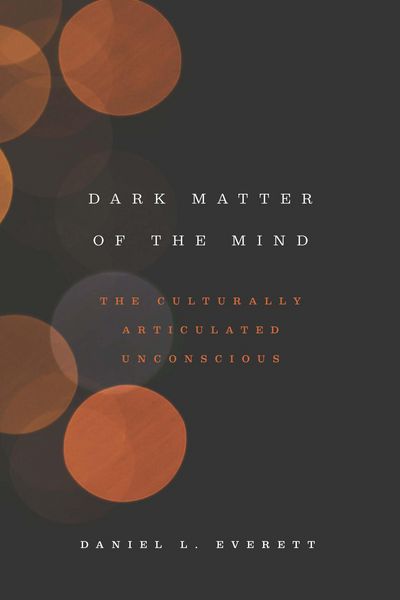
Dark Matter of the Mind The Culturally Articulated Unconscious
-
- Taschenbuch
- eBook ausgewählt
-
Form:Einzelkauf Download
-
Sprache:Englisch
34,09 €
inkl. gesetzl. MwSt.Beschreibung
Produktdetails
Format
ePUB
Kopierschutz
Nein
Family Sharing
Nein
Text-to-Speech
Ja
Erscheinungsdatum
22.12.2022
Verlag
The University of Chicago PressSeitenzahl
396 (Printausgabe)
Dateigröße
2281 KB
Sprache
Englisch
EAN
9780226401430
From a linguist and anthropologist, "a fascinating argument" about culture, cognition, and the concept of human nature (
Choice).
Is it in our nature to be altruistic, or evil, to make art, use tools, or create language? Is it in our nature to think in any particular way? For Daniel L. Everett, the answer is a resounding no: it isn't in our nature to do any of these things because human nature does not exist-at least not as we usually think of it. Flying in the face of major trends in evolutionary psychology and related fields, he offers a provocative and compelling argument in this book that the only thing humans are hardwired for is freedom: freedom from evolutionary instinct and freedom to adapt to a variety of environmental and cultural contexts.
Everett sketches a blank-slate picture of human cognition that focuses not on what is in the mind but, rather, what the mind is in-namely, culture. He draws on years of field research among the Amazonian people of the Pirahã in order to carefully scrutinize various theories of cognitive instinct, including Noam Chomsky's foundational concept of universal grammar, Freud's notions of unconscious forces, Adolf Bastian's psychic unity of mankind, and works on massive modularity by evolutionary psychologists such as Leda Cosmides, John Tooby, Jerry Fodor, and Steven Pinker. Illuminating unique characteristics of the Pirahã language, he demonstrates just how differently various cultures can make us think and how vital culture is to our cognitive flexibility. Outlining the ways culture and individual psychology operate symbiotically, he posits a Buddhist-like conception of the cultural self as a set of experiences united by various apperceptions, episodic memories, ranked values, knowledge structures, and social roles-and not, in any shape or form, biological instinct.
The result is fascinating portrait of the "dark matter of the mind," one that shows that our greatest evolutionary adaptation is adaptability itself.
Choice).
Is it in our nature to be altruistic, or evil, to make art, use tools, or create language? Is it in our nature to think in any particular way? For Daniel L. Everett, the answer is a resounding no: it isn't in our nature to do any of these things because human nature does not exist-at least not as we usually think of it. Flying in the face of major trends in evolutionary psychology and related fields, he offers a provocative and compelling argument in this book that the only thing humans are hardwired for is freedom: freedom from evolutionary instinct and freedom to adapt to a variety of environmental and cultural contexts.
Everett sketches a blank-slate picture of human cognition that focuses not on what is in the mind but, rather, what the mind is in-namely, culture. He draws on years of field research among the Amazonian people of the Pirahã in order to carefully scrutinize various theories of cognitive instinct, including Noam Chomsky's foundational concept of universal grammar, Freud's notions of unconscious forces, Adolf Bastian's psychic unity of mankind, and works on massive modularity by evolutionary psychologists such as Leda Cosmides, John Tooby, Jerry Fodor, and Steven Pinker. Illuminating unique characteristics of the Pirahã language, he demonstrates just how differently various cultures can make us think and how vital culture is to our cognitive flexibility. Outlining the ways culture and individual psychology operate symbiotically, he posits a Buddhist-like conception of the cultural self as a set of experiences united by various apperceptions, episodic memories, ranked values, knowledge structures, and social roles-and not, in any shape or form, biological instinct.
The result is fascinating portrait of the "dark matter of the mind," one that shows that our greatest evolutionary adaptation is adaptability itself.
Noch keine Bewertungen vorhanden
Verfassen Sie die erste Bewertung zu diesem Artikel
Helfen Sie anderen Kundinnen und Kunden durch Ihre Meinung.
Kurze Frage zu unserer Seite
Vielen Dank für Ihr Feedback
Wir nutzen Ihr Feedback, um unsere Produktseiten zu verbessern. Bitte haben Sie Verständnis, dass wir Ihnen keine Rückmeldung geben können. Falls Sie Kontakt mit uns aufnehmen möchten, können Sie sich aber gerne an unseren Kund*innenservice wenden.
zum Kundenservice