KI-Beratung Beta

Gutscheinbedingungen

**Gültig bis 18.11.2026 auf englischsprachige Klassiker (klassiker-32728) online auf thalia.at und in der Thalia App. Einzelne Artikel können ausgeschlossen sein. Ausgenommen sind preisgebundene Artikel & eBooks. Pro Einkauf einmal einlösbar. Click & Collect nur bei Onlinevorabzahlung möglich. Keine Barauszahlung. Nicht kombinierbar mit anderen Aktionen und Gutscheinen. Gutschein wird auf max. 500€ Bestellwert angerechnet. Nicht gültig für Geschenkkarten, Versandkosten und Services.

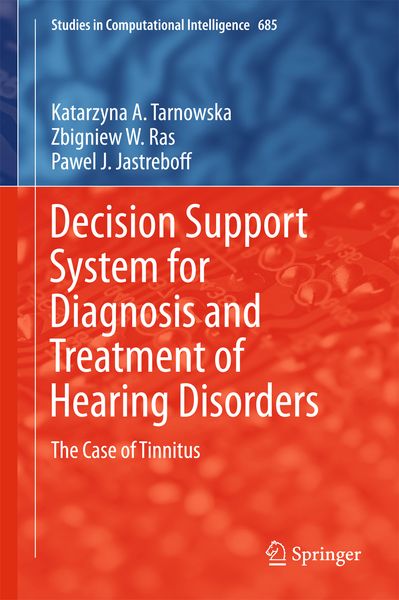
  • Produktbild: Decision Support System for Diagnosis and Treatment of Hearing Disorders
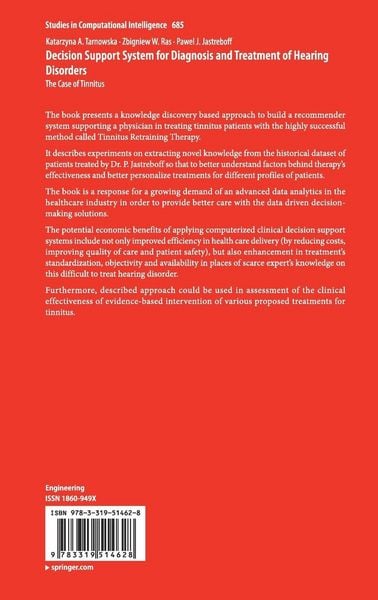
  • Produktbild: Decision Support System for Diagnosis and Treatment of Hearing Disorders
Band 685

Decision Support System for Diagnosis and Treatment of Hearing Disorders The Case of Tinnitus

118,99 €

inkl. gesetzl. MwSt., Versandkostenfrei


Beschreibung

The book presents a knowledge discovery based approach to build a recommender system supporting a physician in treating tinnitus patients with the highly successful method called Tinnitus Retraining Therapy. It describes experiments on extracting novel knowledge from the historical dataset of patients...

Beschreibung

The book presents a knowledge discovery based approach to build a recommender system supporting a physician in treating tinnitus patients with the highly successful method called Tinnitus Retraining Therapy.
It describes experiments on extracting novel knowledge from the historical dataset of patients treated by Dr. P. Jastreboff so that to better understand factors behind therapy's effectiveness and better personalize treatments for different profiles of patients.
The book is a response for a growing demand of an advanced data analytics in the healthcare industry in order to provide better care with the data driven decision-making solutions.
The potential economic benefits of applying computerized clinical decision support systems include not only improved efficiency in health care delivery (by reducing costs, improving quality of care and patient safety), but also enhancement in treatment's standardization, objectivity and availability in places of scarce expert's knowledge on this difficult to treat hearing disorder.
Furthermore, described approach could be used in assessment of the clinical effectiveness of evidence-based intervention of various proposed treatments for tinnitus.

Rezension

“This book describes in great detail and in a step‐wise fashion how to set up a network for an algorithm based decision-making system for treating tinnitus and assessing the effectiveness of treatment interventions for tinnitus. … This book is most suitable for medical practitioners who have been seeing tinnitus patients in their practice … . This book is geared towards clinicians who are also research-based and interested in taking an analytic and data-driven approach to the treatment of tinnitus.” (JoAnn Shih, Doody's Book Reviews, May, 2017)

Produktdetails

Einband

Gebundene Ausgabe

Erscheinungsdatum

03.03.2017

Abbildungen

X, 160 p. 33 illus.

Verlag Springer

Produktdetails

Einband

Gebundene Ausgabe

Erscheinungsdatum

03.03.2017

Abbildungen

X, 160 p. 33 illus.

Verlag Springer
Seitenzahl

160

Maße (L/B/H)

24,1/16/1,6 cm

Gewicht

378 g

Auflage

1st ed. 2017

Sprache

Englisch

ISBN

978-3-319-51462-8

Herstelleradresse

Springer-Verlag GmbH
Europaplatz 3
69115 Heidelberg
DE

Email: ProductSafety@springernature.com

Noch keine Bewertungen vorhanden

Verfassen Sie die erste Bewertung zu diesem Artikel

Helfen Sie anderen Kundinnen und Kunden durch Ihre Meinung.

Kundinnen und Kunden meinen

Bewertungen (0)

  • Produktbild: Decision Support System for Diagnosis and Treatment of Hearing Disorders
  • Produktbild: Decision Support System for Diagnosis and Treatment of Hearing Disorders
  • Preface.- Introduction.- Tinnitus treatment as a problem area .- Recommender solutions overview.- Knowledge discovery approach for recommendation.- RECTIN system design.- Experiment 1: classifiers.- Experiment 2: diagnostic rules.- Experiment 3: treatment rules.- Experiment 4: treatment rules enhancement.- RECTIN implementation.- Final conclusions and future work.- References.