Beschreibung
Produktdetails
Einband
Gebundene Ausgabe
Erscheinungsdatum
05.10.2021
Verlag
John Wiley & SonsSeitenzahl
752
Maße (L/B/H)
24,4/17/4 cm
Gewicht
1383 g
Auflage
2nd edition
Sprache
Englisch
ISBN
978-1-119-38694-0
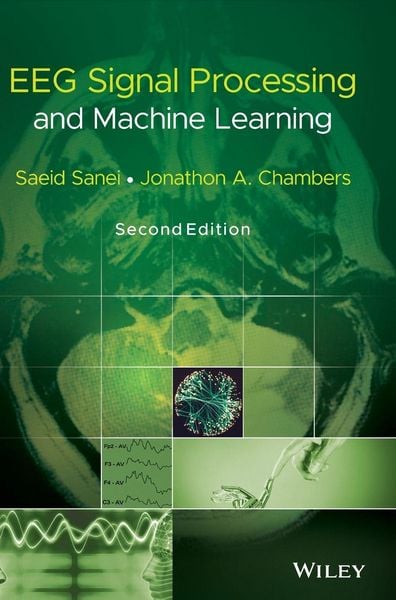
EEG Signal Processing and Machine Learning
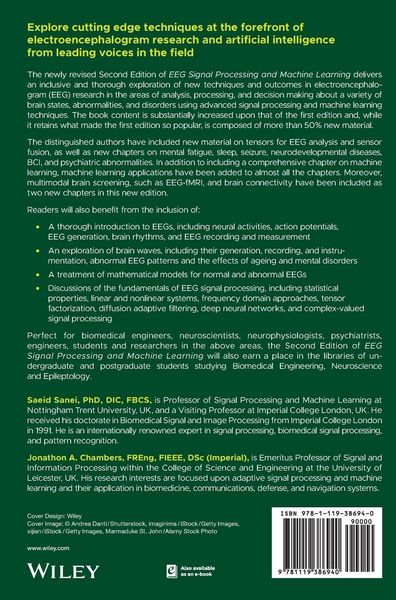
Explore cutting edge techniques at the forefront of electroencephalogram research and artificial intelligence from leading voices in the field
The newly revised Second Edition of EEG Signal Processing and Machine Learning delivers an inclusive and thorough exploration of new techniques and outcomes in electroencephalogram (EEG) research in the areas of analysis, processing, and decision making about a variety of brain states, abnormalities, and disorders using advanced signal processing and machine learning techniques. The book content is substantially increased upon that of the first edition and, while it retains what made the first edition so popular, is composed of more than 50% new material.
The distinguished authors have included new material on tensors for EEG analysis and sensor fusion, as well as new chapters on mental fatigue, sleep, seizure, neurodevelopmental diseases, BCI, and psychiatric abnormalities. In addition to including a comprehensive chapter on machine learning, machine learning applications have been added to almost all the chapters. Moreover, multimodal brain screening, such as EEG-fMRI, and brain connectivity have been included as two new chapters in this new edition.
Readers will also benefit from the inclusion of:
* A thorough introduction to EEGs, including neural activities, action potentials, EEG generation, brain rhythms, and EEG recording and measurement
* An exploration of brain waves, including their generation, recording, and instrumentation, abnormal EEG patterns and the effects of ageing and mental disorders
* A treatment of mathematical models for normal and abnormal EEGs
* Discussions of the fundamentals of EEG signal processing, including statistical properties, linear and nonlinear systems, frequency domain approaches, tensor factorization, diffusion adaptive filtering, deep neural networks, and complex-valued signal processing
Perfect for biomedical engineers, neuroscientists, neurophysiologists, psychiatrists, engineers, students and researchers in the above areas, the Second Edition of EEG Signal Processing and Machine Learning will also earn a place in the libraries of undergraduate and postgraduate students studying Biomedical Engineering, Neuroscience and Epileptology.
Explore cutting edge techniques at the forefront of electroencephalogram research and artificial intelligence from leading voices in the field
The newly revised Second Edition of EEG Signal Processing and Machine Learning delivers an inclusive and thorough exploration of new techniques and outcomes in electroencephalogram (EEG) research in the areas of analysis, processing, and decision making about a variety of brain states, abnormalities, and disorders using advanced signal processing and machine learning techniques. The book content is substantially increased upon that of the first edition and, while it retains what made the first edition so popular, is composed of more than 50% new material.
The distinguished authors have included new material on tensors for EEG analysis and sensor fusion, as well as new chapters on mental fatigue, sleep, seizure, neurodevelopmental diseases, BCI, and psychiatric abnormalities. In addition to including a comprehensive chapter on machine learning, machine learning applications have been added to almost all the chapters. Moreover, multimodal brain screening, such as EEG-fMRI, and brain connectivity have been included as two new chapters in this new edition.
Readers will also benefit from the inclusion of:
* A thorough introduction to EEGs, including neural activities, action potentials, EEG generation, brain rhythms, and EEG recording and measurement
* An exploration of brain waves, including their generation, recording, and instrumentation, abnormal EEG patterns and the effects of ageing and mental disorders
* A treatment of mathematical models for normal and abnormal EEGs
* Discussions of the fundamentals of EEG signal processing, including statistical properties, linear and nonlinear systems, frequency domain approaches, tensor factorization, diffusion adaptive filtering, deep neural networks, and complex-valued signal processing
Perfect for biomedical engineers, neuroscientists, neurophysiologists, psychiatrists, engineers, students and researchers in the above areas, the Second Edition of EEG Signal Processing and Machine Learning will also earn a place in the libraries of undergraduate and postgraduate students studying Biomedical Engineering, Neuroscience and Epileptology.
Noch keine Bewertungen vorhanden
Verfassen Sie die erste Bewertung zu diesem Artikel
Helfen Sie anderen Kundinnen und Kunden durch Ihre Meinung.
Kurze Frage zu unserer Seite
Vielen Dank für Ihr Feedback
Wir nutzen Ihr Feedback, um unsere Produktseiten zu verbessern. Bitte haben Sie Verständnis, dass wir Ihnen keine Rückmeldung geben können. Falls Sie Kontakt mit uns aufnehmen möchten, können Sie sich aber gerne an unseren Kund*innenservice wenden.
zum Kundenservice