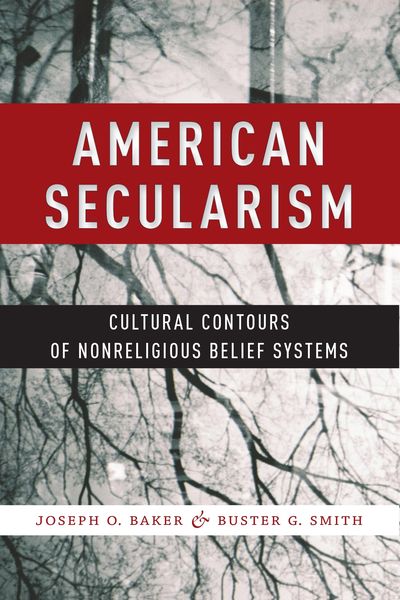
American Secularism Cultural Contours of Nonreligious Belief Systems
-
- Taschenbuch
- eBook ausgewählt
-
Form:Einzelkauf Download
-
Sprache:Englisch
-
eBook Format:ePUB
- PDF 144,00 €
- ePUB 28,30 € ausgewählt
28,30 €
inkl. gesetzl. MwSt.Beschreibung
Produktdetails
Format
ePUB
Kopierschutz
Nein
Family Sharing
Nein
Text-to-Speech
Ja
Erscheinungsdatum
25.09.2015
Verlag
Princeton University PressSeitenzahl
(Printausgabe)
Dateigröße
1514 KB
Sprache
Englisch
EAN
9781479896875
Honorable Mention, American Sociological Association Section on Religion Distinguished Book Award
A rapidly growing number of Americans are embracing life outside the bounds of organized religion. Although America has long been viewed as a fervently religious Christian nation, survey data shows that more and more Americans are identifying as not religious. There are more non-religious Americans than ever before, yet social scientists have not adequately studied or typologized secularities, and the lived reality of secular individuals in America has not been astutely analyzed. American Secularism documents how changes to American society have fueled these shifts in the non-religious landscape and examines the diverse and dynamic world of secular Americans.
This volume offers a theoretical framework for understanding secularisms. It explores secular Americans' thought and practice to understand secularisms as worldviews in their own right, not just as negations of religion. Drawing on empirical data, the authors examine how people live secular lives and make meaning outside of organized religion. Joseph O. Baker and Buster G. Smith link secularities to broader issues of social power and organization, providing an empirical and cultural perspective on the secular landscape. In so doing, they demonstrate that shifts in American secularism are reflective of changes in the political meanings of religion in American culture.
American Secularism addresses the contemporary lived reality of secular individuals, outlining forms of secular identity and showing their connection to patterns of family formation, sexuality, and politics, providing scholars of religion with a more comprehensive understanding of worldviews that do not include traditional religion.
Data Analyses Appendix
Noch keine Bewertungen vorhanden
Verfassen Sie die erste Bewertung zu diesem Artikel
Helfen Sie anderen Kundinnen und Kunden durch Ihre Meinung.
Kurze Frage zu unserer Seite
Vielen Dank für Ihr Feedback
Wir nutzen Ihr Feedback, um unsere Produktseiten zu verbessern. Bitte haben Sie Verständnis, dass wir Ihnen keine Rückmeldung geben können. Falls Sie Kontakt mit uns aufnehmen möchten, können Sie sich aber gerne an unseren Kund*innenservice wenden.
zum Kundenservice