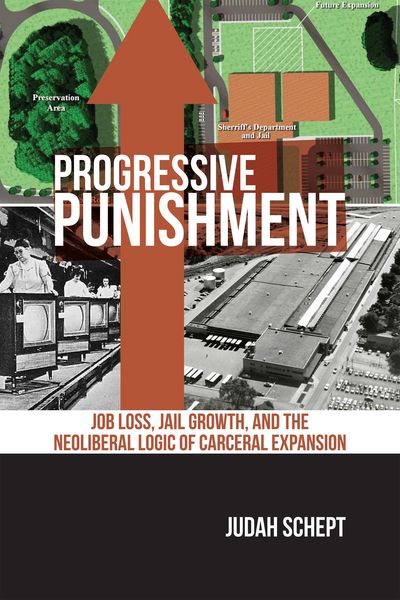
Progressive Punishment Job Loss, Jail Growth, and the Neoliberal Logic of Carceral Expansion
-
- Taschenbuch
- eBook ausgewählt
-
Form:Einzelkauf Download
-
Sprache:Englisch
-
eBook Format:ePUB
- PDF 142,90 €
- ePUB 26,20 € ausgewählt
26,20 €
inkl. gesetzl. MwSt.Beschreibung
Produktdetails
Format
ePUB
Kopierschutz
Nein
Family Sharing
Nein
Text-to-Speech
Ja
Erscheinungsdatum
04.12.2015
Verlag
University Of Pittsburgh PressSeitenzahl
(Printausgabe)
Dateigröße
662 KB
Sprache
Englisch
EAN
9781479876532
Winner, 2017 American Society of Criminology's Division on Critical Criminology and Social Justice Best Book Award
An examination of the neoliberal politics of incarceration
The growth of mass incarceration in the United States eludes neat categorization as a product of the political Right. Liberals played important roles in both laying the foundation for and then participating in the conservative tough on crime movement that is largely credited with the rise of the prison state. But what of those politicians and activists on the Left who reject punitive politics in favor of rehabilitation and a stronger welfare state? Can progressive policies such as these, with their benevolent intentions, nevertheless contribute to the expansion of mass incarceration?
In Progressive Punishment, Judah Schept offers an ethnographic examination into the politics of incarceration in Bloomington, Indiana in order to consider the ways that liberal discourses about therapeutic justice and rehabilitation can uphold the logics, practices and institutions that comprise the carceral state. Schept examines how political leaders on the Left, despite being critical of mass incarceration, advocated for a "justice campus" that would have dramatically expanded the local criminal justice system. At the root of this proposal, Schept argues, is a confluence of neoliberal-style changes in the community that naturalized prison expansion as political common sense among leaders negotiating crises of deindustrialization, urban decline, and the devolution of social welfare. In spite of the momentum that the proposal gained, Schept uncovers resistance among community organizers, who developed important strategies and discourses to challenge the justice campus, disrupt some of the logics that provided it legitimacy, and offer new possibilities for a non-carceral community.
A well-researched and well-narrated study, Progressive Punishment offers a novel perspective on the relationship between liberal politics, neoliberalism, and mass incarceration.
Noch keine Bewertungen vorhanden
Verfassen Sie die erste Bewertung zu diesem Artikel
Helfen Sie anderen Kundinnen und Kunden durch Ihre Meinung.
Kurze Frage zu unserer Seite
Vielen Dank für Ihr Feedback
Wir nutzen Ihr Feedback, um unsere Produktseiten zu verbessern. Bitte haben Sie Verständnis, dass wir Ihnen keine Rückmeldung geben können. Falls Sie Kontakt mit uns aufnehmen möchten, können Sie sich aber gerne an unseren Kund*innenservice wenden.
zum Kundenservice