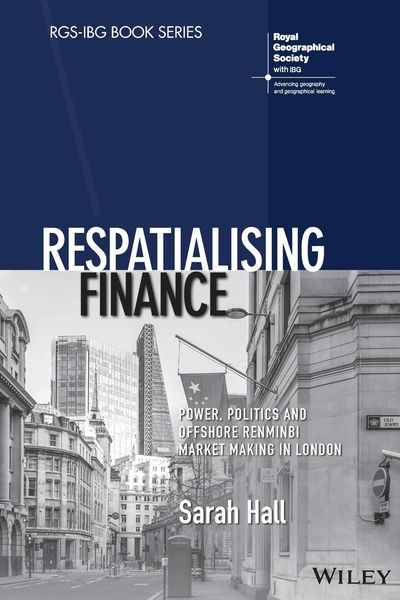
Respatialising Finance Power, Politics and Offshore Renminbi Market Making in London
-
- Hardcover
- Taschenbuch ausgewählt
-
Sprache:Englisch
47,99 €
inkl. gesetzl. MwSt.,
Beschreibung
Produktdetails
Einband
Taschenbuch
Erscheinungsdatum
26.04.2021
Verlag
John Wiley & Sons IncSeitenzahl
192
Maße (L/B/H)
22,9/15,2/1 cm
Gewicht
282 g
Auflage
1. Auflage
Sprache
Englisch
ISBN
978-1-119-38604-9
'In Respatialising Finance Sarah Hall uses the internationalisation of the Chinese Renminbi (RMB) to work through a sympathetic conceptual and empirical critique of prevailing analyses of International Financial Centres (IFCs). Her conceptual (re)framing stresses the politics, institutions and economics of IFCs and will be essential reading for all social scientists interested in the dynamism of contemporary finance and financial centres.'
Professor Jane Pollard, Centre for Urban and Regional Development Studies (CURDS), Newcastle University, UK
'Through detailed study of Chinese RMB internationalisation and combining analytical insights from economic geography, sociology, and international political economy, Sarah Hall shows why offshore networks anchored in territories such as the City of London are both core to global monetary and financial landscapes, and provide a key terrain for state power and politics.'
Professor Paul Langley, Department of Geography, Durham University, UK
Respatialising Finance is one of the first detailed empirical studies of how and why London became the leading western financial centre within the wider Chinese economic and political project of internationalising its currency, the renminbi (RMB). This in-depth volume examines how political authorities in both London and Beijing identified the potential value of London's international financial centre in facilitating and legitimising RMB internationalisation, and how they sought to operationalise this potential through a range of market-making activities.
The text features original data from on-the-ground research in London and Beijing conducted with financial and legal professionals working in RMB markets and offers an original theoretical approach that brings economic geography into closer dialogue with international political economy. Recent work on territory illustrates how financial centres are not simply containers and facilitators of global financial flows - rather they serve as territorial fixes within the dynamic and crisis-prone nature of global finance.
Noch keine Bewertungen vorhanden
Verfassen Sie die erste Bewertung zu diesem Artikel
Helfen Sie anderen Kundinnen und Kunden durch Ihre Meinung.
Kurze Frage zu unserer Seite
Vielen Dank für Ihr Feedback
Wir nutzen Ihr Feedback, um unsere Produktseiten zu verbessern. Bitte haben Sie Verständnis, dass wir Ihnen keine Rückmeldung geben können. Falls Sie Kontakt mit uns aufnehmen möchten, können Sie sich aber gerne an unseren Kund*innenservice wenden.
zum Kundenservice