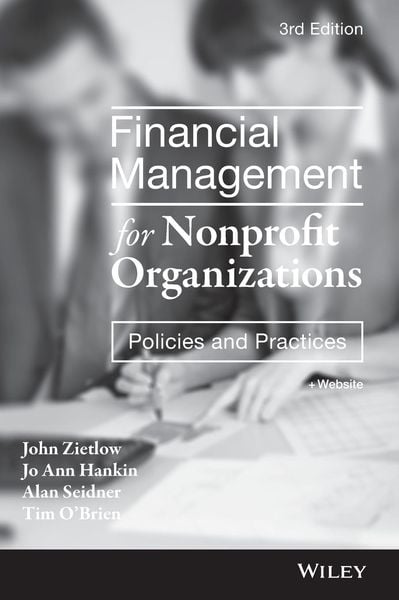
Financial Management for Nonprofit Organizations Policies and Practices
-
- Hardcover ausgewählt
- Taschenbuch
- eBook
-
Sprache:Englisch
-
Auflage:3rd edition
- 1. Auflage 282,99 €
- 3rd edition 148,99 € ausgewählt
148,99 €
inkl. gesetzl. MwSt.,
Beschreibung
Produktdetails
Einband
Gebundene Ausgabe
Erscheinungsdatum
23.03.2018
Verlag
John Wiley & Sons IncSeitenzahl
768
Maße (L/B/H)
26/18,3/4,5 cm
Gewicht
1615 g
Auflage
3rd edition
Sprache
Englisch
ISBN
978-1-119-38256-0
Financial Management for Nonprofit Organizations provides students, professionals, and board members with a comprehensive reference for the field. Identifying key objectives and exploring current practices, this book offers practical guidance on all major aspects of nonprofit financial management. As nonprofit organizations fall under ever-increasing scrutiny and accountability, this book provides the essential knowledge and tools professional need to maintain a strong financial management system while serving the organization's stated mission. Financial management, cash flow, and financial sustainability are perennial issues, and this book highlights the concepts, skills, and tools that help organizations address those issues. Clear guidance on analytics, reporting, investing, risk management, and more comprise a singular reference that nonprofit finance and accounting professionals and board members should keep within arm's reach.
Updated to reflect the post-recession reality and outlook for nonprofits, this new edition includes new examples, expanded tax-exempt financing material, and recession analysis that informs strategy going forward.
* Articulate the proper primary financial objective, target liquidity, and how it ensures financial health and sustainability
* Understand nonprofit financial practices, processes, and objectives
* Manage your organization's resources in the context of its mission
* Delve into smart investing and risk management best practices
* Manage liquidity, reporting, cash and operating budgets, debt and other liabilities, IP, legal risk, internal controls and more
* Craft appropriate financial policies
Although the U.S. economy has recovered, recovery has not addressed the systemic and perpetual funding challenges nonprofits face year after year. Despite positive indicators, many organizations remain hampered by pursuit of the wrong primary financial objective, insufficient funding and a lack of investment in long-term sustainability; in this climate, financial managers must stay up-to-date with the latest tools, practices, and regulations in order to serve their organization's interests. Financial Management for Nonprofit Organizations provides clear, in-depth reference and strategy for navigating the expanding financial management function.
Noch keine Bewertungen vorhanden
Verfassen Sie die erste Bewertung zu diesem Artikel
Helfen Sie anderen Kundinnen und Kunden durch Ihre Meinung.
Kurze Frage zu unserer Seite
Vielen Dank für Ihr Feedback
Wir nutzen Ihr Feedback, um unsere Produktseiten zu verbessern. Bitte haben Sie Verständnis, dass wir Ihnen keine Rückmeldung geben können. Falls Sie Kontakt mit uns aufnehmen möchten, können Sie sich aber gerne an unseren Kund*innenservice wenden.
zum Kundenservice