Gutscheinbedingungen

**Gültig bis 06.07.2026 auf fremdsprachige Bücher online auf thalia.at, in der Thalia App ab einem Mindestbestellwert von 30€ und in allen Thalia Buchhandlungen in Österreich. In den Buchhandlungen nur gültig auf lagernde Ware. Einzelne Artikel können ausgeschlossen sein. Ausgenommen sind preisgebundene Artikel & eBooks. Pro Einkauf einmal einlösbar. Nur gültig gegen Vorlage oder im Onlineshop hinterlegter Bonuscard. Infos zur Einlösung in der Buchhandlung sind auf der Bonuscard-Vorteilspreisseite zu finden. Click & Collect nur bei Onlinevorabzahlung möglich. Keine Einlösung bei Scan & Go-Bezahlung. Keine Barauszahlung. Nicht kombinierbar mit anderen Aktionen und Gutscheinen. Gutschein wird auf max. 500€ Bestellwert angerechnet. Nicht gültig für Versandkosten und Services.

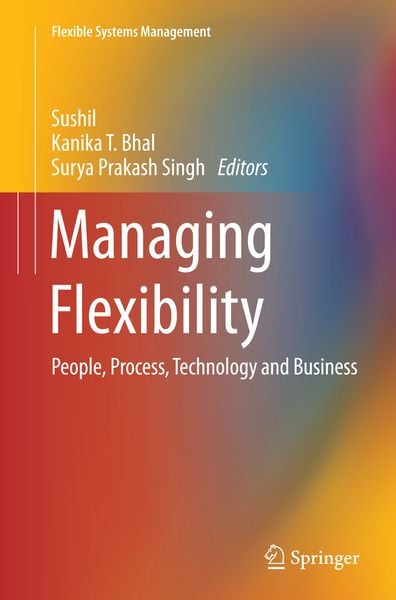
  • Produktbild: Managing Flexibility
  • Produktbild: Managing Flexibility
- 13%

Managing Flexibility People, Process, Technology and Business

13% sparen

142,99 € UVP 164,99 €

inkl. gesetzl. MwSt., Versandkostenfrei


Beschreibung

Produktdetails

Einband

Taschenbuch

Erscheinungsdatum

25.10.2016

Abbildungen

XVII, 97 illus., schwarz-weiss Illustrationen

Herausgeber

Sushil + weitere

Verlag

Springer India

Seitenzahl

335

Maße (L/B/H)

23,5/15,5/2 cm

Gewicht

545 g

Auflage

Softcover reprint of the original 1st ed. 2016

Sprache

Englisch

ISBN

978-81-322-3461-6

Beschreibung

Portrait

Sushil is Abdulaziz Alsagar chair professor (professor of strategic, flexible systems and technology management), and Chair, Strategic Management Group at the Department of Management Studies, Indian Institute of Technology (IIT) Delhi. He has served as visiting professor and delivered seminars in many leading universities; some representative ones are University of Minnesota, Minneapolis, MN, Stevens Institute of Technology, NJ, University of Lethbridge, Alberta, Université Paris 1 Panthéon-Sorbonne, Paris, among others. He is an active researcher and supervised more than 60 doctoral dissertations. He has 20 books to his credit in the areas of flexibility, strategy, systems thinking, and technology management. He has over 300 papers in various refereed journals and conferences and pioneered the area of “flexible systems management”, making original contributions to the field of knowledge in the form of interpretive approaches in management. He is the founder editor-in-chief of Global Journal of Flexible Systems Management and serving on the editorial boards of leading international journals. He is the founder president of the professional body, “Global Institute of Flexible Systems Management.” Currently he is serving as an independent director on the boards of RINL and HSCC.

Kanika T. Bhal is Modi Chair Professor and Head at the Department of Management Studies at IIT Delhi. A PhD from IIT Kanpur, and a visiting fellow at Sloan School of Management (Cambridge, USA), she is an expert in behavioural sciences in general and leadership in particular. She has published several articles in national and international journals and conferences and is on the editorial boards of national and international journals. She has authored books on leadership, culture and ethics. She has conducted sponsored research on several nationally and internationally funded (with Fordham University, Bronx, USA and Wharton Business School, Philadelphia,USA) projects. Besides being a consultant to various national organizations like Fifth Central Pay Commission of India, First National Judicial Pay Commission of India, DRDO, UPSC, DGS&D, Ministry of Rural Development NICD, and Ministry of Environment and Forests; she is invited as expert on Government committees and is a member of the Academy of Management, USA; Society for Industrial Organization and Psychology; and Global Institute of Flexible Systems Management.

Surya Prakash Singh is an associate professor in the area of operations management at the Department of Management Studies, IIT Delhi. He obtained his PhD from IIT Kanpur and Post-Doctoral fellowship in Manufacturing Systems from Singapore-MIT Alliance, National University of Singapore. Prior to joining IIT Delhi, he was faculty at Xavier Institute of Management Bhubaneswar and visiting faculty at Management Centre, Ravenshaw University, Cuttack, India. His research interests includes facility layout and locations problems, optimization techniques, optimizing supply chains, materials management, designing heuristics and meta-heuristics, and operations research. He has published his work in various leading international journals such as International Journal of Production Research, Lecture notes in Computer Science, International Journal of Advance Manufacturing Technology, European Journal of Management, Review of Business Research, and International Journal of Recent Trends in Engineering, among others. He has also contributed chapters in edited volumes published by Vilnius Gediminas Technical University Publishing House “Technika” Vilinius, Lithuania ( Continuous Optimization And Knowledge-Based Technologies ), and INTECH publisher, Vienna, Austria ( Travelling Salesman Problem: Theory And Applications ). He is a life member of IAENG, Hong Kong; senior member, International Association of Computer science and Information Technology, Singapore; and senior member, ACEEE,India. He is on the Editorial Board of Journal of Management and Public Policy.
Produktdetails

Einband

Taschenbuch

Erscheinungsdatum

25.10.2016

Abbildungen

XVII, 97 illus., schwarz-weiss Illustrationen

Herausgeber

Verlag

Springer India

Seitenzahl

335

Maße (L/B/H)

23,5/15,5/2 cm

Gewicht

545 g

Auflage

Softcover reprint of the original 1st ed. 2016

Sprache

Englisch

ISBN

978-81-322-3461-6

Herstelleradresse

Springer Nature Customer Service Center GmbH
Tiergartenstr. 17
69121 Heidelberg
DE
ProductSafety@springernature.com

Noch keine Bewertungen vorhanden

Verfassen Sie die erste Bewertung zu diesem Artikel

Helfen Sie anderen Kundinnen und Kunden durch Ihre Meinung.

Kundinnen und Kunden meinen

Bewertungen (0)

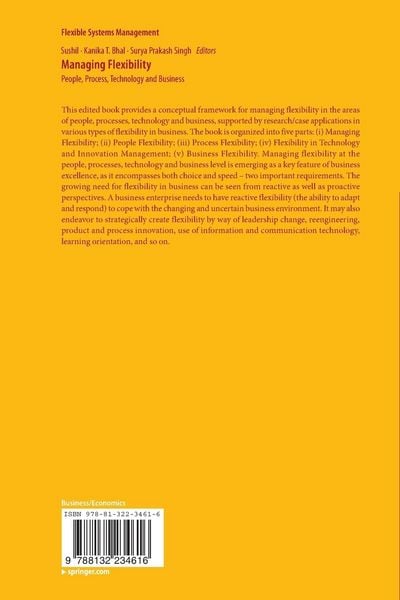
  • Produktbild: Managing Flexibility
  • Produktbild: Managing Flexibility
  • Part I: MANAGING FLEXIBILITY .- Chapter 1. Managing Flexibility: Developing a Framework of Flexibility Maturity Model.- Chapter 2. Critical Design Elements for Service Systems.- Chapter 3. Flexibility Intensity: How Market Forces Drive Variability.- Chapter 4. Organizational Excellence through Total Flexi-Quality: People Dimension.- Chapter 5. Examining Comprehensiveness of Strategy Formulation and E-governance Performance.- Part II: PEOPLE FLEXIBILITY .- Chapter 6. Significance of LMX Congruence and its Flexibility on Subordinate Performance and Promotability.- Chapter 7. Practical Insights on Managing Diversity in International ICT Projects.- Chapter 8. Developing Flexible Leaders Flexibly.- Chapter 9. Role Efficacy and People Flexibility: Examining Moderating Functions of Demographic Factors.- Chapter 10. Exploring the Complex Interface between IT Professional and HR: Building Flexibility Applying Cybernetic Concepts.- Part III: PROCESS FLEXIBILITY .- Chapter 11. Incentives for Information Sharing in Collaborative Supply Chains.- Chapter 12. Modelling Flexible Procurement Problem.- Chapter 13. Modeling Hierarchical Relationships among Enablers of Supply Chain Coordination in Flexible Environment.- Chapter 14. Flexibility in Transportation Management Strategy for Improved Efficiency: An Indian Soft Drink Industry Perspective.- Chapter 15. R&D Sustainability of Biotech Start-ups in Financial Crisis.- Part IV: FLEXIBILITY IN TECHNOLOGY AND INNOVATION MANAGEMENT .- Chapter 16. Stakeholder Engagement Methodology in the Context of Innovation Management.- Chapter 17. Strategic Flexibility and its Leveraging Effects on Technological Exploitation.- Chapter 18. A Framework Conceptualization for National Technological Competitiveness.- Part V: BUSINESS FLEXIBILITY .- Chapter 19. Development ofMarketing Flexibility for e-Commerce by Assessing Impact of Mobile Devices on Sales with Multiple Classes of Customers.- Chapter 20. Emotional Balancing and Change Outcomes during Post Merger Integration: A Case Study.- Chapter 21. Technology Integration among Stakeholders in Services Sector: A Case Study.- Chapter 22. Managing Demand Variability at Customer Level in a FMCG Company.