
• Produktbild: Derailed Organizational Interventions for Stress and Well-Being
  • Produktbild: Derailed Organizational Interventions for Stress and Well-Being
- 13%

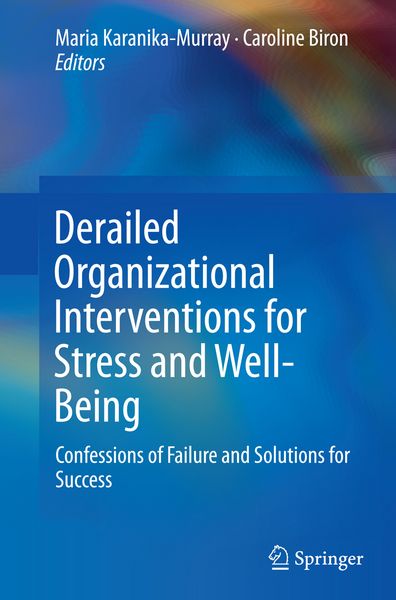
Derailed Organizational Interventions for Stress and Well-Being Confessions of Failure and Solutions for Success

13% sparen

104,99 € UVP 120,99 €

inkl. gesetzl. MwSt., Versandkostenfrei


Beschreibung

Produktdetails

Einband

Taschenbuch

Erscheinungsdatum

23.10.2016

Abbildungen

XXIV, 16 illus., schwarz-weiss Illustrationen

Herausgeber

Maria Karanika-Murray + weitere

Verlag

Springer Netherland

Seitenzahl

286

Maße (L/B/H)

23,5/15,5/1,7 cm

Gewicht

476 g

Auflage

Softcover reprint of the original 1st edition 2015

Sprache

Englisch

ISBN

978-94-024-0163-9

Beschreibung

Produktdetails

Einband

Taschenbuch

Erscheinungsdatum

23.10.2016

Abbildungen

XXIV, 16 illus., schwarz-weiss Illustrationen

Herausgeber

Verlag

Springer Netherland

Seitenzahl

286

Maße (L/B/H)

23,5/15,5/1,7 cm

Gewicht

476 g

Auflage

Softcover reprint of the original 1st edition 2015

Sprache

Englisch

ISBN

978-94-024-0163-9

Herstelleradresse

Springer-Verlag KG
Sachsenplatz 4-6
1201 Wien
AT

Email: GPSR Kontakt

Noch keine Bewertungen vorhanden

Verfassen Sie die erste Bewertung zu diesem Artikel

Helfen Sie anderen Kundinnen und Kunden durch Ihre Meinung.

Kundinnen und Kunden meinen

Bewertungen (0)

  • Produktbild: Derailed Organizational Interventions for Stress and Well-Being
  • Produktbild: Derailed Organizational Interventions for Stress and Well-Being
  • Chapter 1 Introduction – Why do some interventions derail? Deconstructing the elements of organizational interventions for stress and well-being.- Part 1 Content.- Chapter 2 Derailed or failed? A closer look at reduced working hours as an occupational health intervention.- Chapter 3 Integrating job stress and workplace mental health literacy intervention: Challenges and benefits.- Chapter 4 Burnout: Why interventions fail and what Can we do differently.- Chapter 5 Managing work-related musculoskeletal disorders - socio-technical ‘solutions’ and unintended psychosocial consequences.- Part 2 Context.- Chapter 6 Population level interventions to control psychosocial risks: Problems and prospects.- Chapter 7 Derailed, but implemented - A study of two natural work-life interventions.-Chapter 8 Organizational changes torpedoing the intervention.- Chapter 9 Corporate philosophy: Making stress and wellbeing a priority.- Chapter 10 Evidence is not enough: The challenges of engaging organisational stakeholders with different perspectives.- Chapter 11 In line for takeoff…and waiting: Challenges with getting a wellness intervention started in the Military.- Chapter 12 Assessing and addressing the fit of planned interventions to the organizational context.- Part 3 Process.- Chapter 13 Managing conflicts and diversity during implementation of programs and other changes.- Chapter 14 Carnage in the research lab: Power, personality and neglect.- Chapter 15 Power mad: A case of professional services.- Chapter 16 “I Object!” Overcoming obstacles between organizational researchers and legal advisors.- Chapter 17 Challenges of intervention acceptance in complex, multifaceted organizations: The importance of local champions.- Chapter 18 Mutual goals as essential for the results of team coaching.- Chapter 19 Role behavior of the coach and the participants as essential for the results of individual coaching.- Chapter 20 Increasing worker participation: The mental health action checklist.- Chapter 21 Decreasing response rates in employee health surveys: initial findings from a Longitudinal Stress-management Project in the Workplace.- Chapter 22 Recruitment and retention challenges of a mental health promotion intervention targeting small and medium enterprises.- Chapter 23 Perspectives on randomization and readiness for change in a workplace intervention study.- Part 4  Outcome.- Chapter 24 Ensuring the long-term sustainability of organizational interventions: Potential obstacles to be avoided.- Chapter 25 Creating sustained change: Avoiding derailment during the Last stage of a wellbeing intervention.- Chapter 26 A proper needs assessment is key to starting a wellbeing intervention off right.- Chapter 27 Explaining intervention success and failure: What works, when, and why?.- Chapter 28. The ‘best available evidence’ could be better: Evidence from systematic reviews of organizational interventions.- Chapter 29 Work analysis and the resolution of organizational conflict: Theoretical method, measurement and application.- Part 5 Concluding Thoughts.- Chapter 30 The highs and lows of occupational stress intervention research: Lessons learnt from collaborations with high-risk industries.- Chapter 31 Stress management interventions: Reflections.- Chapter 32 Concluding thoughts – From black and white to colours: Moving the science of organizational interventions for stress and well-being forward.