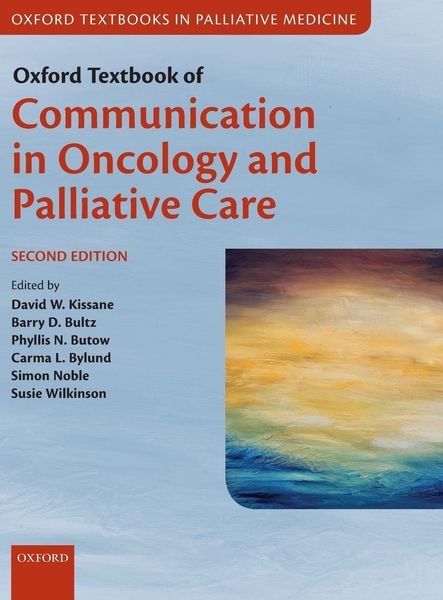
Produktbild: Oxford Textbook of Communication in Oncology and Palliative Care

Oxford Textbook of Communication in Oncology and Palliative Care

247,99 €

inkl. gesetzl. MwSt., Versandkostenfrei


Beschreibung

Produktdetails

Einband

Gebundene Ausgabe

Erscheinungsdatum

18.10.2012

Herausgeber

Kissane David W. + weitere

Verlag

Oxford Academic

Seitenzahl

456

Maße (L/B/H)

28,6/22,1/2,9 cm

Gewicht

1320 g

Auflage

2. Auflage

Sprache

Englisch

ISBN

978-0-19-873613-4

Beschreibung

Produktdetails

Einband

Gebundene Ausgabe

Erscheinungsdatum

18.10.2012

Herausgeber

Verlag

Oxford Academic

Seitenzahl

456

Maße (L/B/H)

28,6/22,1/2,9 cm

Gewicht

1320 g

Auflage

2. Auflage

Sprache

Englisch

ISBN

978-0-19-873613-4

Herstelleradresse

Libri GmbH
Europaallee 1
36244 Bad Hersfeld
DE

Email: gpsr@libri.de

Noch keine Bewertungen vorhanden

Verfassen Sie die erste Bewertung zu diesem Artikel

Helfen Sie anderen Kundinnen und Kunden durch Ihre Meinung.

Kundinnen und Kunden meinen

Bewertungen (0)

Die Leseprobe wird geladen.
  • Produktbild: Oxford Textbook of Communication in Oncology and Palliative Care
    • 1: Mack Lipkin Jr.: The history of communications skills knowledge and training

    • 2: Renee Lim and Stewart Dunn: Journeys to the centre of empathy: the authentic core of communication skills

    • 3: Richard Brown, Alexander Wuensch, and Carma L. Bylund: Models of communication skills training and their practical implications

    • 4: Amiram Gafni and Cathy Charles: Shared decision-making, decision-aids and the role of values in treatment decision-making

    • 5: Laura A. Siminoff and Maria D. Thomson: The ethics of communication in cancer and palliative care

    • 6: Marianne Schmid Mast, ValÃ(c)rie Carrard, and Judith A. Hall: Gender, power, and nonverbal communication

    • 7: Gregory Makoul, Joshua Hauser, and Henry Schneiderman: Medical student training in communication skills

    • 8: Thomas A. D Agostino, Carma L. Bylund, an dBetty Chewning: Training patients to reach their communication goals: a concordance perspective

    • 9: Emily B. Peterson, Megan Shen, Jennifer Gueguen Weber, and Carma Bylund: Cancer patients use of the internet for cancer information and support

    • 10: Thomas F Hack, Kinta Beaver, and Penelope Schofield: Audio-recording cancer consultations for patients and their families putting evidence into practice

    • 11: Suzanne M. Kurtz and Lara J. Cooke: Learner-centered communication training

    • 12: Walter F. Baile and Patricia A. Parker: Breaking bad news

    • 13: Phyllis N. Butow, Martin H. N. Tattersall, and Martin Stockler: Discussing prognosis and communicating risk

    • 14: Martin H. N. Tattersall and David W. Kissane: Achieving shared treatment decisions

    • 15: Jennifer Philip and David W. Kissane: Responding to difficult emotions

    • 16: Linda Sheahan and David W. Kissane: Denial and communication

    • 17: Isabelle Merckaert, Yves Libert, Aurore LiÃ(c)nard, and Darius Razavi: Communicating with relatives in cancer care

    • 18: David W. Kissane and Courtney Hempton: Conducting a family meeting

    • 19: Linda E. Carlson , Janine Giese-Davis, and Barry D. Bultz: Communication about coping as a survivor

    • 20: Lidia Schapira and Lauren Goldstein: Dealing with cancer recurrence

    • 21: Katalin Urban, Josephine M. Clayton, and David W. Kissane: Introducing or transitioning patients to palliative care

    • 22: Tomer T. Levin and Alison Wiesenthal: Talking about dying: end-of-life communication training

    • 23: Deborah Ann Lewis , Marie O Boyle-Duggan, and Sue Poultney: Communication skills education and training in pre-registration BSc Nursing

    • 24: Michael Connolly: Sage and Thyme

    • 25: Anne Finn, Emma King, and Susie Wilkinson: Implementation of advanced communication skills training for senior health care professionals in Northern Ireland: the challenges and rewards

    • 26: Susie Wilkinson and Anita Roberts: Training facilitators to deliver an advanced communication course for senior health care professional in cancer and palliative care.

    • 27: Patsy Yates: Communication in the context of cancer as a chronic disease

    • 28: Talia Zaider, Shira Hichenberg, and Lauren Latella: Advancing family communication skills in oncology nursing

    • 29: Anthony De La Cruz, Richard Brown, and Steve Passik: Ambulatory care nurses responding to depression

    • 30: Anita Roberts: The last hours and days of life

    • 31: Hannah Waterhouse, Melanie D.S. Burton , and Julia Neal: Elearning as a medium for communication skills training

    • 32: Richard Brown and Terrance Albrecht: Enrolment in clinical trials

    • 33: Jane Turner: Working as a multidisciplinary team

    • 34: Clara Gaff, Louise Keogh. and Elizabeth Lobb: Communicating genetic risk

    • 35: Diana Harcourt and Alex Clarke: Supporting patients considering reconstructive surgery

    • 36: Penelope Schofield and Michael Jefford: Discussing unproven therapies

    • 37: Kelly B Haskard-Zolnierek , Tricia A Miller: Promoting treatment adherence

    • 38: Melanie Lovell and Frances Boyle: Communication strategies and skills for optimum pain control

    • 39: Andy S..L. Tan and Thomas H. Gallagher: Discussing adverse outcomes with patients

    • 40: Kimlin Tam Ashing, Noe R. Chavez, and Marshalee George: A health equity care model for improving communication and patient-centered care: a focus on oncology care and diversity

    • 41: Bejoy C. Thomas and Rebecca L. Malhi: Challenges in communicating with ethnically diverse populations: the role of health literacy

    • 42: Zeev Rosberger, Barry D. Bultz, Sylvie Aubin , and Peter Chan: Communicating about infertility risks

    • 43: John W. Robinson, Joshua J. Lounsberry, and Lauren M. Walker: Communicating about sexuality in cancer care

    • 44: Barry D. Bultz, Paul B. Jacobsen, and Matthew Loscalzo: Screening for distress: a communication tool that highlights patient concerns and facilitates psychosocial program development

    • 45: Carrie Lethborg and Grace H. Christ: Social work support in crisis

    • 46: Kimberly Feigin and Donna D Alessio: Communication in cancer radiology

    • 47: Amanda Tristram: Communication in surgical oncology

    • 48: Lai Cheng Yew and E Jane Maher: Communication in non-surgical oncology

    • 49: Nikki Pease: Palliative medicine: communication to promote life near the end of life

    • 50: Peter Speck and Christopher Herbert: Communication issues in pastoral care and chaplaincy

    • 51: Bethan Tranter: Communication in oncology pharmacy: the challenge of treatment adherence

    • 52: Ronald D. Adelman, Michele G. Greene, and Milagros D. Silva: Communication challenges with the elderly

    • 53: Cynthia W. Moore and Paula K. Rauch: Communicating with children when a parent is dying

    • 54: Ruth Manna, Carma L Bylund, Richard F. Brown, Barbara Lubrano di Ciccone, and Lyuba Konopasek: Facilitating skills practice in communication role play sessions: essential elements and training facilitators

    • 55: Paul Heinrich: The role of the actor in medical education

    • 56: Robert M Arnold, Anthony L Back, Walter F Baile, Kelly Fryer-Edwards, and James A Tulsky: The Oncotalk/Vitaltalk model

    • 57: Frederic Stiefel, Juerg Bernhard, Gabriella Bianchi, Lilo Dietrich, Christoph Huerny, Alexander Kiss, Brigitta Wössmer, and CÃ(c)line Bourquin: The Swiss model

    • 58: Simon Noble, Nicola Pease: The United Kingdom general practitioner and palliative care model

    • 59: Isabelle Merckaert, Yves Libert, and Darius Razavi: The Belgian experience in communication skills training

    • 60: Luigi Grassi and Lucia Travado: EU policy initiatives and communication

    • 61: Carma L. Bylund, Stephen Scott, and Khalid Alyafei: Communication skills training in Arab countries: opportunities and challenges, the Qatar experience

    • 62: Lyuba Konopasek, Marcy Rosenbaum, John Encandela, and Kathy Cole-Kelly: Evaluating communication skills training courses

    • 63: Felicia Roberts: Qualitative approaches to clinician patient communication

    • 64: Phyllis Butow: Issues in coding cancer consultations: interaction analysis systems

    • 65: Debra L. Roter, Sarina R. Isenberg, and Lauren M. Czaplicki: The Roter interaction analysis system (rias): applicability within the context of cancer and palliative care