KI-Beratung Beta

  • Produktbild: Solving Direct and Inverse Heat Conduction Problems
  • Produktbild: Solving Direct and Inverse Heat Conduction Problems

Solving Direct and Inverse Heat Conduction Problems

198,99 €

inkl. gesetzl. MwSt., Versandkostenfrei


Beschreibung

This book is devoted to the concept of simple and inverse heat conduction problems. The process of solving direct problems is based on the tempera ture determination when initial and boundary conditions are known, while the solving of inverse problems is based on the search for boundary condi tions when...

Beschreibung

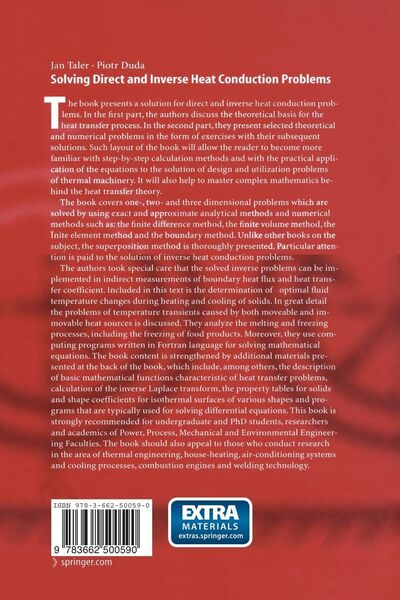
This book is devoted to the concept of simple and inverse heat conduction problems. The process of solving direct problems is based on the tempera ture determination when initial and boundary conditions are known, while the solving of inverse problems is based on the search for boundary condi tions when temperature properties are known, provided that temperature is the function of time, at the selected inner points of a body. In the first part of the book (Chaps. 1-5), we have discussed theoretical basis for thermal conduction in solids, motionless liquids and liquids that move in time. In the second part of the book, (Chapters 6-26), we have discussed at great length different engineering problems, which we have presented together with the proposed solutions in the form of theoretical and mathematical examples. It was our intention to acquaint the reader in a step-by-step fashion with all the mathematical derivations and solutions to some of the more significant transient and steady-state heat conduction problems with respect to both, the movable and immovable heat sources and the phenomena of melting and freezing. Lots of attention was paid to non-linear problems. The methods for solving heat conduction problems, i. e. the exact and approximate analytical methods and numerical methods, such as the finite difference method, the finite volume method, the finite element method and the boundary element method are discussed in great detail. Aside from algorithms, applicable computational programs, written in a FORTRAN language, were given.

Rezension

From the reviews:


"The present book is devoted to direct and inverse heat conduction problems. … The methods for solving problems involved with welding and laser technology are also discussed in great detail. The present book is addressed to undergraduate and PhD students of mechanical, power, process and environment engineering. … it can also serve as a reference book to be used by nuclear, industrial and civil engineers." (Lubomira Softova, Zentralblatt MATH, Vol. 1122 (24), 2007)

Produktdetails

Einband

Taschenbuch

Erscheinungsdatum

29.10.2016

Abbildungen

XXVI, 889 p.

Verlag Springer Berlin

Produktdetails

Einband

Taschenbuch

Erscheinungsdatum

29.10.2016

Abbildungen

XXVI, 889 p.

Verlag Springer Berlin
Seitenzahl

889

Maße (L/B/H)

23,5/15,5/4,9 cm

Gewicht

1364 g

Auflage

Softcover reprint of the original 1st edition 2006

Sprache

Englisch

ISBN

978-3-662-50059-0

Herstelleradresse

Springer-Verlag GmbH
Tiergartenstr. 17
69121 Heidelberg
DE

Email: ProductSafety@springernature.com

Noch keine Bewertungen vorhanden

Verfassen Sie die erste Bewertung zu diesem Artikel

Helfen Sie anderen Kundinnen und Kunden durch Ihre Meinung.

Kundinnen und Kunden meinen

Bewertungen (0)

  • Produktbild: Solving Direct and Inverse Heat Conduction Problems
  • Produktbild: Solving Direct and Inverse Heat Conduction Problems
  • Heat Conduction Fundamentals.- Fourier Law.- Mass and Energy Balance Equations.- The Reduction of Transient Heat Conduction Equations and Boundary Conditions.- Substituting Heat Conduction Equation by Two-Equations System.- Variable Change.- Exercises. Solving Heat Conduction Problems.- Heat Transfer Fundamentals.- Two-Dimensional Steady-State Heat Conduction. Analytical Solutions.- Analytical Approximation Methods. Integral Heat Balance Method.- Two-Dimensional Steady-State Heat Conduction. Graphical Method.- Two-Dimensional Steady-State Problems. The Shape Coefficient.- Solving Steady-State Heat Conduction Problems by Means of Numerical Methods.- Finite Element Balance Method and Boundary Element Method.- Transient Heat Exchange between a Body with Lumped Thermal Capacity and Its Surroundings.- Transient Heat Conduction in Half-Space.- Transient Heat Conduction in Simple-Shape Elements.- Superposition Method in One-Dimensional Transient Heat Conduction Problems.- Transient Heat Conduction in a Semi-Infinite Body. The Inverse Problem.- Inverse Transient Heat Conduction Problems.- Multidimensional Problems. The Superposition Method.- Approximate Analytical Methods for Solving Transient Heat Conduction Problems.- Finite Difference Method.- Solving Transient Heat Conduction Problems by Means of Finite Element Method (FEM).- Numerical-Analytical Methods.- Solving Inverse Heat Conduction Problems by Means of Numerical Methods.- Heat Sources.- Melting and Solidification (Freezing).