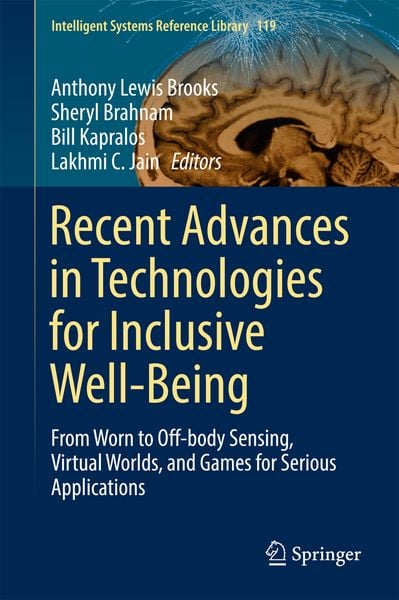
Recent Advances in Technologies for Inclusive Well-Being From Worn to Off-body Sensing, Virtual Worlds, and Games for Serious Applications
-
- Hardcover ausgewählt
- Taschenbuch
- eBook
-
Sprache:Englisch
-
Auflage:1st ed. 2017
99,99 €
inkl. gesetzl. MwSt.,
Beschreibung
Produktdetails
Einband
Gebundene Ausgabe
Erscheinungsdatum
24.02.2017
Abbildungen
XXII, 383 p. 85 illus.
Herausgeber
Anthony Lewis Brooks + weitereVerlag
SpringerSeitenzahl
383
Maße (L/B/H)
24,1/16/2,8 cm
Gewicht
776 g
Auflage
1st ed. 2017
Sprache
Englisch
ISBN
978-3-319-49877-5
This book presents current innovative, alternative and creative approaches that challenge traditional mechanisms in and across disciplines and industries targeting societal impact. A common thread throughout the book is human-centered, uni and multi-modal strategies across the range of human technologies, including sensing and stimuli; virtual and augmented worlds; games for serious applications; accessibility; digital-ethics and more. Focusing on engaging, meaningful, and motivating activities that at the same time offer systemic information on human condition, performance and progress, the book is of interest to anyone seeking to gain insights into the field, be they students, teachers, practicing professionals, consultants, or family representatives. By offering a wider perspective, it addresses the need for a core text that evokes and provokes, engages and demands and stimulates and satisfies.
Noch keine Bewertungen vorhanden
Verfassen Sie die erste Bewertung zu diesem Artikel
Helfen Sie anderen Kundinnen und Kunden durch Ihre Meinung.
Kurze Frage zu unserer Seite
Vielen Dank für Ihr Feedback
Wir nutzen Ihr Feedback, um unsere Produktseiten zu verbessern. Bitte haben Sie Verständnis, dass wir Ihnen keine Rückmeldung geben können. Falls Sie Kontakt mit uns aufnehmen möchten, können Sie sich aber gerne an unseren Kund*innenservice wenden.
zum Kundenservice