KI-Beratung Beta

Gutscheinbedingungen

**Gültig am 27.11.2026 auf Spielzeug, Schreibwaren, Filme, Geschenke & Trends, Musik, tolino eReader & Zubehör, Hörbücher und Hörbuch-Downloads, nicht preisgebundene Bücher und Kalender online auf thalia.at und in der Thalia App. Einzelne Artikel können ausgeschlossen sein. Aufgrund der Buchpreisbindung sind deutschsprachige Bücher und eBooks ausgenommen. Zusätzlich ausgenommen sind Abos & Flatrates, Games, Geschenkkarten/-boxen, Shelfies, Software, Zeitschriften sowie einzelne Artikel von tonies®. Pro Einkauf einmal einlösbar. Click & Collect nur bei Onlinevorabzahlung möglich. Keine Barauszahlung. Nicht kombinierbar mit anderen Aktionen und Gutscheinen. Gutschein wird auf max. 500€ Bestellwert angerechnet. Nicht gültig für Versandkosten und Services.

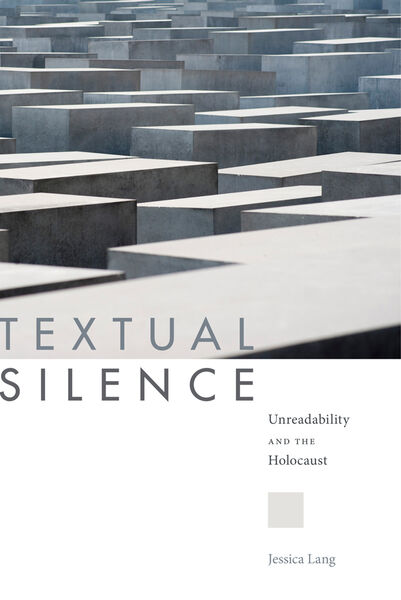
Produktbild: Textual Silence

Textual Silence Unreadability and the Holocaust

39,99 €

inkl. gesetzl. MwSt., Versandkostenfrei


Beschreibung

There are thousands of books that represent the Holocaust, but can, and should, the act of reading these works convey the events of genocide to those who did not experience it? In Textual Silence, literary scholar Jessica Lang asserts that language itself is a barrier between the author and the reader...

Beschreibung

There are thousands of books that represent the Holocaust, but can, and should, the act of reading these works convey the events of genocide to those who did not experience it? In Textual Silence, literary scholar Jessica Lang asserts that language itself is a barrier between the author and the reader in Holocaust texts-and that this barrier is not a lack of substance, but a defining characteristic of the genre.
Holocaust texts, which encompass works as diverse as memoirs, novels, poems, and diaries, are traditionally characterized by silences the authors place throughout the text, both deliberately and unconsciously. While a reader may have the desire and will to comprehend the Holocaust, the presence of "textual silence" is a force that removes the experience of genocide from the reader's analysis and imaginative recourse. Lang defines silences as omissions that take many forms, including the use of italics and quotation marks, ellipses and blank pages in poetry, and the presence of unreliable narrators in fiction. While this limits the reader's ability to read in any conventional sense, these silences are not flaws. They are instead a critical presence that forces readers to acknowledge how words and meaning can diverge in the face of events as unimaginable as those of the Holocaust.

Rezension

"A valuable and timely resource that speaks to the necessity of ethical reading in regard to Holocaust representation." - Victoria Aarons (O.R. & Eva Mitchell Endowed Chair in Literature, Trinity University) "Lang's exquisitely wrought study defines and explores the challenges of reading trauma literature, shedding light on the irony that reading does not equate to understanding." - Alan L. Berger (Raddock Family Eminent Scholar Chair in Holocaust Studies, Florida Atlantic University)

Produktdetails

Einband

Taschenbuch

Erscheinungsdatum

24.08.2017

Abbildungen

10 photographs

Verlag Rutgers University Press

Produktdetails

Einband

Taschenbuch

Erscheinungsdatum

24.08.2017

Abbildungen

10 photographs

Verlag Rutgers University Press
Seitenzahl

232

Maße (L/B/H)

22,6/15/1,5 cm

Gewicht

340 g

Sprache

Englisch

ISBN

978-0-8135-8991-6

Herstelleradresse

Libri GmbH
Europaallee 1
36244 Bad Hersfeld
DE

Email: gpsr@libri.de

Noch keine Bewertungen vorhanden

Verfassen Sie die erste Bewertung zu diesem Artikel

Helfen Sie anderen Kundinnen und Kunden durch Ihre Meinung.

Kundinnen und Kunden meinen

Bewertungen (0)

  • Produktbild: Textual Silence
  • Introduction 1
    1 Readability and Unreadability: A Fractured Dialogue 9

    Part I
    Generational Differences in Holocaust Literature
    2 Before, During, and After: Reading and the Eyewitness 35
    3 Reading to Belong: Second-Generation and the Audience of Self 58
    4 The Third Generation's Holocaust: The Story of Time and Place 87

    Part II
    Pushed to the Edges: The Holocaust in American Fiction
    5 American Fiction and the Act of Genocide 119
    6 Receding into the Distance: The Holocaust as Background 155
    Afterword: Reading the Fragments of Memory 175

    Acknowledgments 179
    Notes 181
    Bibliography 199
    Index 209