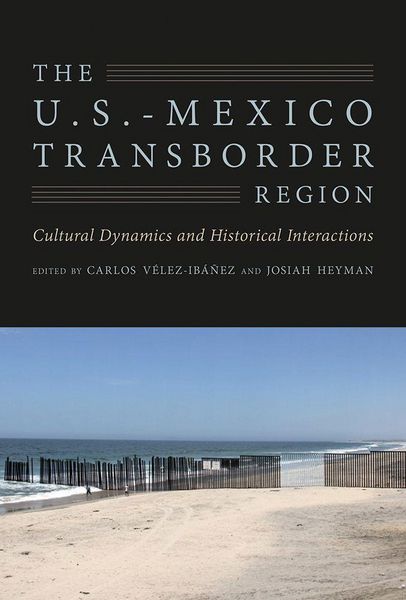
The U.S.-Mexico Transborder Region Cultural Dynamics and Historical Interactions
-
- Englisch ausgewählt
49,99 €
inkl. gesetzl. MwSt.,
Beschreibung
Produktdetails
Einband
Taschenbuch
Erscheinungsdatum
11.04.2017
Herausgeber
Carlos G. Vélez-Ibáñez + weitereVerlag
University Of Arizona PressSeitenzahl
408
Maße (L/B/H)
22,6/15,2/2,5 cm
Gewicht
567 g
Sprache
Englisch
ISBN
978-0-8165-3515-6
The U.S.-Mexico Transborder Region presents advanced anthropological theorizing of culture in an important regional setting. Not a static entity, the transborder region is peopled by ever-changing groups who face the challenges of social inequality: political enforcement of privilege, economic subordination of indigenous communities, and organized resistance to domination.
The book, influenced by the work of Eric Wolf and senior editor Carlos Vélez-Ibáñez, centers on the greater Mexican North/U.S. Southwest, although the geographic range extends farther. This tradition, like other transborder approaches, attends to complex and fluid cultural and linguistic processes, going beyond the classical modern anthropological vision of one people, one culture, one language. With respect to recent approaches, however, it is more deeply social, focusing on vertical relations of power and horizontal bonds of mutuality.
Vélez-Ibáñez and Heyman envision this region as involving diverse and unequal social groups in dynamic motion over thousands of years. Thus the historical interaction of the U.S.-Mexico border, however massively unequal and powerful, is only the most recent manifestation of this longer history and common ecology. Contributors emphasize the dynamic “transborder” quality—conflicts, resistance, slanting, displacements, and persistence—in order to combine a critical perspective on unequal power relations with a questioning perspective on claims to bounded simplicity and perfection.
The book is notable for its high degree of connection across the various chapters, strengthened by internal syntheses from notable border scholars, including Alejandro Lugo and Roberto Alvarez. In the final section, Judith Freidenberg draws general lessons from particular case studies, summarizing that “access to valued scarce resources prompts the erection of human differences that get solidified into borders,” dividing and limiting, engendering vulnerabilities and marginalizing some people.
At a time when understanding the U.S.-Mexico border is more important than ever, this volume offers a critical anthropological and historical approach to working in transborder regions.
Contributors: Amado Alarcón, Robert R. Alvarez, Jr., Miguel Diaz-Barriga, Margaret Dorsey, Judith Noemí Freidenberg, Ruth Gomberg-Muñoz, James B. Greenberg, Josiah Heyman, Jane H. Hill, Sarah Horton, Alejandro Lugo, Luminita-Anda Mandache, Corina Marrufo, Guillermina Gina Nunez-Mchiri, Anna Ochoa O’Leary, Luis F. B. Plascencia, Lucero Radonic,
Diana Riviera, Thomas E. Sheridan, Kathleen Staudt, Carlos G. Vélez-Ibáñez.
Noch keine Bewertungen vorhanden
Verfassen Sie die erste Bewertung zu diesem Artikel
Helfen Sie anderen Kundinnen und Kunden durch Ihre Meinung.
Kurze Frage zu unserer Seite
Vielen Dank für Ihr Feedback
Wir nutzen Ihr Feedback, um unsere Produktseiten zu verbessern. Bitte haben Sie Verständnis, dass wir Ihnen keine Rückmeldung geben können. Falls Sie Kontakt mit uns aufnehmen möchten, können Sie sich aber gerne an unseren Kund*innenservice wenden.
zum Kundenservice