KI-Beratung Beta

Gutscheinbedingungen

**Gültig am 01.10.2026 ab einem Mindestbestellwert von 30€ auf Spielzeug, Schreibwaren, Filme, Geschenke & Trends, Musik, tolino eReader & Zubehör, Hörbücher und Hörbuch-Downloads, nicht preisgebundene Bücher und Kalender online auf thalia.at und in der Thalia App. Einzelne Artikel können ausgeschlossen sein. Aufgrund der Buchpreisbindung sind deutschsprachige Bücher und eBooks ausgenommen. Zusätzlich ausgenommen sind Abos & Flatrates, Games, Geschenkkarten/-boxen, Shelfies, Software, Zeitschriften sowie einzelne Artikel von tonies®. Pro Einkauf einmal einlösbar. Click & Collect nur bei Onlinevorabzahlung möglich. Keine Barauszahlung. Nicht kombinierbar mit anderen Aktionen und Gutscheinen. Gutschein wird auf max. 500€ Bestellwert angerechnet. Nicht gültig für Versandkosten und Services. Preisgebundene Artikel sind vom Mindestbestellwert ausgeschlossen.

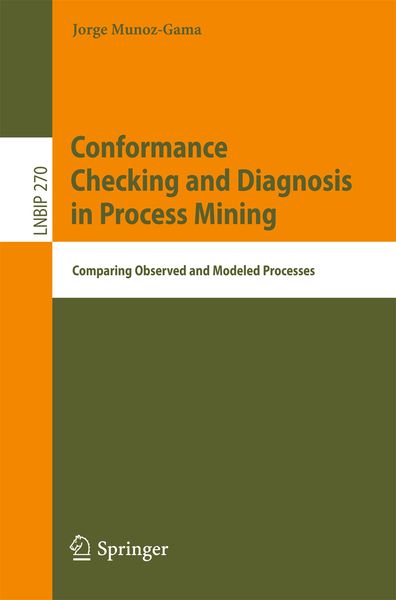
  • Produktbild: Conformance Checking and Diagnosis in Process Mining
  • Produktbild: Conformance Checking and Diagnosis in Process Mining
Band 270

Conformance Checking and Diagnosis in Process Mining Comparing Observed and Modeled Processes

51,99 €

inkl. gesetzl. MwSt., Versandkostenfrei


Beschreibung

Produktdetails

Einband

Taschenbuch

Erscheinungsdatum

25.11.2016

Abbildungen

XIV, 202 p. 90 illus.

Verlag

Springer

Seitenzahl

202

Maße (L/B/H)

23,5/15,5/1,2 cm

Gewicht

335 g

Auflage

1st ed. 2016

Sprache

Englisch

ISBN

978-3-319-49450-0

Beschreibung

Produktdetails

Einband

Taschenbuch

Erscheinungsdatum

25.11.2016

Abbildungen

XIV, 202 p. 90 illus.

Verlag

Springer

Seitenzahl

202

Maße (L/B/H)

23,5/15,5/1,2 cm

Gewicht

335 g

Auflage

1st ed. 2016

Sprache

Englisch

ISBN

978-3-319-49450-0

Herstelleradresse

Springer-Verlag KG
Sachsenplatz 4-6
1201 Wien
AT

Email: ProductSafety@springernature.com

Noch keine Bewertungen vorhanden

Verfassen Sie die erste Bewertung zu diesem Artikel

Helfen Sie anderen Kundinnen und Kunden durch Ihre Meinung.

Kundinnen und Kunden meinen

Bewertungen (0)

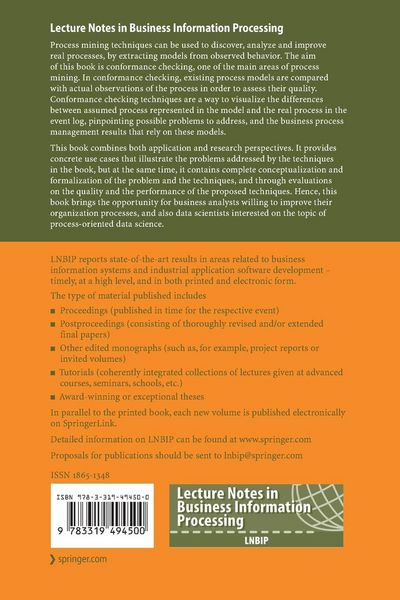
  • Produktbild: Conformance Checking and Diagnosis in Process Mining
  • Produktbild: Conformance Checking and Diagnosis in Process Mining

  • Introduction.- 1.1 Processes, Models, and Data.- 1.2 Process Mining.- 1.3 Conformance Checking Explained: The University Case.- 1.4 Book Outline.- Part I Conformance Checking in Process Mining.- 2 Conformance Checking and its Challenges.- 2.1 The Role of Process Models in Conformance Checking.- 2.2 Dimensions of Conformance Checking.- 2.3 Replay-based and Align-based Conformance Checking.- 2.4 Challenges of Conformance Checking.- 3 Conformance Checking and its Elements.- 3.1 Basic Notations.- 3.2 Event Log.- 3.3 Process Models.- 3.4 Process Modeling Formalisms.- 3.4.1 Petri Nets.- 3.4.2 Workflow Nets.- 3.4.3 Other Formalisms.- Part II Precision in Conformance Checking.- 4 Precision in Conformance Checking.- 4.1 Precision: The Forgotten Dimension.- 4.2 The Importance of Precision.- 4.3 Measures of Precision.- 4.4 Requirements for Precision.- 5 Measuring Precision.- 5.1 Precision based on Escaping Arcs.- 5.2 Constructing the Observed Behavior.- 5.3 Incorporating Modeled Behavior.- 5.4Detecting Escaping Arcs and Evaluating Precision.- 5.5 Minimal Imprecise Traces.- 5.6 Limitations and Extensions.- 5.6.1 Unfitting Scenario.- 5.6.2 Indeterministic Scenario.- 5.7 Summary.- 6 Evaluating Precision in Practice.- 6.1 The University Case: The Appeals Process.- 6.2 Experimental Evaluation.- 7 Handling Noise and Incompleteness.- 7.1 Introduction.- 7.2 Robustness on the Precision.- 7.3 Confidence on Precision.-7.3.1 Upper Confidence Value.- 7.3.2 Lower Confidence Value.- 7.4 Experimental Results.- 7.5 Summary.- 8 Assessing Severity.- 8.1 Introduction.- 8.2 Severity of an Escaping Arc.- 8.2.1 Weight of an Escaping Arc.- 8.2.2 Alternation of an Escaping Arc.- 8.2.3 Stability of an Escaping Arc.- 8.2.4 Criticality of an Escaping Arc.- 8.2.5 Visualizing the Severity.- 8.2.6 Addressing Precision Issues based on Severity.- 8.3 Experimental Results.- 8.4 Summary.- 9 Handling non-Fitness.- 9.1 Introduction.- 9.2 Cost-Optimal Alignment.- 9.3 Precision based on Alignments.- 9.4 Precision from 1-Alignment.- 9.5 Summary.- 10 Alternative and Variants to Handle non-Fitness.- 10.1 Precision from All-Alignment.- 10.2 Precision from Representative-Alignment.- 10.3 Abstractions for the Precision based on Alignments.- 10.3.1 Abstraction on the Order.- 10.3.2 Abstraction on the Direction.- 10.4 Summary.- 11 Handling non-Fitness in Practice.- 11.1 The University Case: The Exchange Process.- 11.2 Experimental Results.- Part III Decomposition in Conformance Checking.- 12 Decomposing Conformance Checking. -12.1 Introduction.- 12.2 Single-Entry Single-Exit and Refined Process Structure Tree.- 12.3 Decomposing Conformance Checking using SESEs.- 12.4 Summary.- 13 Decomposing for Fitness Checking.- 13.1 Introduction.- 13.2 Bridging a Valid Decomposition.- 13.3 Decomposition with invisible/duplicates.- 13.4 Summary.- 14 Decomposing Conformance Checking in Practice.- 14.1 The Bank Case: The Transaction Process.- 14.2 Experimental Results.- 15 Diagnosing Conformance.- 15.1 Introduction.- 15.2 Topological Conformance Diagnosis.- 15.3 Multi-level Conformance Diagnosis and its Applications.- 15.3.1 Stand-alone Checking.- 15.3.2 Multi-Level Analysis.- 15.3.3 Filtering.- 15.4 Experimental Results.- 15.5 Summary.- 16 Data-aware Processes and Alignments.- 16.1 Introduction.- 16.2 Data-aware Processes.- 16.2.1 Petri nets with Data.- 16.2.2 Event Logs and Relating Models to Event Logs.- 16.2.3 Data Alignments.- 16.3 Summary.- 17 Decomposing Data-aware Conformance.- 17.1 Introduction.- 17.2 Valid Decomposition of Data-aware Models.- 17.3 SESE-based Strategy for a Valid Decomposition.- 17.4 Implementation and Experimental Results.- 17.5 Summary.- 18 Event-based Real-time Decomposed Conformance Checking.- 18.1 Introduction.- 18.2 Event-based Real-time Decomposed Conformance.- 18.2.1 Model and Log Decomposition.- 18.2.2 Event-based Heuristic Replay.- 18.3 Experimental Results.- 18.4 Summary.- Part IV Conclusions and Future Work.- 19 Conclusions.- 19.1 Conclusion and Reflection.-19.2 Summary of Contributions.- 19.3 Challenges and Directions for Future Work.- References.