Gutscheinbedingungen

**Gültig am 28.06.2026 auf Spielzeug, Schreibwaren, Filme, Geschenke & Trends, Musik, tolino eReader & Zubehör, Hörbücher und Hörbuch-Downloads (außer Abo), nicht preisgebundene Bücher und Kalender online auf thalia.at und in der Thalia App. Einzelne Artikel können ausgeschlossen sein. Aufgrund der Buchpreisbindung sind deutschsprachige Bücher und eBooks ausgenommen. Zusätzlich ausgenommen sind preisgebundene Artikel, Abos & Flatrates, eBooks, Games, Geschenkkarten/-boxen, Shelfies, Software, Zeitschriften sowie einzelne Artikel von tonies®. Pro Einkauf einmal einlösbar. Click & Collect nur bei Onlinevorabzahlung möglich. Keine Barauszahlung. Nicht kombinierbar mit anderen Aktionen und Gutscheinen. Gutschein wird auf max. 500€ Bestellwert angerechnet. Nicht gültig für Versandkosten und Services.

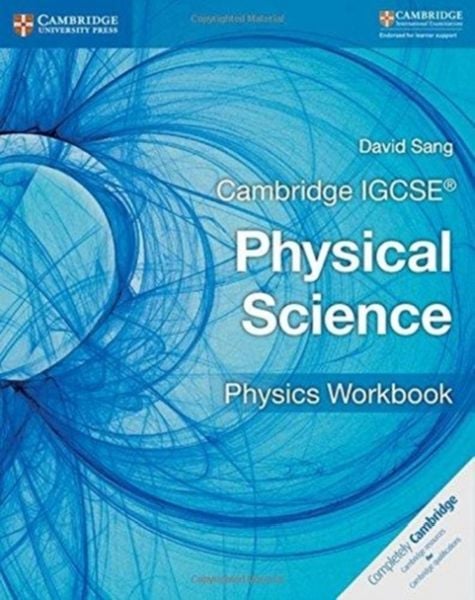
Produktbild: Cambridge IGCSE® Physical Science Physics Workbook

Cambridge IGCSE® Physical Science Physics Workbook

18,99 €

inkl. gesetzl. MwSt., zzgl. Versandkosten


  • Kostenlose Lieferung ab 30 € Einkaufswert
  • Versandkostenfrei für Bonuscard-Kund*innen

Beschreibung

Produktdetails

Einband

Taschenbuch

Altersempfehlung

14 - 16 Jahr(e)

Erscheinungsdatum

16.02.2017

Verlag

Cambridge University Press

Seitenzahl

178

Maße (L/B/H)

27,7/21,7/1,2 cm

Gewicht

476 g

Sprache

Englisch

ISBN

978-1-316-63352-6

Beschreibung

Produktdetails

Einband

Taschenbuch

Altersempfehlung

14 - 16 Jahr(e)

Erscheinungsdatum

16.02.2017

Verlag

Cambridge University Press

Seitenzahl

178

Maße (L/B/H)

27,7/21,7/1,2 cm

Gewicht

476 g

Sprache

Englisch

ISBN

978-1-316-63352-6

Herstelleradresse

Libri GmbH
Europaallee 1
36244 Bad Hersfeld
DE

Email: GPSR Kontakt

Kundinnen und Kunden meinen

0 Bewertungen

Informationen zu Bewertungen

Zur Abgabe einer Bewertung ist eine Anmeldung im Konto notwendig. Die Authentizität der Bewertungen wird von uns nicht überprüft. Wir behalten uns vor, Bewertungstexte, die unseren Richtlinien widersprechen, entsprechend zu kürzen oder zu löschen.

Die Bewertungen sind nach Format, Anzahl Sterne und Datum sortiert.

Verfassen Sie die erste Bewertung zu diesem Artikel

Helfen Sie anderen Kund*innen durch Ihre Meinung

Kundinnen und Kunden meinen

0 Bewertungen filtern

Weitere Artikel finden Sie in

  • Produktbild: Cambridge IGCSE® Physical Science Physics Workbook
  • Introduction; How to use this book; P1. Making measurements; P1.1 The SI system of units; P1.2 Paper measurements; P1.3 Density data; P1.4 Testing your body clock; P2. Describing motion; P2.1 Measuring speed; P2.2 Speed calculations; P2.3 More speed calculations; P2.4 Distance-time graphs; P2.5 Acceleration; P2.6 Velocity-time graphs; P3. Forces and motion; P3.1 Identifying forces; P3.2 The effects of forces; P3.3 Combining forces; P3.4 Force, mass and acceleration; P3.5 Mass and weight; P3.6 Falling; P4. Turning effects of forces; P4.1 Turning effect of a force; P4.2 Calculating moments; P4.3 Stability and centre of mass; P4.4 Make a mobile; P5. Forces and matter; P5.1 Stretching a spring; P5.2 Stretching rubber; P5.3 Pressure; P6. Energy transformations and energy transfers; P6.1 Recognising forms of energy; P6.2 Energy efficiency; P6.3 Energy calculations; P7. Energy resources; P7.1 Renewables and non-renewables; P7.2 Wind energy; P7.3 Energy from the Sun; P8. Work and power; P8.1 Forces doing work, transferring energy; P8.2 Calculating work done; P8.3 Measuring work done; P8.4 Power; P9. The kinetic model of matter; P9.1 Changes of state; P9.2 The kinetic model of matter; P9.3 Understanding gases; P10. Thermal properties of matter; P10.1 Calibrating a thermometer; P10.2 Demonstrating thermal expansion; P10.3 Thermal expansion; P11. Thermal (heat) energy transfers; P11.1 Conductors of heat; P11.2 Convection currents; P11.3 Radiation; P11.4 Losing heat; P12. Sound; P12.1 Sound on the move; P12.2 Sound as a wave; P13. Light; P13.1 On reflection; P13.2 Refraction of light; P13.3 The changing speed of light; P13.4 A perfect mirror; P13.5 Image in a lens; P14. Properties of waves; P14.1 Describing waves; P14.2 The speed of waves; P14.3 Wave phenomena; P15. Spectra; P15.1 Electromagnetic waves; P15.2 Using electromagnetic radiation; P16. Magnetism; P16.1 Attraction and repulsion; P16.2 Make a magnet; P16.3 Magnetic fields; P17. Static electricity; P17.1 Attraction and repulsion; P17.2 Moving charges; P17.3 Static at home; P18. Electrical quantities; P18.1 Current in a circuit; P18.2 Current and charge; P18.3 Electrical resistance; P18.4 Electrical energy and power; P19. Electric circuits; P19.1 Circuit components and their symbols; P19.2 Resistor combinations; P19.3 More resistor combinations; P19.4 Electrical safety; P20. Electromagnetism; P20.1 Using electromagnetism; P20.2 Electricity generation; P20.3 Transformers; P21. The nuclear atom; P21.1 The structure of the atom; P21.1 Isotopes; P22. Radioactivity; P22.1 The nature of radiation; P22.2 Radioactive decay equations; P22.3 Radioactive decay; Answers.