KI-Beratung Beta

Gutscheinbedingungen

**Gültig am 20.11.2026 ab einem Mindestbestellwert von 30€ auf Spielzeug, Schreibwaren, Filme, Geschenke & Trends, Musik, tolino eReader & Zubehör, Hörbücher und Hörbuch-Downloads, nicht preisgebundene Bücher und Kalender online auf thalia.at und in der Thalia App. Einzelne Artikel können ausgeschlossen sein. Aufgrund der Buchpreisbindung sind deutschsprachige Bücher und eBooks ausgenommen. Zusätzlich ausgenommen sind Abos & Flatrates, Games, Geschenkkarten/-boxen, Shelfies, Software, Zeitschriften sowie einzelne Artikel von tonies®. Pro Einkauf einmal einlösbar. Click & Collect nur bei Onlinevorabzahlung möglich. Keine Barauszahlung. Nicht kombinierbar mit anderen Aktionen und Gutscheinen. Gutschein wird auf max. 500€ Bestellwert angerechnet. Nicht gültig für Versandkosten und Services. Preisgebundene Artikel sind vom Mindestbestellwert ausgeschlossen.

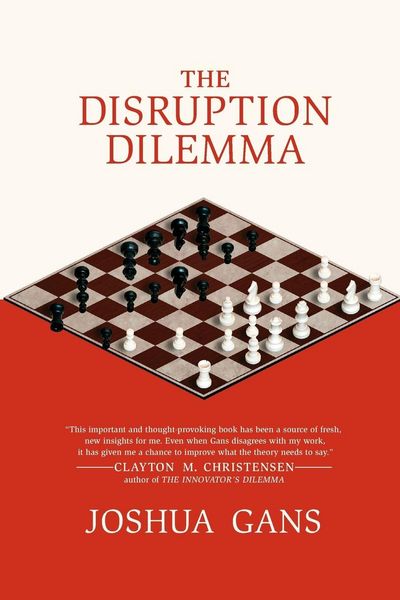
Produktbild: The Disruption Dilemma

The Disruption Dilemma

33,99 €

inkl. gesetzl. MwSt., Versandkostenfrei


Beschreibung

"Disruption" is a business buzzword that has gotten out of control. Today everything and everyone seem to be characterized as disruptive - or, if they aren't disruptive yet, it's only a matter of time before they become so. In this book, Joshua Gans cuts through the chatter to focus on disruption in...

Beschreibung

"Disruption" is a business buzzword that has gotten out of control. Today everything and everyone seem to be characterized as disruptive - or, if they aren't disruptive yet, it's only a matter of time before they become so. In this book, Joshua Gans cuts through the chatter to focus on disruption in its initial use as a business term, identifying new ways to understand it and suggesting new tools to manage it. Almost twenty years ago Clayton Christensen popularized the term in his book The Innovator's Dilemma, writing of disruption as a set of risks that established firms face. Since then, few have closely examined his account. Gans does so in this book. He looks at companies that have proven resilient and those that have fallen, and explains why some companies have successfully managed disruption - Fujifilm and Canon, for example - and why some like Blockbuster and Encyclopedia Britannica have not. Departing from the conventional wisdom, Gans identifies two kinds of disruption: demand-side, when successful firms focus on their main customers and underestimate market entrants with innovations that target niche demands; and supply-side, when firms focused on developing existing competencies become incapable of developing new ones.

Rezension

"If you think you understand when large firms are in danger, and what they should do, as well as when there are opportunities for start-ups, this is a must-read book." - Washington Post

Produktdetails

Einband

Taschenbuch

Erscheinungsdatum

21.04.2017

Abbildungen

2 ill.

Verlag MIT Press

Produktdetails

Einband

Taschenbuch

Erscheinungsdatum

21.04.2017

Abbildungen

2 ill.

Verlag MIT Press
Seitenzahl

178

Maße (L/B/H)

22,9/15,2/1 cm

Gewicht

268 g

Sprache

Englisch

ISBN

978-0-262-53362-1

Herstelleradresse

Libri GmbH
Europaallee 1
36244 Bad Hersfeld
DE

Email: gpsr@libri.de

Noch keine Bewertungen vorhanden

Verfassen Sie die erste Bewertung zu diesem Artikel

Helfen Sie anderen Kundinnen und Kunden durch Ihre Meinung.

Kundinnen und Kunden meinen

Bewertungen (0)

Die Leseprobe wird geladen.
  • Produktbild: The Disruption Dilemma