
Gutscheinbedingungen

**Gültig bis 06.07.2026 auf fremdsprachige Bücher online auf thalia.at, in der Thalia App ab einem Mindestbestellwert von 30€ und in allen Thalia Buchhandlungen in Österreich. In den Buchhandlungen nur gültig auf lagernde Ware. Einzelne Artikel können ausgeschlossen sein. Ausgenommen sind preisgebundene Artikel & eBooks. Pro Einkauf einmal einlösbar. Nur gültig gegen Vorlage oder im Onlineshop hinterlegter Bonuscard. Infos zur Einlösung in der Buchhandlung sind auf der Bonuscard-Vorteilspreisseite zu finden. Click & Collect nur bei Onlinevorabzahlung möglich. Keine Einlösung bei Scan & Go-Bezahlung. Keine Barauszahlung. Nicht kombinierbar mit anderen Aktionen und Gutscheinen. Gutschein wird auf max. 500€ Bestellwert angerechnet. Nicht gültig für Versandkosten und Services.

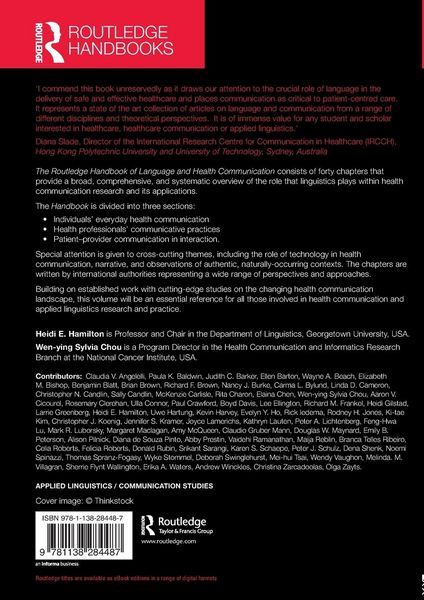
  • Produktbild: The Routledge Handbook of Language and Health Communication
  • Produktbild: The Routledge Handbook of Language and Health Communication

The Routledge Handbook of Language and Health Communication

114,99 €

inkl. gesetzl. MwSt., Versandkostenfrei


Beschreibung

Produktdetails

Einband

Taschenbuch

Erscheinungsdatum

18.10.2016

Herausgeber

Hamilton Heidi + weitere

Verlag

Taylor & Francis

Seitenzahl

700

Maße (L/B/H)

24,6/17,4/3,7 cm

Gewicht

1300 g

Sprache

Englisch

ISBN

978-1-138-28448-7

Beschreibung

Produktdetails

Einband

Taschenbuch

Erscheinungsdatum

18.10.2016

Herausgeber

Verlag

Taylor & Francis

Seitenzahl

700

Maße (L/B/H)

24,6/17,4/3,7 cm

Gewicht

1300 g

Sprache

Englisch

ISBN

978-1-138-28448-7

Herstelleradresse

Libri GmbH
Europaallee 1
36244 Bad Hersfeld
DE

Email: gpsr@libri.de

Noch keine Bewertungen vorhanden

Verfassen Sie die erste Bewertung zu diesem Artikel

Helfen Sie anderen Kundinnen und Kunden durch Ihre Meinung.

Kundinnen und Kunden meinen

Bewertungen (0)

Die Leseprobe wird geladen.
  • Produktbild: The Routledge Handbook of Language and Health Communication
  • Produktbild: The Routledge Handbook of Language and Health Communication
  • Introduction, Heidi E.Hamilton, Wen-ying SylviaChou; Part 1 Individuals’ everyday health communication; Chapter 1 Health communication ‘noise’, Nancy J.Burke, Judith C.Barker; Chapter 2 Speaking your health, Mark R.Luborsky; Chapter 3 Perceived risk and health risk communication, Erika A.Waters, AmyMcQueen, Linda D.Cameron; Chapter 4 If numbers could speak, ChristinaZarcadoolas, WendyVaughon; Chapter 5 Corpus linguistics and evidence-based health communication, Paul Crawford, BrianBrown, KevinHarvey; Chapter 6 A linguistic analysis of diabetes patients’ talk, UllaConnor, KathrynLauten; Chapter 7 Health risks and mediated discourse, Rodney H.Jones; Chapter 8 Contesting chemotherapy, amputation, and prosthesis, VaidehiRamanathan; Chapter 9 Alzheimer’s diagnosis on trial, Peter A.Lichtenberg, Mark R.Luborsky; Chapter 10 Applied linguistics as a resource for understanding and advancing health literacy, DonaldRubin; Chapter 11 Health disparities research and practice, Sherrie FlyntWallington; Chapter 12 Web 2.0 and the changing health communication environment, AbbyPrestin, Wen-ying SylviaChou; Chapter 13 Interaction in online support groups, WykeStommel, JoyceLamerichs; Chapter 14 Quality and usefulness of written communication for patients, RosemaryClerehan; Chapter 15 Persuasion vs. information in direct-to-consumer advertising of prescription drugs, Peter J.Schulz, UweHartung; Part 2 Health professionals’ communicative practices; Chapter 16 Why read and write in the clinic?, RitaCharon; Chapter 17 Presencing in the context of enhancing patient well-being in nursing care, SallyCandlin, Christopher N.Candlin; Chapter 18 Transforming medical school culture, Richard M.Frankel, ElainaChen; Chapter 19 Communication skills training for resident physicians, BenjaminBlatt, Noemi AliceSpinazzi, LarrieGreenberg; Chapter 20 Teaching medical students to become discourse analysts, Mei-huiTsai, Feng-hwaLu, Richard M.Frankel; Chapter 21 Exploring communicative interactions between visitors and assisted-living residents with dementia, BoydDavis, MargaretMaclagan, DenaShenk; Chapter 22 Healthcare team communication, Melinda M.Villagran, Paula K.Baldwin; Chapter 23 The interpenetration of communicative contexts, Aaron V.Cicourel; Chapter 24 Mental healthcare professionals’ role performance, Branca TellesRibeiro, Diana de SouzaPinto, Claudio GruberMann; Chapter 25 Clinical incident reporting, incident investigation, and incident disclosure, RickIedema; Part 3 Patient–provider communication in interaction; Chapter 26 Before the ‘official diagnosis’, ThomasSpranz-Fogasy; Chapter 27 After the diagnosis, Karen S.Schaepe, Douglas W.Maynard; Chapter 28 Managing hopeful moments, Wayne A.Beach; Chapter 29 Medication and morality, FeliciaRoberts, Jennifer S.Kramer; Chapter 30 The role of the electronic patient record in the clinical consultation, DeborahSwinglehurst, CeliaRoberts; Chapter 31 Provider–patient communication about complementary and alternative medicine, Evelyn Y.Ho, Christopher J.Koenig; Chapter 32 Negotiation of health, illness, and treatment in Korean Oriental medical discourse, Ki-taeKim; Chapter 33 Midwives’ communicative expertise in obstetric ultrasound encounters, SrikantSarangi, HeidiGilstad; Chapter 34 Genetic counseling in multicultural and multilingual contexts, OlgaZayts, AlisonPilnick; Chapter 35 Interpreting in the healthcare setting, Claudia V.Angelelli; Chapter 36 The contribution of provider–patient communication to health disparities, Carma L.Bylund, Emily B.Peterson; Chapter 37 Analyzing ethics-in-interaction in medical decision-making, EllenBarton, AndrewWinckles; Chapter 38 Physician–patient communication about cancer clinical trials, Richard F.Brown; Chapter 39 Medical interaction analysis systems, LeeEllington, McKenzieCarlisle, MaijaReblin; Chapter 40 Donation solicitation in interaction, Elizabeth M.Bishop;