• Produktbild: Twisted Rails, Sunken Ships
  • Produktbild: Twisted Rails, Sunken Ships

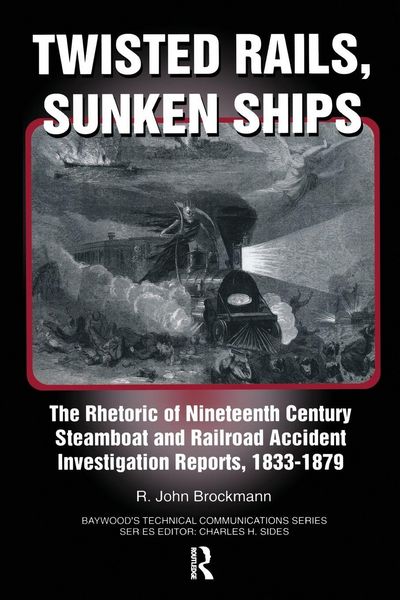
Twisted Rails, Sunken Ships The Rhetoric of Nineteenth Century Steamboat and Railroad Accident Investigation Reports, 1833-1879

65,99 €

inkl. gesetzl. MwSt., Versandkostenfrei


Beschreibung

Produktdetails

Einband

Taschenbuch

Erscheinungsdatum

30.09.2020

Verlag

Taylor and Francis

Seitenzahl

204

Maße (L/B/H)

22,9/15,2/1,6 cm

Gewicht

453 g

Sprache

Englisch

ISBN

978-0-415-78479-5

Beschreibung

Produktdetails

Einband

Taschenbuch

Erscheinungsdatum

30.09.2020

Verlag

Taylor and Francis

Seitenzahl

204

Maße (L/B/H)

22,9/15,2/1,6 cm

Gewicht

453 g

Sprache

Englisch

ISBN

978-0-415-78479-5

Herstelleradresse

Libri GmbH
Europaallee 1
36244 Bad Hersfeld
DE

Email: gpsr@libri.de

Kundinnen und Kunden meinen

0 Bewertungen

Informationen zu Bewertungen

Zur Abgabe einer Bewertung ist eine Anmeldung im Konto notwendig. Die Authentizität der Bewertungen wird von uns nicht überprüft. Wir behalten uns vor, Bewertungstexte, die unseren Richtlinien widersprechen, entsprechend zu kürzen oder zu löschen.

Die Bewertungen sind nach Format, Anzahl Sterne und Datum sortiert.

Verfassen Sie die erste Bewertung zu diesem Artikel

Helfen Sie anderen Kund*innen durch Ihre Meinung

Kundinnen und Kunden meinen

0 Bewertungen filtern

Die Leseprobe wird geladen.
  • Produktbild: Twisted Rails, Sunken Ships
  • Produktbild: Twisted Rails, Sunken Ships
  • Introduction: The Dance of Nineteenth Century Steamboat and Railroad Accident Investigation Reports

     Two 1911 ICC Reports
     Shifts in America Affecting Accident Investigation Reports
     Three Shifts in the Discourse Community

    PART ONE: USING SCIENCE AS A CORPORATE DEFENSE

     Chapter 1: The Collaboration of Science and the Corporations Takes Center Stage While the Coroner's Jury is Befuddled by Complexity
     The Accident-The Explosion of the Steam Boat New England, October 9, 1883
     The Coroner's Jury Investigation
     The Company Investigation Report Exonerates Its Actions Using Science
     Establishing a Scientific Ethos for the Investigation Report
     Dispositio (Arrangement) as a Means of Persuasion in the Investigation Report
     "Outside Experts" Give Their Findings . . . But Not Very Persuasively Other "Outside Experts" Offer Their Critical Comments, But Much Later
     In the End

    Chapter 2: Science for Sale
     The Accident-Explosion of the Locomotive Engine Richmond near Reading, Penna. on the 2nd of September 1844
     The Coroner's Jury Verdict-Act of God or an Act of Man
     The Shaky Scientific Ethos of Dionysus Lardner
     Needing to Present Both Sides when Lardner Declaims
     Committee on Science and the Arts Report
     In the End

    PART TWO: PUBLICITY, POLITICAL PRESSURE, AND EMOTIONAL INVOLVEMENT BY AUTHORS TRANSFORM DISASTER INVESTIGATIONS

     Chapter 3: Publicity, Politics, and Emotions Enter the Investigation Constellation-The Steamboat Moselle Explosion, Spring 1838  The Steamboat Moselle Explosion on the Cincinnati Waterfront Cincinnati in the 1830s: Frontier Law and Order
     Political Control of the Investigation Locke's Highly Charged Personal Emotional Involvement in the Investigation
     How Locke Used Silliman's Report
     The Beginning of a New Approach to Accident Investigation
     In the End

    Chapter 4: What Happens When the Scientific Ethos is Missing in Investigation Reports: The Camden and Amboy Railroad Disaster, 29 of August 1855
     Railroad Dangers
     The Joint Companies (the Camden and Amboy Railroad and the Delaware and Raritan Canal) and Commodore Robert F. Stockton
     The Coroner's Jury Verdict
     The Joint Companies Try to Exonerate their Actions but Meet with Disdain
     The Franklin Institute Scientists Offer a Sermon, Not Science The Stockton-Van Rensselaer Controversy
     In the End

    Chapter 5: The Gasconade Bridge Accident, November 2, 1855
     A Celebration with Political Effects
     Railroad Truss Bridges
     Unfinished Bridges were Routinely Used
     The Accident
     The Coroner's Inquest
     The Press Weighs In
     The Company's Report-Does Not Fully Exonerate the Company
     Henry Kayser-A Critical Scientific Voice of the Company
     Julius Adams's Rebuttal
     In the End

    PART THREE: THE ANTEBELLUM PERIOD OF DISASTER INVESTIGATION: TRANSFORMATION ENDS AND A CONSTELLATION OF ROLES AND REPORTS BECOMES NORMAL
     The Role of the Newspapers in the Investigative Process
     International Influences in the United States Investigative Process

    Chapter 6: The Eastern Railroad Accident at Revere, Massachusetts, August 26, 1871
     The Accident
     Instant Analysis, The Railroad Gazette, September 2, 1871
     Coroner's Jury Verdict, September 10
     Report of the Committee of the Directors, October 20, 1871, and "Justice" in the American Railroad Times, October 21 to December 23
     The Massachusetts Railroad Commission Report, January 1872
     Charles Francis Adams, Jr.'s Account of the Revere Accident, Atlantic Monthly, January 1876
     In the End

    Chapter 7: The Ashtabula Railroad Disaster, December 29, 1876- The State and the Professionals Take Over
     Four Variations on the Tried-and-True Howe Truss Design
     The Accident
     The Investigations
     Three Unique Investigations
     In the End-Move toward Legislative Action

    Chapter 8: Notes on Railroad Accidents
     A Railroad Philosopher
     Contemporary Reviews of Notes on Railroad Accidents
     Rhetorical Element One: "Thrilling Incidents"
     Rhetorical Element Two: "Accident Taxonomy"
     Rhetorical Element Three: "Statistics"
     Rhetorical Element Four: "Scientific Analysis"
     The Impact of Notes on Railroad Accidents

    Glossary
     Index