KI-Beratung Beta

Gutscheinbedingungen

**Gültig bis 18.11.2026 auf englischsprachige Klassiker (klassiker-32728) online auf thalia.at und in der Thalia App. Einzelne Artikel können ausgeschlossen sein. Ausgenommen sind preisgebundene Artikel & eBooks. Pro Einkauf einmal einlösbar. Click & Collect nur bei Onlinevorabzahlung möglich. Keine Barauszahlung. Nicht kombinierbar mit anderen Aktionen und Gutscheinen. Gutschein wird auf max. 500€ Bestellwert angerechnet. Nicht gültig für Geschenkkarten, Versandkosten und Services.

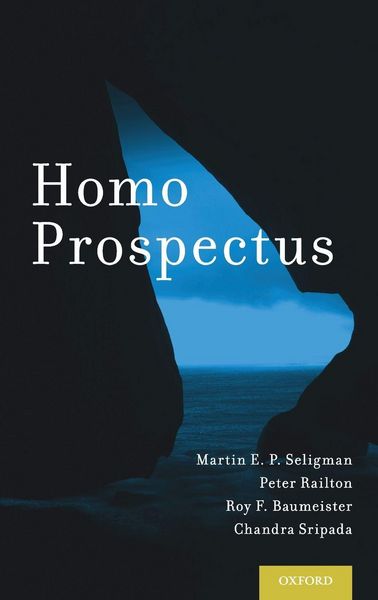
Produktbild: Homo Prospectus

Homo Prospectus

39,60 €

inkl. gesetzl. MwSt., Versandkostenfrei


Beschreibung

Our species is misnamed. Though sapiens defines human beings as "wise" what humans do especially well is to prospect the future. We are homo prospectus. In this book, Martin E. P. Seligman, Peter Railton, Roy F. Baumeister, and Chandra Sripada argue it is anticipating and evaluating future possibilities...

Beschreibung

Our species is misnamed. Though sapiens defines human beings as "wise" what humans do especially well is to prospect the future. We are homo prospectus. In this book, Martin E. P. Seligman, Peter Railton, Roy F. Baumeister, and Chandra Sripada argue it is anticipating and evaluating future possibilities for the guidance of thought and action that is the cornerstone of human success.
Much of the history of psychology has been dominated by a framework in which people's behavior is driven by past history (memory) and present circumstances (perception and motivation). Homo Prospectus reassesses this idea, pushing focus to the future front and center and opening discussion of a new field of Psychology and Neuroscience.
The authors delve into four modes in which prospection operates: the implicit mind, deliberate thought, mind-wandering, and collective (social) imagination. They then explore prospection's role in some of life's most enduring questions: Why do people think about the future? Do we have free will? What is the nature of intuition, and how might it function in ethics? How does emotion function in human psychology? Is there a common causal process in different psychopathologies? Does our creativity
change with age?
In this remarkable convergence of research in philosophy, statistics, decision theory, psychology, and neuroscience, Homo Prospectus shows how human prospection fundamentally reshapes our understanding of key cognitive processes, thereby improving individual and social functioning. It aims to galvanize interest in this new science from scholars in psychology, neuroscience, and philosophy, as well as an educated public curious about what makes humanity what it is.

Rezension

An important insight about how the mind works, presented with a slew of fascinating discoveries and a refreshingly interdisciplinary approach. Steven Pinker, Johnstone Family Professor of Psychology, and author of The Language Instinct and How the Mind Works

Produktdetails

Einband

Gebundene Ausgabe

Erscheinungsdatum

01.07.2016

Abbildungen

2

Verlag KNV Besorgung

Produktdetails

Einband

Gebundene Ausgabe

Erscheinungsdatum

01.07.2016

Abbildungen

2

Verlag KNV Besorgung
Seitenzahl

400

Maße (L/B/H)

24/16,1/2,6 cm

Gewicht

713 g

Sprache

Englisch

ISBN

978-0-19-937447-2

Herstelleradresse

Libri GmbH
Europaallee 1
36244 Bad Hersfeld
DE

Email: gpsr@libri.de

Noch keine Bewertungen vorhanden

Verfassen Sie die erste Bewertung zu diesem Artikel

Helfen Sie anderen Kundinnen und Kunden durch Ihre Meinung.

Kundinnen und Kunden meinen

Bewertungen (0)

  • Produktbild: Homo Prospectus
    • Preface
    • Part I: Homo Prospectus
    • Chapter One: Introduction
    • Chapter Two: Intuitive Guidance: Emotion, Information, and Experience
    • Chapter Three: Deliberative Guidance: Intuitive Guidance in the Counterfactual Mode
    • Chapter Four: Imaginative Guidance: A Mind Forever Wandering
    • Chapter Five: Collective Prospection: The Social Construction of the Future
    • Part II: Prospection and Life's Enduring Questions
    • Chapter Six: Pragmatic Prospection
    • Chapter Seven: Free Will and the Construction of Options
    • Chapter Eight: Emotions: How the Future Feels (and Could Feel)
    • Chapter Nine: Morality and Prospection
    • Chapter Ten: Prospection Gone Awry: Depression
    • Chapter Eleven: Creativity and Aging: What we can Make with what we Have Left
    • Afterword
    • Notes
    • References
    • Index